


 53 / 540

THE ITALIAN LEGACY IN THE DOMINICAN REPUBLIC
52
dependence began. The house was sold
on April 7, 1864, to Esteban Pozo by
Gregorio Ramírez, who had previously
purchased it from the Bona family.
6
Another Bona family, but with-
out any documented kinship with the
above-mentioned family, is made up of
the descendants of Joseph Antoine Bona
and Marie Steffani (Felícitas), both na-
tives of Corsica. They were the grand-
parents of the contractor and architect
Henri Jean Edward Gazón Bona, who
designed various projects throughout
the 1940s and 1950s.
7
The Piantinis descend from José
Eugenio Piantini circa 1791–1871, and
while he has always been believed to be
Italian, no documentation substantiates
this. He lived with Florina Blanchard, a
native of Bánica and a descendant of the vegan Raimundo del Orbe Bocanegra. He later married Ignacia Arjo-
na Ramos, widow of the Piedmontese Juan Antonio Mazara), and he also lived together with Victoria Tejera.
We know that José Eugenio Piantini was a gunsmith, and that he died in San Carlos de Tenerife outside of the
walls of Santo Domingo. Several of his children emigrated to different regions of the country:
1) Zeferino Piantini Blanchard married Josefa Díaz Vargas
8
in Santa Cruz del Seibo on October 1, 1840. They
are the Piantinis of Mata de Palma, an area formerly named Hato Del Prado, which was the property of
General Pedro Santana Familias and his wife Micaela Antonia Rivera de Soto, widow of Febles.
2) Valentín Piantini Blanchard, who married María de la Paz Núñez in La Vega on October 20, 1841.
9
Va-
lentín also had children in that city with Manuela Carreño and with Manuela Núñez.
Most of the Piantini families in San Carlos and Santo Domingo descend from José Eugenio’s sons Secundino
and Delfín Piantini Blanchard. Ensanche Piantini neighborhood in Santo Domingo derives its name from them.
10
The Mazara family originated with Juan Antonio Mazara, a native of Prado Sesia, Novara, Piedmont, a
veteran solider of the Third Company but the army is not mentioned. He married Ignacia Arjona Ramos in
1812. Presumably he died, because, as we noted above, she later married José Eugenio Piantini. The children
of Antonio Mazara, including Ramón Remigio
11
and Domingo Mazara Arjona,
12
moved to the Mata de Palma
area (Hato del Prado) in El Seibo where they married and had a large family comprised of the Mazaras from El
Seibo and the Mazaras from San Pedro de Macorís.
13
Juan Patricio Mazara Arjona, a blacksmith by profession,
had children with Victoriana de Soto in Santo Domingo and in San Cristóbal.
José Campillo Bit, the son of Domingo Campillo and Dominga Bit, a native of Maret, Piedmont, married
Ramona Arjona Ramos (1788–1864) at the Cathedral of Santo Domingo on April 6, 1812, and she was the wid-
ow of the Italian citizen José Pigni.
14
She and her sister Ignacia were the daughters of Gregorio Arjona López
and Dolores Ramos. Ignacia first married the Italian Juan Antonio Mazara, who presumably died. She then
married José Eugenio Piantini. Ramona had married José Pigni, and upon becoming a widow she married the
Piedmontese José Campillo Pit. The families had close ties. José Campillo died in Santo Domingo on April
8, 1812,
15
without a will but with nine children. The best known branch of the family branch stems from his
daughter María Gregoria Campillo Arjona, who had children with Faustino de Hoyos. These children retained
her surname of Campillo. Her descendants include Julio Genaro Campillo Pérez, attorney, historian, politi-
cian, and professor, as well as a member of the Dominican Central Board of Elections (1979–1985), president of
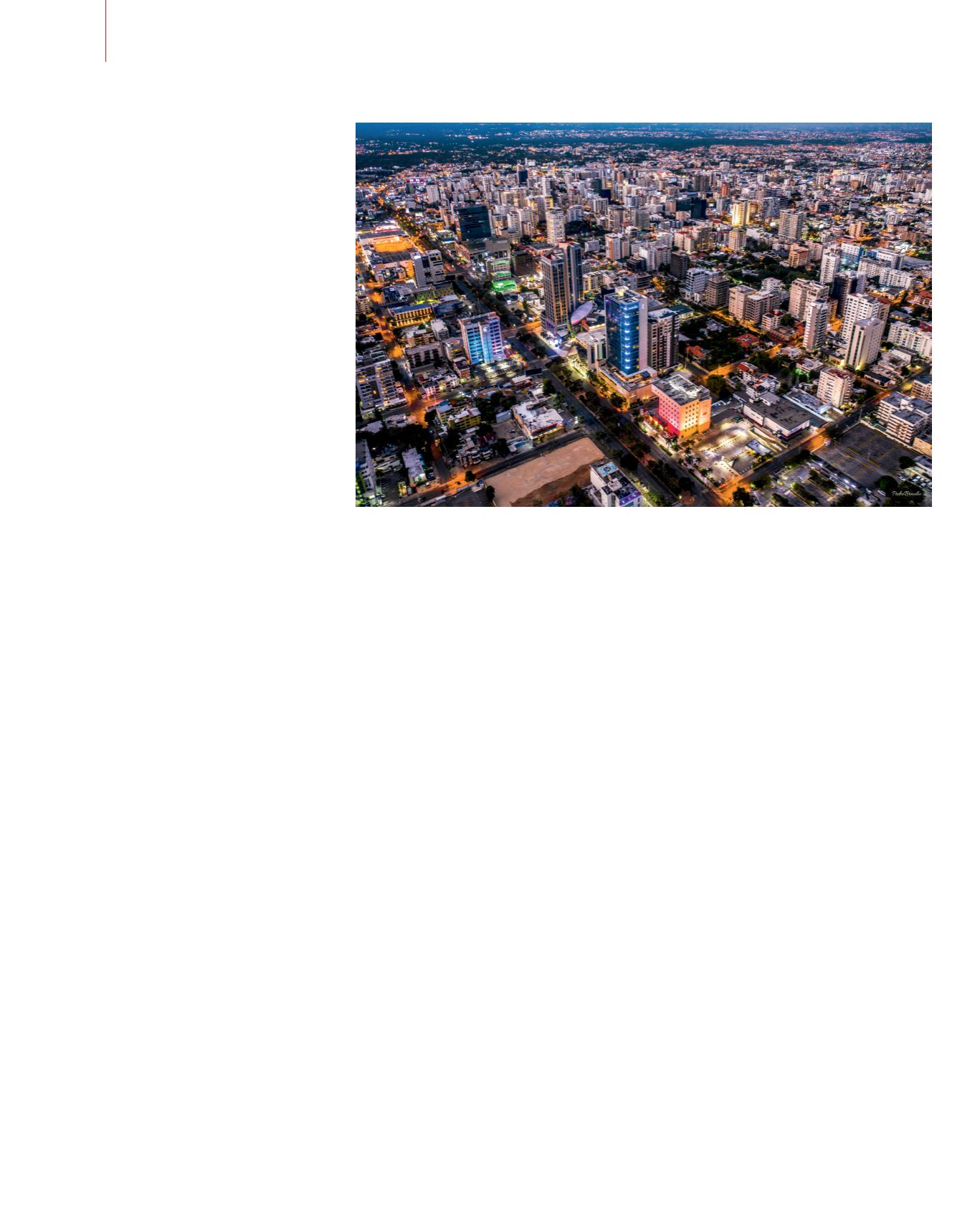
Today’s epicenter
of the city of Santo
Domingo, the area
enclosed between
the avenues: Gustavo
Mejía Ricart, Abraham
Lincoln, 27 de
Febrero, and Winston
Churchill. In the mid-
1930s, this was an
area of pastures
and uncultivated
vegetation mainly used
for cattle breeding.
© Public domain
José María Bonetti
Ernest, ancestor of the
Bonetti Burgos family
(
La Nación
, December
8, 1951).
© Antonio Guerra