


 54 / 540

53
the Dominican Institute of Genealogy
(1992–1995), president of the Domin-
ican Academy of History (1995–2001),
secretary of Ministry of Industry and
Commerce, (1977) and a member of
Congress (1957–1958).
A common last name primarily in
San Carlos de Tenerife, outside the city
walls of Santo Domingo, and in Baní is
Vittini, Bitines or Bitini. Variations
of the name appear in different docu-
ments in the nineteenth century. Fam-
ily tradition claims it is an Italian last
name though the genealogist and histo-
rian Carlos Larrazábal Blanco does not
provide any details.
16
Meanwhile, histo-
rian Dr. Vetilio Manuel Valera Valdez
17
of Baní states that the family descends
from Pedro Vittini Chiossone, son of
Tomás Vittini and Ana Chiossone, both natives of Narba, Piedmont. In 1792, he married Aurora Prandi San-
terro, daughter of Carlos Prandi and Rosa Santerro, both natives of Savona, Liguria. The latter can be doc-
umented. From this union come the Vittini families of Baní, Santo Domingo, San Cristóbal and San Pedro
de Macorís. The best known figure from this family is Dr. Mario Antonio Read Vittini (1926–2010), who was
president of the Partido Dominicano in San Cristóbal (1948–1951). In 1960 he sought asylum at the Embassy
of Brazil during the dictatorship of Rafael Trujillo (1891-1961). He was a co-founder of the Christian Social
Revolutionary Party (1961) and served as Secretary of State (1963), governor of the Central Bank, ambassador
to Washington (1969–1970), and consultant to the Executive Branch of the Government (1986–1988).
The aforementioned Prandis descend from José Prandi Santerro, a native of Savona, Liguria (near Genoa),
the son of Carlos and Rosa. He was born sometime around 1782, and was married to Victoria de Fuentes
Pérez-Guillama
18
from San Carlos at the Cathedral of Santa María la Menor on Septem-
ber 7, 1808. After her death he married a French citizen María Teresa Collot de Bruli
19
at
the same cathedral on April 20, 1819. He was widowed yet again. His third marriage was
in Baní to María Teresa Pujol Clanxet,
20
a member of a family with close relations with
Patricio Juan Pablo Duarte. José Prandi Santerro left a will in Baní on February 15, 1835.
The Prandis established roots predominantly in Santo Domingo and in Baní.
Sometime around 1805, Juan Nepomuceno Bonetti Judijo arrived in Santo Domin-
go. Born in approximately 1784 in San Remo, Liguria, he was the son of José Bonetti
and Angela Judijo. In 1810, he married María de las Angustias Garoz Cruz (1795–1845)
of Santo Domingo. Juan Nepomuceno appears to have been a sailor and boat captain
by profession in 1831; he was also a retail merchant.
21
One of his children, José Ramón
Bonetti Garoz, was married on November 25, 1848, to Julia Ernest Copens,
22
a descend-
ent of immigrants from Guadalupe in the French Antilles. After José Ramón’s death,
she married his brother José María Bonetti Garoz,
23
Director of Public Works (1884), on
January 1, 1862. The Bonetti Ernest descendants are the largest branch of this family.
Notable members of this family include postmaster José María (Chiro) Bonetti Ernest,
father of the Bonetti Burgos family that excelled in public administration, diplomacy
and were also successful entrepreneurs.
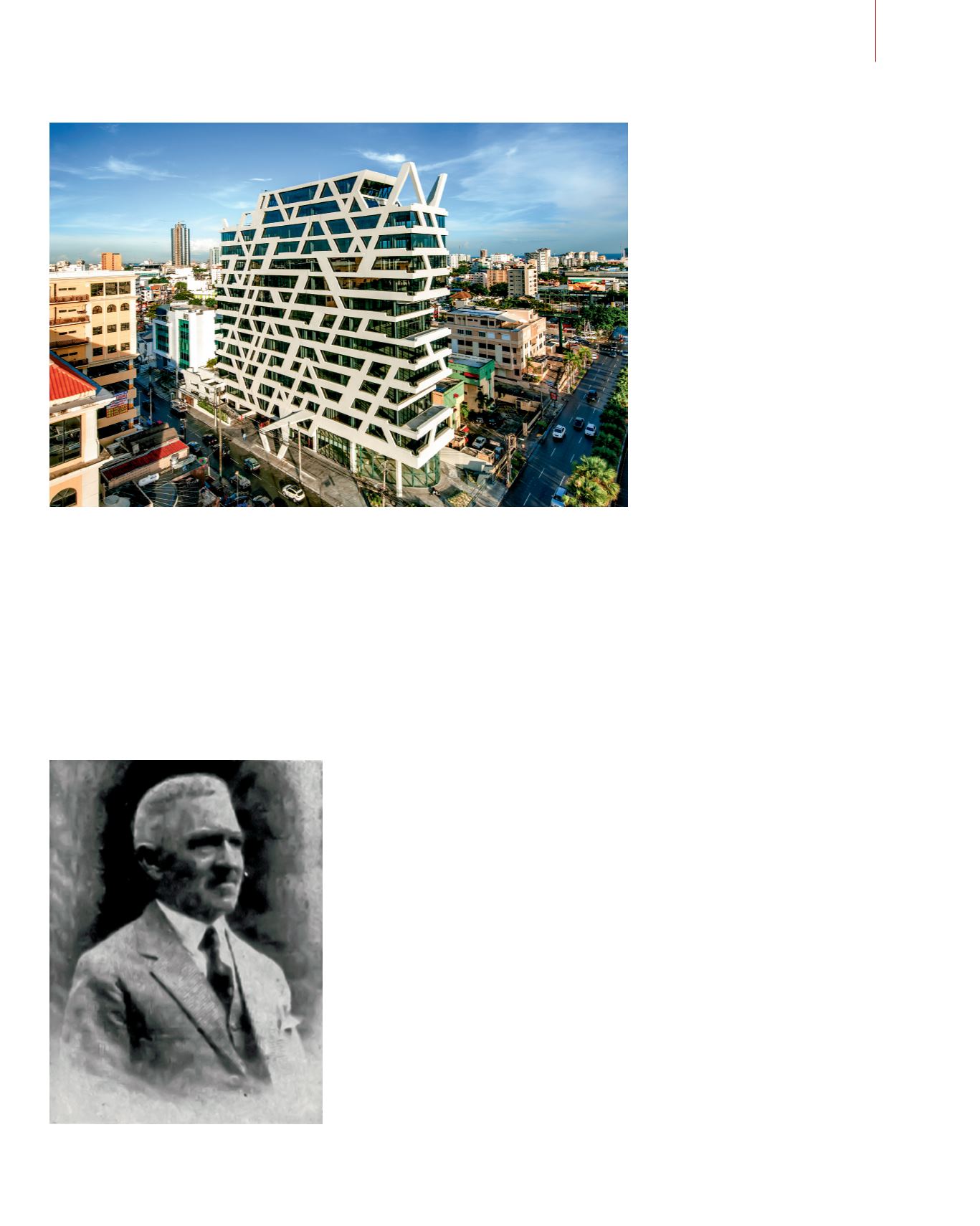
The building
“Corporativo 2010,”
which was designed
by the architect Jose
Horacio Marranzini of
Italian origin, located in
the modern business
district of Santo
Domingo “Piantini,”
and named after an
illustrious Italian family.
© Alejandro Marranzini
ITALIAN IMMIGRATION TO SANTO DOMINGO