


 55 / 540

THE ITALIAN LEGACY IN THE DOMINICAN REPUBLIC
54
María del Carmen Bonetti Garoz (1814–1883) married a fellow townsman Juan Bautista (Gio Batta)
Pellerano Costa (1806–1880) on October 19, 1852, at the Cathedral de Santo Domingo. Meanwhile, Clara
Bonetti Ernest married the prominent attorney, writer and public figure Juan Nepomuceno Publio Scipión
Emiliano Tejera Penson on May 7, 1879, in Santo Domingo,
24
to mention only a few important connections
between this family with other Dominican and Italian ones.
At the end of 1834, Juan Bautista (Gio Batta) Pellerano Costa arrived in the Dominican Republic from
Santa Margherita Ligure, Genoa, where he was born on August 23, 1806. He was the son of Benedetto Pellera-
no Bertollo and Maddalena Costa. Gio Batta’s first wife María Teresa Costa, with whom he had two children,
Vicenzo Benedetto (Benito) and Maddalena, died. On October 19, 1852, Gio Batta was married for the second
time at the Cathedral of Santo Domingo to María del Carmen Bonetti Garoz
25
(mentioned above). On October
5, 1859, Vicenzo Benedetto (Benito) Pellerano
Costa, born in Genoa, married María de Belén
Alfau Sánchez,
26
the half-sister of the Febreri-
sta party members Felipe and Antonio Alfau
Bustamante. Together they had a son Arturo
Joaquín Pellerano Alfau, the founder of the
Listín Diario
newspaper (August 1, 1899).
Rosa Pellerano Costa, one of Gio Batta
Pellerano’s sisters, was married in Genoa to
Juan Bautista (Gio Batta) Maggiolo Mag-
giolo. Gio Batta Maggiolo and Gio Batta
Pellerano were partners at the Maggiolo &
Pellerano company. This firm was located
at Calle del Comercio in Santo Domingo
in 1850, and both owned the María Luisa
schooner active in the Azua region during
the Dominican War of Independence against
Haiti. Gio Batta Pellerano died at age 74; his
wife Carmen Bonetti predeased him. The priest Eliseo Sandoli
27
performed his funeral rites.
The Pelleranos produced successful entrepreneurs as well as famous intellectuals, e.g. the writer and poet
Arturo Bautista Pellerano de Castro (March 13, 1864–May 5, 1916), the “Dominican Byron.” Another Pellera-
no family settled in Santiago de los Caballeros. They are the descendents of Gierolamo Pellerano and Colom-
bina Cuneo, also natives of Santa Margherita Ligure in Genoa, Italy.
Brothers José Bartolo and Juan Bautista (Gio Batta) Maggiolo Maggiolo also came from Genoa, Lig-
uria. In many documents this last name appears as Mayolo and even Mayoyo. They were the sons of Giro-
lamo (Gerónimo) Maggiolo and Maddalena Maggiolo. Juan Bautista Maggiolo married fellow townswoman
Rosa Pellerano Costa, and he was the business partner of her brother, Gio Batta Pellerano. As the captain of a
schooner, Gio Batta was involved in the Dominican War of Independence. He left the country permanently
in 1856 for unknown destinations. His children Bartolomeo and Maddalena Maggiolo Pellerano, both born in
Italy, remained in Santo Domingo. From them the Maggiolo Gimeli, Maggiolo Ravelo, Maggiolo Pimentel,
Maggiolo de Castro, and Maggiolo Núñez families descend.
28
José Bartolo Maggiolo Maggiolo married María del Carmen Vidal Henríquez at the Cathedral of Santo
Domingo on July 17, 1858.
29
In 1858, he worked as a coachman; in 1886 he resided at Calle Consistorial in the
Santa Bárbara neighborhood of Santo Domingo. He had many children with María del Carmen Vidal, Amelia
Pereira, and Agustina Landestoy. Baní native Eudocia Maggiolo Landestoy (1869–1949) was a child of José Bar-
tolo Maggiolo Maggiolo and Agustina Landestoy. Eudocia Maggiolo lived with Juan Francisco (Papi) Sánchez
Peña (1852–1932), son of Patricio Francisco del Rosario Sánchez.
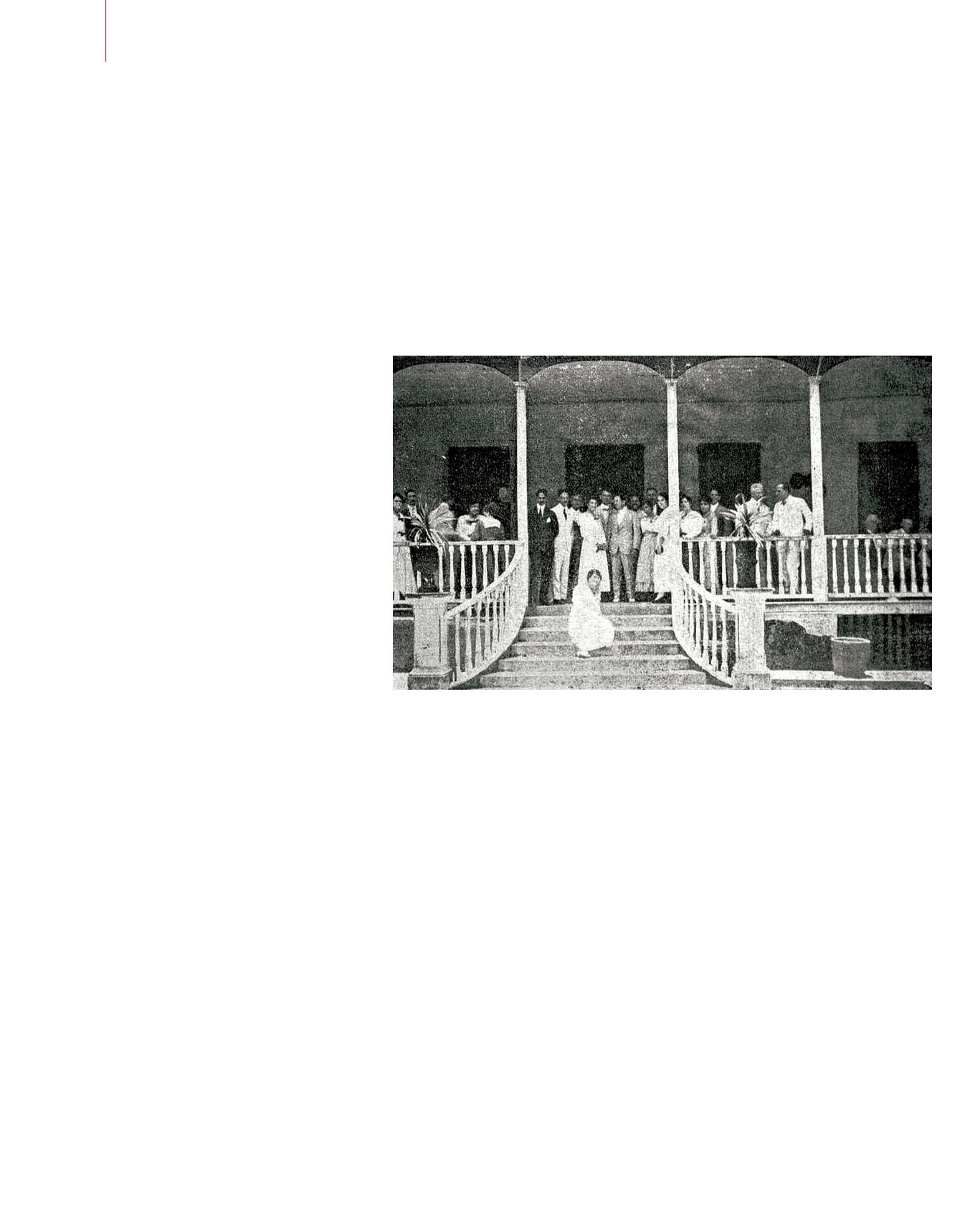
The “Empress,”
Ms. Evangelina
Bonetti, and a group
of friends attending
the sumptuous picnic
given in her honor
the previous Sunday
at Mr. Juan Bautista
Vicini Perdomo’s villa.
LETRAS Magazine #22
of 1917.
© Antonio Guerra