


 43 / 540

THE ITALIAN LEGACY IN THE DOMINICAN REPUBLIC
42
Prior to that, on his second journey Columbus was accompanied by a young compatriot, Michele da Cu-
neo, a native of Savona, a town close to Genoa, who seeking adventures asked to join that expedition in his
capacity as mere curious traveler. Cuneo wrote an account of his arrival in the Antilles, and in it he recounts
that Columbus in honor of him christened a small island to the southeast of Española with the name of Saona
(the Ligurian variant for Savona). Michele da Cuneo was the first European “tourist” to visit the New World.
The shipowner for that second voyage was Juanoto Berardi, to whom the monarchs entrusted the respon-
sibility of preparing a ship for Columbus to return to the Antilles. This assignment resulted in the organization
of a fleet composed of sixteen ships. For the financing of this fleet, Berardi lent 65,000 maravedíes, which were
paid to him by the Crown during the following summer.
Another Italian friend of Columbus who acted as his confidant and repository for information gathered
during his first two voyages was the Milanese Pedro Martir de Anglería (Pietro Martire d’Anghieria), the au-
thor of the famous
Décadas del Nuevo Mundo
, one of the earliest chronicles about the presence of Europeans in
Española.
As Columbus’s partner and financier, Berardi acted as his agent until the latter’s death in 1495. Following
that, his business remained under the responsibility of Vespucci. Ten years later, Columbus died, and his son
Diego was appointed governor and viceroy of the lands discovered by his father, which would be governed
from Santo Domingo. Diego moved to this newly founded city in 1509 with his wife, María de Toledo, and a
small entourage of European noblemen and women sent by the Crown to “ennoble the land.”
Columbus left Diego with a vast inheritance. With those resources and the labor of numerous Indigenous
slaves, between 1511 and 1512 this new governor built an imposing viceregal palace with obviously Renais-
sance Florentine architectural features. We still do not know the name of the designer of this beautiful build-
ing incorrectly referred to today as the Columbus Alcazar. However, it has already been clearly determined
that its architecture is Italian, as has been established by researcher Julia Vicioso, who has been studying this
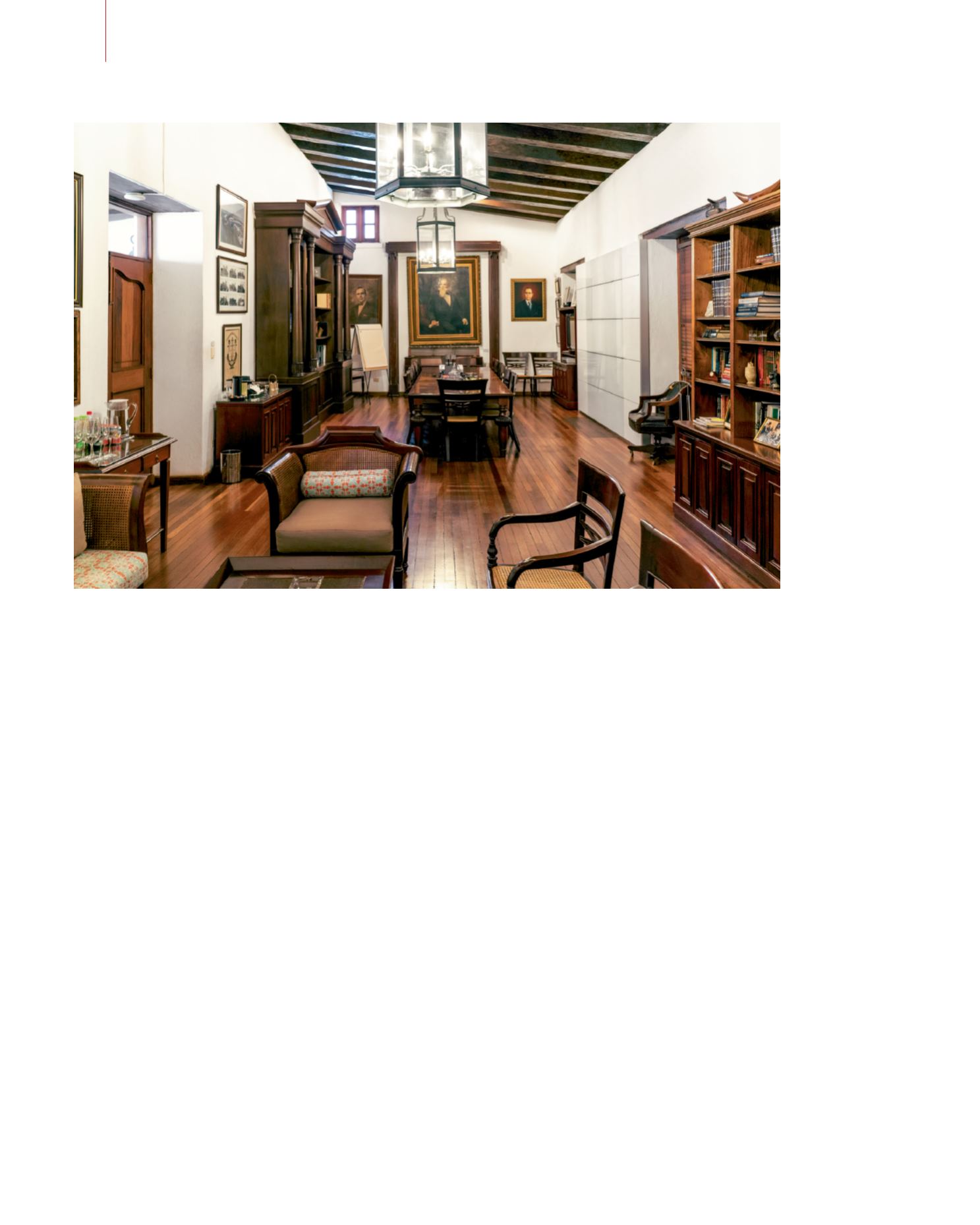
The large meeting
room of Casa Vicini
is the second floor’s
main room: the
company’s business
has been handled
here for decades.
Santo Domingo.
© Giovanni Cavallaro /
Casa Vicini / Inicia
Opening page:
Oil portrait of
Giovanni Battista Vicini
Canepa inside the
large meeting room
of Casa Vicini.
© Giovanni Cavallaro /
Casa Vicini