


 335 / 540

THE ITALIAN LEGACY IN THE DOMINICAN REPUBLIC
334
his objects allow him to obtain a novel image
that interweaves erotic, religious, and popular
themes, most notably with mobile sculptures
that affect space from different angles. He has
won prizes in biennials and national competi-
tions. His erotic
Trip Sculpture of a Ciguapa
can
be viewed on the Avenida 27 de Febrero, in
Santo Domingo.
Pascal Mecariello
(1968). Mecariello is
Italian surname originating in Campania.
17
An
Instalation artist, ceramist, and photographer,
he was born in Santo Domingo in 1968. He
achieved prominence in the 1990s through
awards in competitions and biennials, most no-
tably the Grand Prize at the XXV National Bi-
ennial of Visual Arts in Santo Domingo (2009).
An autodidact, he has attended engraving and
ceramics workshops in the Netherlands and
also dabbled in digital art.
Orlando Menicucci
(1949). Menicucci is an Italian surname from Tuscany.
18
A painter and draftsman,
he was born in Santiago de los Caballeros, Dominican Republic. Self-taught, he was a founding member of
the Friordano group, a collective that arose at the Universidad Católica Madre y Maestra in Santiago, which
proposed opening the exhibition spaces to the public. Some of its members experimented with extra-pictorial
materials and resources. Considered an important figure of the School of Santiago, Menicucci has exhibited
on numerous occasions and received many prizes and recognitions, most notably the Painting Prize at the XIII
National Biennial (1974) for his work
0, 1, 3, 1, 0, 1
.
Luis Nova
(1957). Nova is an Italian surname from Milan.
19
Nova, a renowned Dominican photographer,
was born in Santo Domingo in 1957. He studied Industrial Psychology at the Pedro Henríquez Ureña National
University (UNPHU). He later became part of the Fotogroup. In 1981, he presented his first solo exhibition
at the Nouveau Art Center. He has exhibited on numerous occasions and was awarded important prizes and
recognitions in biennials and national competitions, including the Grand Prize at the XIX National Biennial of
Visual Arts (1994) for his color photograph
Captive of Time
. Since 1984, he has devoted himself to professional
photography. He has specialized in social photography, artistic portraiture, design, and the production of book
covers.
Josefina Romano Pou
(1917-1980). A Roman Italian surname which literally means a native of Rome.
20
A self-taught painter and draftswoman, she achieved fame in the mid-1960s, after having won prizes in two
consecutive competitions by the firm E. León Jimenes: First Prize for Drawing in 1967 and Third Prize for
Painting in 1968.
Carlos Sangiovanni
(1949). Sangiovanni is an Italian surname from Valenza, Piedmont.
21
A graphic artist
and designer, he was born in Santiago, Dominican Republic. He studied at the National School of Fine Arts.
He studied woodcut in Puerto Rico and later at the Faculty of Fine Arts of the Rodríguez Faccio University
of San José, Costa Rica, with a scholarship from the OAS. He has exhibited successfully at home and abroad.
He has won awards in national contests and biennials. He is currently Vice Chancellor of APEC University.
Inés Tolentino
(1962). Tolentino is an Italian surname from Milan.
22
A painter and draftswoman, she was
born in Santo Domingo. She studied at the APEC School of Art and at the École Nationale Supérieure des
Beaux-Arts in Paris, where she received a master’s degree in visual arts and art sciences (1980). She then went
on to complete a PhD in aesthetics at The Sorbonne. She has had solo exhibitions and participated in group
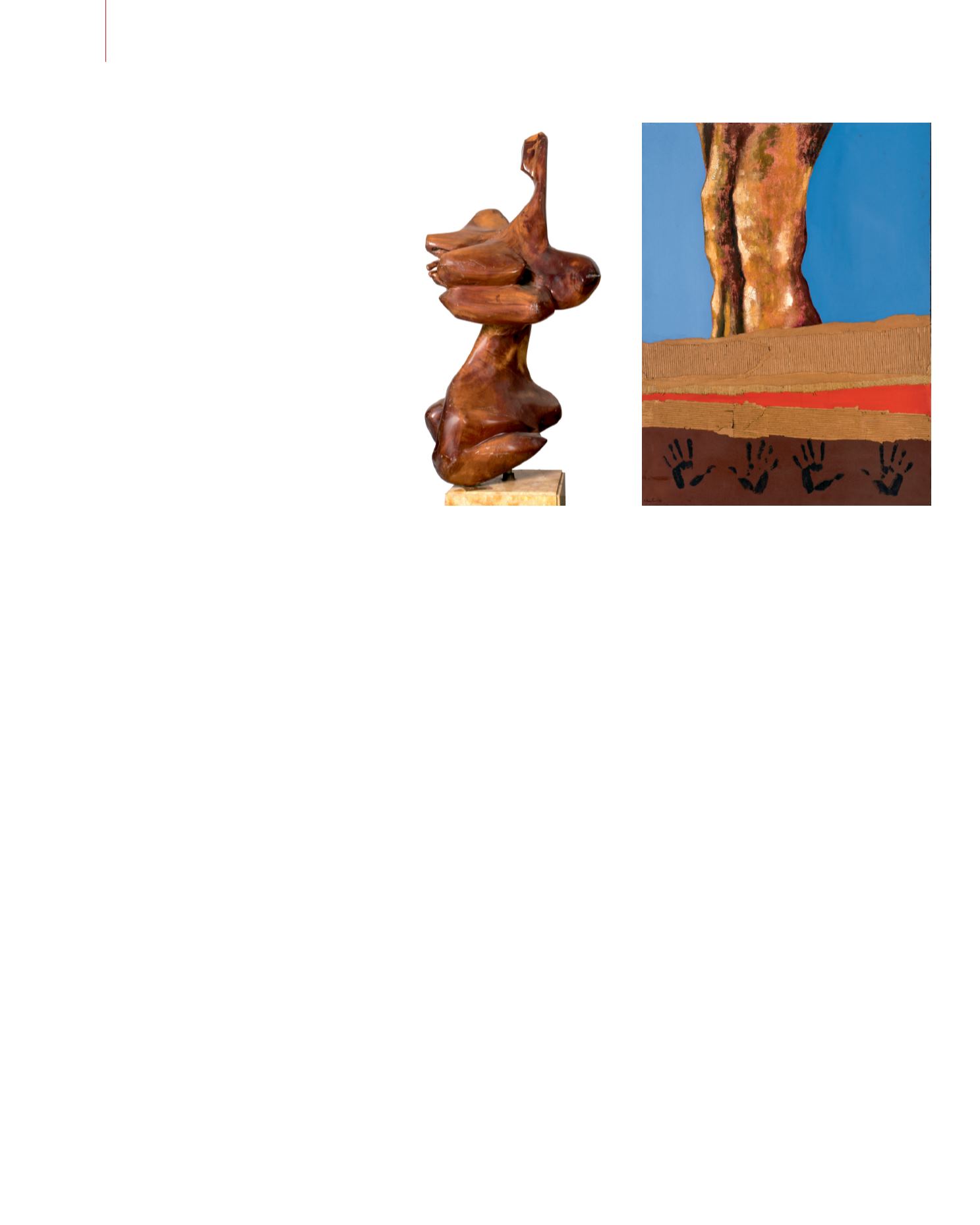
José Ramón Rotellini,
Femenino 90
, 1989,
wooden sculpture,
130x70x39 cm, Santo
Domingo, Museum
of Modern Art. The
work was awarded
the second prize for
sculpture at the XVII
National Art Biennial
in 1990.
© Photograph by Mariano
Hernández / Museum of
Modern Art
Adolfo Piantini,
Desgarramiento
, 1983,
collage / canvas, 96.5
x 119.5 cm, Santo
Domingo, Museum of
Modern Art.
© Photograph by Mariano
Hernández / Museo de
Arte Moderno