


 334 / 540

333
ITALY’S INFLUENCE ON DOMINICAN ART
and the Afro-Caribbean syncretism of
the
bateyes
, he achieved new approach-
es to subject and surface, thereby influ-
encing the artists of his time. His great
conceptual ability and pictorial mastery
have made him a key figure in art, not
only in the Caribbean, but also across the
hemisphere.
José Ramón Rotellini
(1942). Rotel-
lini is a surname originating in Tusca-
ny.
14
A sculptor and draftsman, he was
born in Santo Domingo. He studied at
the National School of Fine Arts, where
he received awards in drawing and sculp-
ture. Later he attended the Academia San
Fernando in Madrid and had his first solo
exhibition in Santo Domingo in 1969. He
has won prizes in national contests and
biennials. His work approaches human-
ity and nature in figurative and abstract
modalities, preferring vertical composi-
tional approaches that endow his sculptures with a spirituality that also employs symbolism. He uses wood,
metal, cement, and other materials, which he sometimes combines in harmonic solutions. A professor at the
National School of Fine Arts and at the Autonomous University of Santo Domingo, Rotellini has also created
outdoor sculptures, including a noteworthy composition utilizing asymmetrical and symmetrical elements
and situated on the Avenida 27 de Febrero, in Santo Domingo.
Adolfo Piantini
(1946). Piantini is an Italian surname of unidentified origin. The first member of this clan
to arrive in Santo Domingo, José Eugenio Piantini (1791-1871) emigrated from Italy in the early nineteenth
century.
15
Adolfo Piantini’s primary medium is painting. He was born in Santo Domingo and studied at the
National School of Fine Arts under Gilberto Hernández Ortega, and at the Art Students League in New York.
He had his first solo show at Casa de Teatro in 1966. His importance on the Dominican art scene derives from
his focus on religious iconography utilizing thick black lines, as well as monumentally treated Dominican
themes, which are characterized by an ingenious approach to colorism. He has participated in numerous
group shows, biennials, and competitions, thereby achieving a considerable level of renown. He currently
lives in the United States.
Aquiles Azar Billini
(1965). As previously noted, the surname Billini originates from the Piedmont region.
Aquiles Azar Billini was born in Santo Domingo. He is a painter, draftsman and photographer, as well as an
evangelical pastor and the head of the Achilles Azar Ministries. He studied architecture at the Pedro Henríquez
Ureña National University (UNPHU) and at the Iberoamerican University (UNIBE). He graduated from the
Altos de Chavón School of Design, where he also later taught. He has participated in group and biennial ex-
hibitions, and received various prestigious prizes, including First Prize for Drawing in the XIII Eduardo León
Jiménes Art Contest (1990); First Prize for Painting at the XIX National Biennial of Visual Arts (1994); and
Photography Prize at the XXIII National Biennial of Visual Arts (2005).
Johnny Bonnelly
(1951). Bonnelly is a variant of Bonelli, a surname widely found in Italy, predominantly
in the northern central region.
16
A sculptor, he was born in Santiago de los Caballeros. He studied architec-
ture and crafts in the Dominican Republic and France. In the 1980s, his approach shifted, thereby bringing
major changes to Dominican sculpture. The use of wood, ribbons, gangorra, and colored metals to make
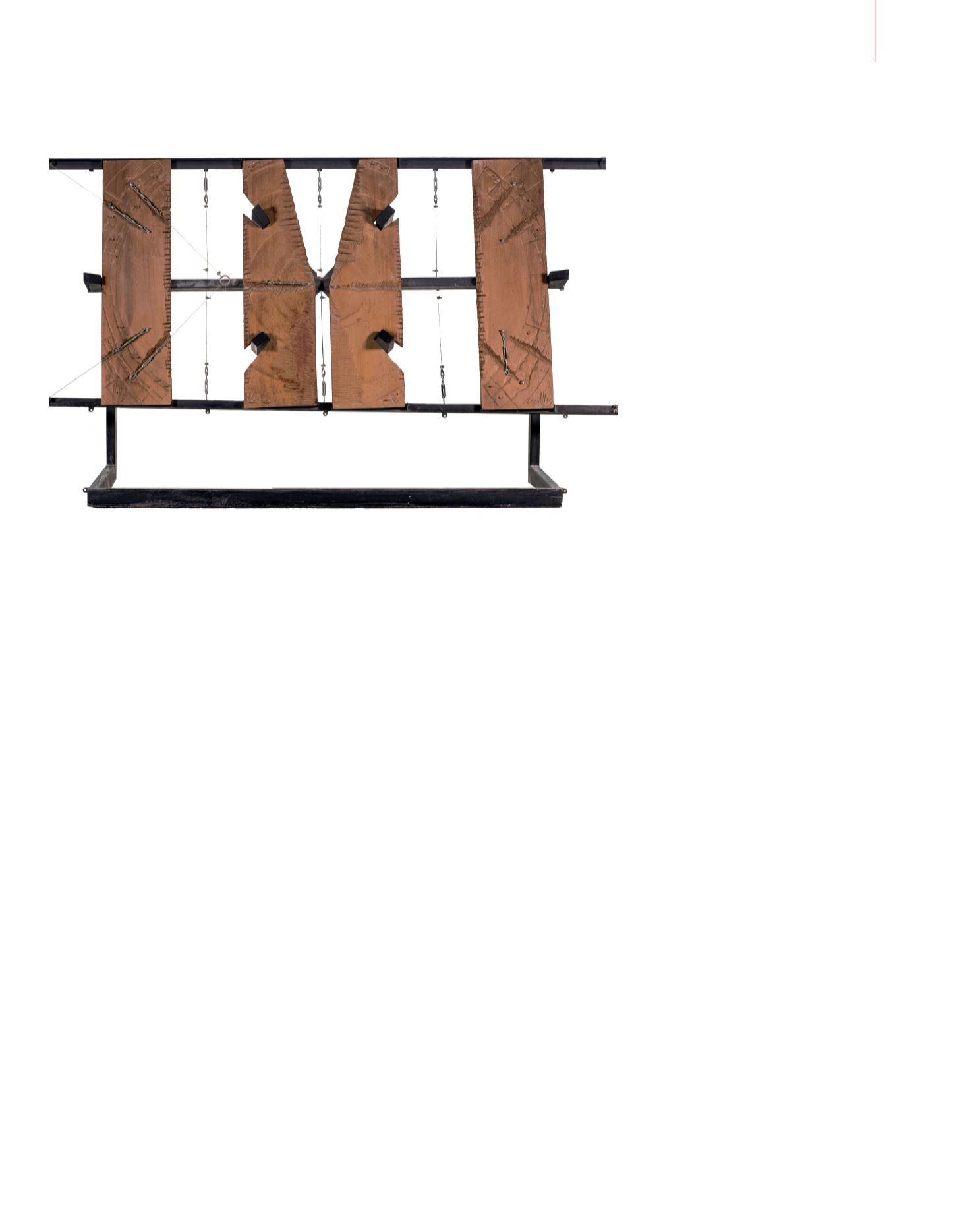
Crismar,
Deconstruction
, 1986,
sculpture in iron,
wood, iron wire,
308x178x100 cm,
Santo Domingo,
Museum of Modern
Art.
© Photograph by Mariano
Hernández / Museo de
Arte Moderno