


 338 / 540

337
ITALY’S INFLUENCE ON DOMINICAN ART
in the lobby of the National Library. Those works create a new
perspective that dialogues between painting and sculpture for
the Dominican public. Among the public monuments that he has
designed, the most important is the mausoleum containing the
remains of the three founding fathers of the country: Juan Pablo
Duarte, Francisco del Rosario Sánchez, and Ramón Matías Mel-
la. Inaugurated on February 27, 1976, and located in Parque de la
Independencia, it is part of the path to the Puerta del Conde, the
site where Dominican independence was proclaimed on February
27, 1844. The statues of Duarte, Sánchez, and Mella located in the
Interior of the mausoleumwere created by the Italian artist Nicola
Arrighini.
27
Geo Ripley
(1950). Born in Venezuela, Ripley is the son of
Dominican political exiles. Since he was a child, he showed inter-
est in painting and drawing. In 1967, he won the Second Draw-
ing Prize of the Third Annual León Jimenes Art Contest for his
work in mixed media on paper entitled
Inspiración
. He received a
master’s in visual arts from the Autonomous University of Santo
Domingo, UASD (1972), and completed the postgraduate course
“New Materials for Sculpture” (1973-75) at the Accademia di Belle
Arti in Rome. He has taught at the Simón Bolívar University of
Caracas (1976), the Art School of the APEC University (1978), and
the Autonomous University of Santo Domingo (1980), as well as
fulfilled the role of visiting professor through the Access Project
at Buena Vista University in Iowa (1995). In 1972, he inaugurated
his first installation in Santiago de los Caballeros. He is considered one of the initiators of performance and
installation art in the Caribbean area.
Carluis Pérez Abreu
(1975). An architect and photographer born in Santo Domingo. Pérez Abreu stud-
ied at the Pedro Henríquez Ureña National University, the National School of Fine Arts in Santo Domingo
(1991-1993), the Albertina Academy of Fine Arts in Turin (1993-1994), the Milan Polytechnic (2001), and the
Polytechnic University of Catalonia (2001-2003). In Santo Domingo, he took courses in Creative Photography
(2007-2008) and Digital Photography (2007) with Polibio Díaz and Héctor Báez, respectively. Since 2005 he
has been a member of the Colectivo Escritura del Espacio and has participated in group exhibitions. Part of his
photographic work reproduces architectural structures and spaces, both ancient and modern, from the major
cities of Italy. He has taught at the Pontificia Universidad Católica Madre y Maestra, PUCMM (2005-2010).
An ever-expanding exchange of customs and cultural visions
As we have seen, relations between Italy and the Dominican Republic have become increasingly close over
time. The number of Italians who come to live in the country and the Dominicans who emigrate to Italy
continues to expand, thereby establishing an exchange of customs and cultural visions that brings us closer
together. As a consequence, the mutual interest in both cultures has gained momentum in approaches where
a synthesis of elements from both cultures and histories has become quite significant.
The artists noted above are part of a much larger group that will emerge as research becomes more com-
prehensive, demonstrating the ties that have always existed between Italy and the Dominican Republic, yet
within the realm of the arts.
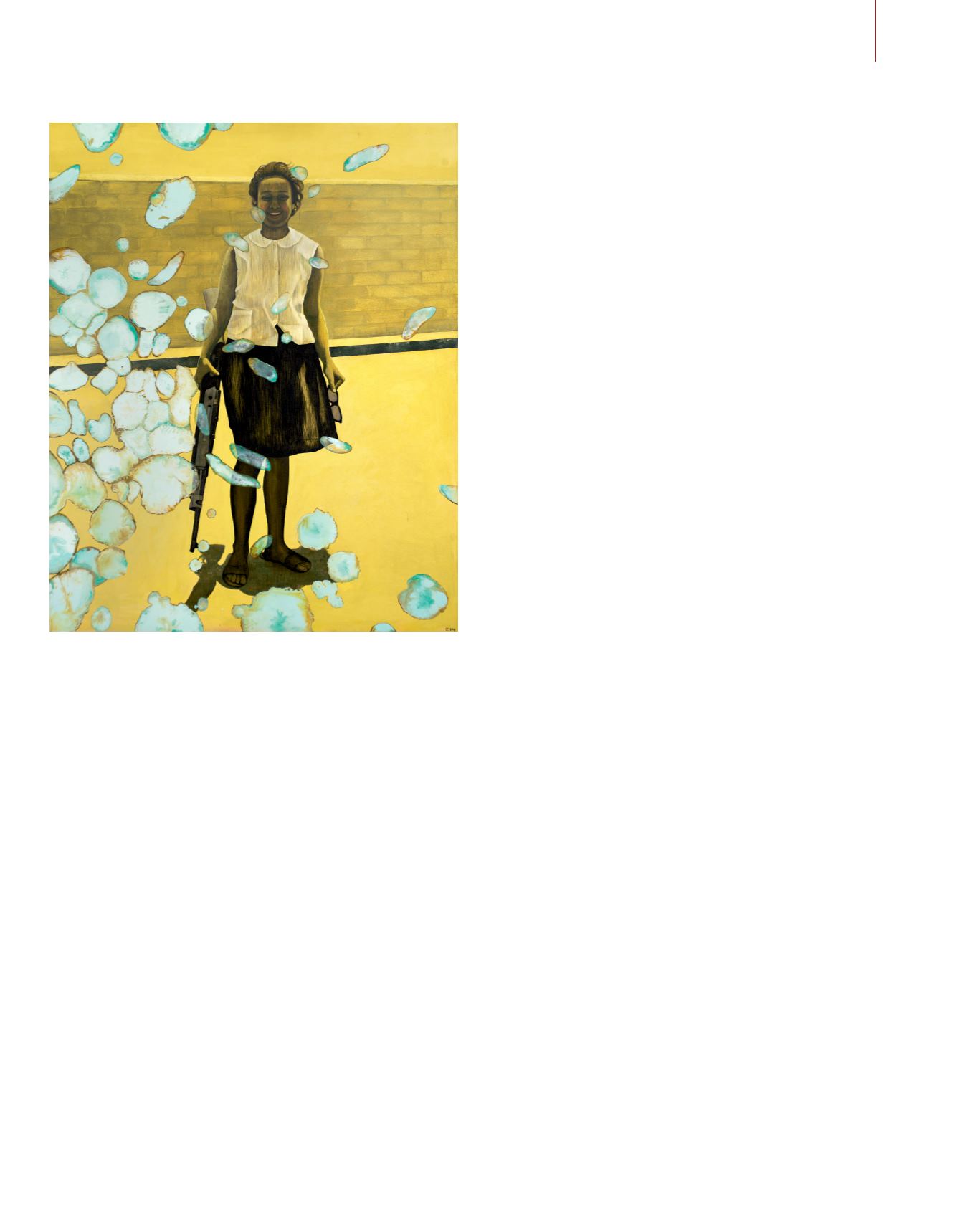
Inés Tolentino, Tina,
1965, 2018, acrylic on
canvas, 150x120 cm,
artist’s collection.
© Photograph by Mariano
Hernández