


 331 / 540

THE ITALIAN LEGACY IN THE DOMINICAN REPUBLIC
330
to grow incrementally, encompassing
sectors of the economy such as agricul-
ture and commerce, while also making
inroads into the world of art. Dominican
art was not limited to reproducing clas-
sical style and themes, but it did include
the presence of Italian educators who
had traveled or lived in the Americas and
taught art during their stay in the Domin-
ican Republic.
Italy was a mecca for painters such
as Juan Ramón Fiallo Cabral, who creat-
ed two oil portraits of the Puerto Rican
philosophical writer Eugenio María de
Hostos and who mentioned Fiallo Cabral
in his writings, where he “praised some
of his paintings and advocated that the
young artist return to Italy.”
4
A similar
request was made by Agustín Jiménez,
who “in 1933 asked the Dominican gov-
ernment to repatriate him or to assign
him a subsidy to continue his studies in
Rome.”
5
It is important to note that two masterpieces by the father of Dominican sculpture, Abelardo Rodríguez
Urdaneta,
One of Many
(1903) and
Caonabo
(1915), which appear at strategic points in the city of Santo Do-
mingo, were sent to Italy by the Dominican historian Pedro Troncoso Sánchez to have them cast in bronze.
Between 1949 and 1953, Troncoso Sánchez served as ambassador to the Holy See, and then as ambassador to
Italy from 1956 to 1958. He was also appointed Minister of Education in 1952.
6
Over the course of the twentieth century, a dynamic cultural exchange between Italy and the Dominican
Republic was forged. The presence of Italians in the Americas—as a result of economic, social and political
factors—grew markedly in the Dominican Republic with the outbreak of World War I (1914), taking on a
different and more augmented form after the death of the dictator Rafael Trujillo in 1961.
7
In addition to Dominicans traveling to Europe, contacts with Italian art occurred in other countries in the
Western Hemisphere. For example, various renowned Dominican artists received their training under Italian
masters in the United States and Venezuela: Alejandro Bonilla (1820-1901), painter and draftsman, lived in
1868 in Caracas, where he studied with an Italian master from whom he learned the portrait technique; Elena
Cabrera (1942), a painter, draftswoman, and installation artist, took painting classes in New York with the Ital-
ian professor Luis de Donato; and Antonio Guadalupe (1941), a painter and draftsman, enrolled in classes in
the United States with the Italian professor Prillo Grinilli. Furthermore, a sizable number of major Dominican
painters, sculptors, and photographers who left their mark in Dominican art history were the descendants of
Italian immigrants.
Since the late twentieth century, an increase in cultural exchange between the two countries can be meas-
ured by the creation of the Casa de Italia in 1994. Located in the colonial city of Santo Domingo, this cultural
center offers Italian classes and art exhibitions, as well as conferences on subjects of mutual interest to both
countries, and other cultural events and activities.
Similarly, exhibitions of Dominican art have been presented in Italy, and publications on Dominican liter-
ature have been issued, several of them compiled by Professor Danilo Manera of the University of Milan, in-
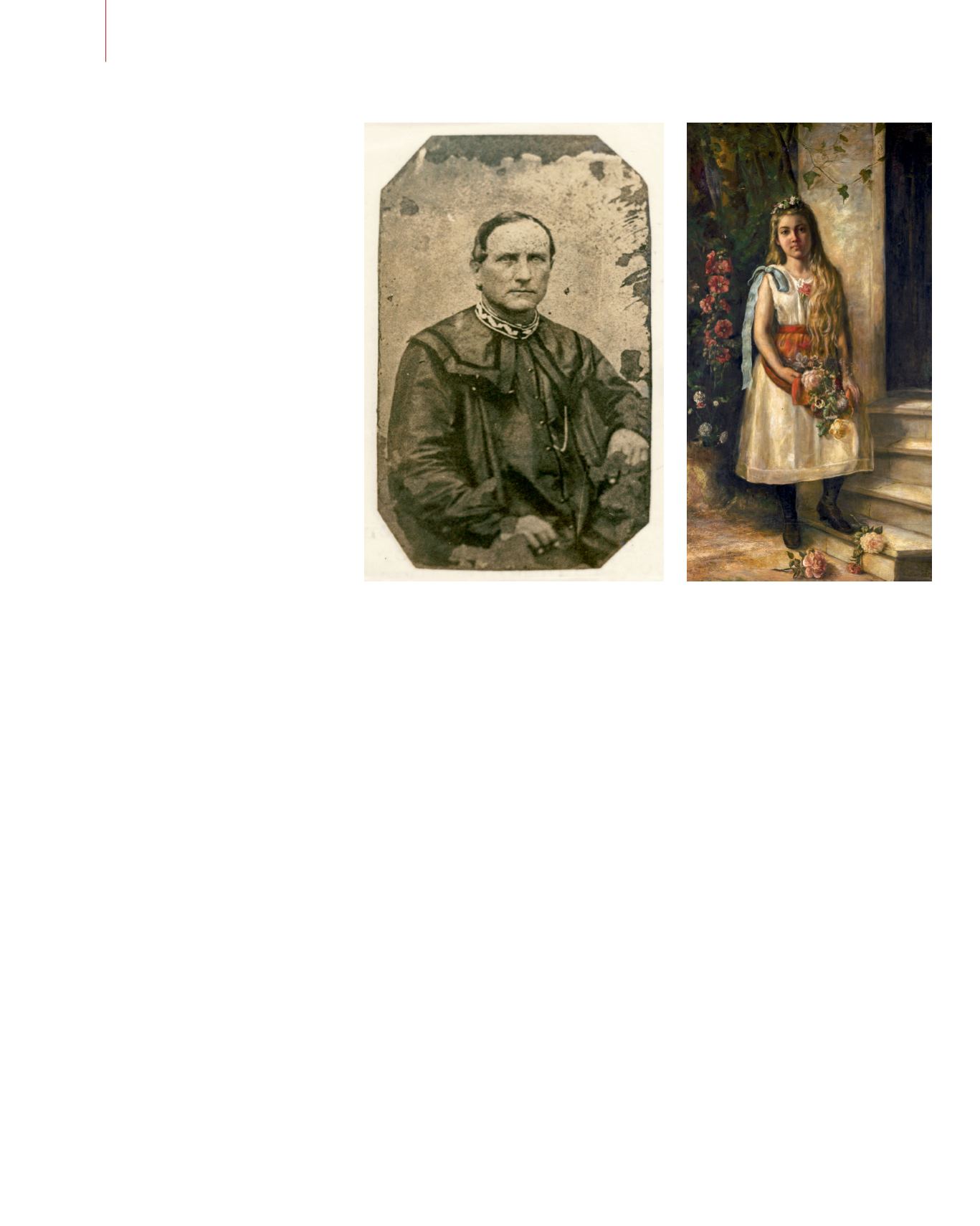
Epifanio Billini
(Credited),
Presbítero
Francisco Roca y
Castañer, s
econd half
of the 19th century.
Daguerreotype,
Dominican Republic.
Adriana Billini,
Retrato
de una Infanta
Oil /
canvas, 157 x 87 cm,
1930, Santo Domingo,
Museum of Modern Art.
© Photograph by Mariano
Hernández / Museo de Arte
Moderno