


 135 / 540

THE ITALIAN LEGACY IN THE DOMINICAN REPUBLIC
134
seminary in Caracas until 1899. He then moved to the Dominican Republic, arriving on a Dutch schooner on
November 8, 1899. His first assignment was assistant to Fr. Antonio Luciani, another Italian who had founded
San Antonio Hospital in San Pedro de Macorís on the eastern end of the island. However, on March 12, 1900,
he was assigned to the Conciliar Seminary of Santo Domingo—the former Palace of Borgellá—where he
would then become prefect and chaplain of the cathedral.
On February 16, 1903, and for only a little over five months, he was assigned to the parish of Monte Cristi,
where he taught Latin, French, and Spanish grammar at the public elementary school, although he was still
not fluent in Spanish. In July 1903, he left voluntarily and moved to La Vega, where the establishment of a
school was being planned despite the continual threat of civil war. The school, called Colegio San Sebastián,
was provisionally opened on September 1, 1903, and enrollment grew quickly.
From 1904 to 1907, Fantino established the San Vicente de Paúl home and children’s school, in collabora-
tion with the Sisters of Charity and the Little Sisters of the Abandoned Elderly. In 1905, the chapel of Christ
Crucified was added, and in 1919, he was transferred to Santo Cerro, La Vega, where he would remain until
1925, fostering a traditional devotion to Our Lady of Mercy and sponsoring a spiritual retreat for priests on
September 7-11, 1919. Between 1925 and 1926, he was responsible for three parishes: Jarabacoa, La Vega, and
Constanza. In 1926, he returned once again to Santo Cerro, where he remained until his death thirteen years
later. He suffered an accident, collapsed, and died at San Antonio Hospital in San Pedro de Macorís on July 4,
1939. After being honored at the Cathedral of Santo Domingo, he was buried that same day in the church of
Santo Cerro.
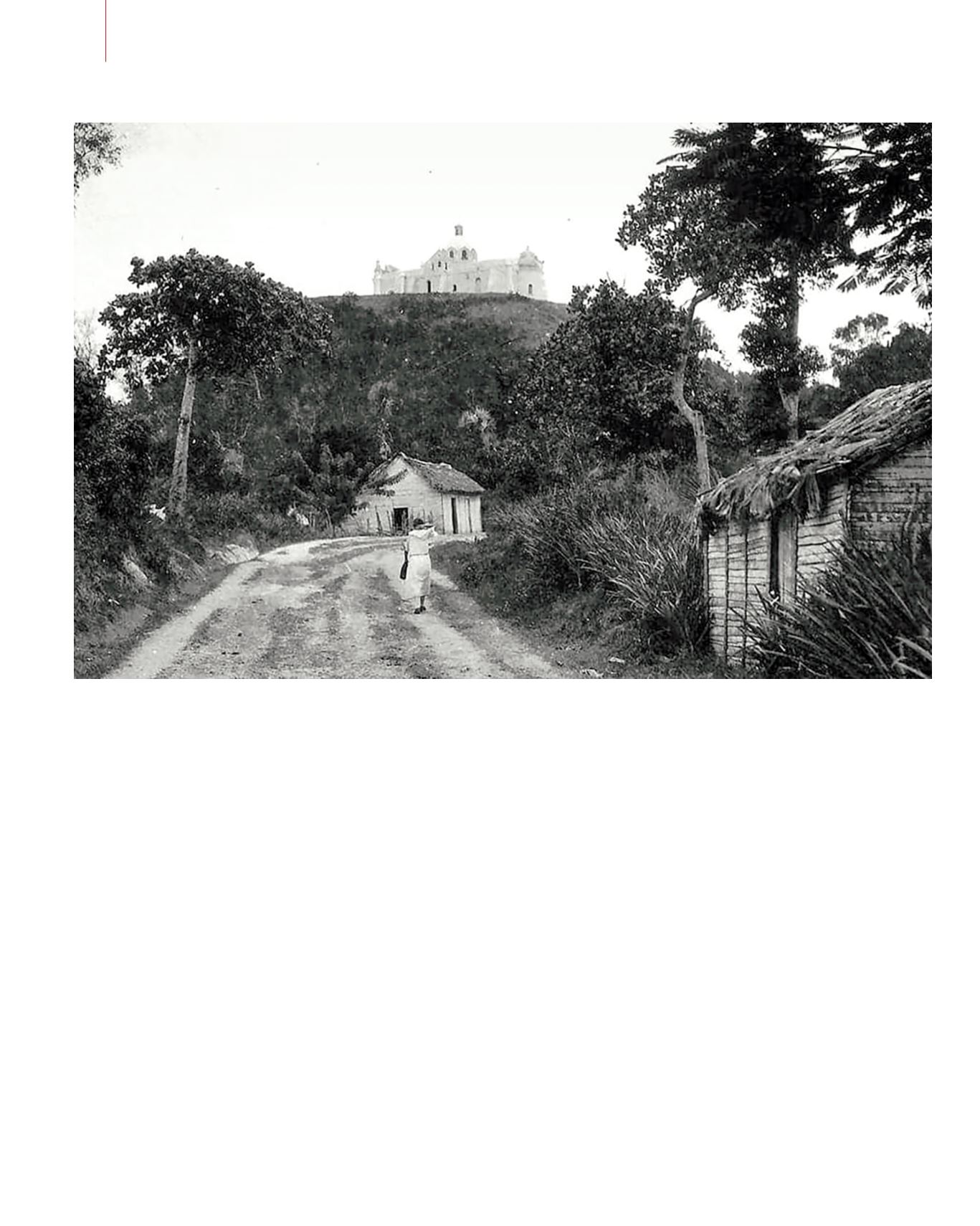
Santo Cerro, where
Father Francisco
Fantino engaged in his
pastoral work.
© Edwin Espinal