


 133 / 540

THE ITALIAN LEGACY IN THE DOMINICAN REPUBLIC
132
press and the local clergy, who were unhappy with an-
other foreigner reigning over the Dominican Church. He
dealt with a challenging political climate in Venezuela,
and on January 1, 1875, for the first time since Domini-
can independence, he established an Honorary Council
of the Cathedral; the Council consisted of 15 members,
all Dominicans. He made pastoral visits to at least nine
parishes between 1875 and 1882. He upgraded the Con-
ciliar Seminary and joyfully witnessed the discovery of
Christopher Columbus’s true remains during the cathe-
dral restoration work that he ordered. While lowering
the altar in the sanctuary, two workers had stumbled
upon the relics and notified the pastor, Fr. Francisco Bil-
lini. The momentous discovery of Columbus’s remains
was highlighted by the apostolic vicar when Diocesan
Synod IX—the second of the nineteenth century—took
place May 12–19, 1878 (title II, art. XXIV).
Cocchia departed from the Dominican Republic,
and on August 9, 1883, he was appointed archbishop of
Otranto, Italy. He then became an internuncio in Brazil
from 1884 to 1887, and finally, on May 27, 1887, archbish-
op of Chieti, Italy, a position he held until his death on December 19, 1901. Years later, his remains would be
moved to San Rocco Church in his hometown of Cesinali.
During the bishop’s entire residency in the Dominican Republic, Fr. Bernardino di Milia, O.F.M.Cap., was
secretary of the vicarage. In Cocchia’s absence, he became the chargé d’affaires of the apostolic delegation. He
was born in Calitri in the province of Avellino in the Campania region of Italy on October 28, 1839. During his
years as acting delegate, he assisted in such parishes as Baní (July–September 1878), Higüey (October–Novem-
ber 1879), and the cathedral (August 27, 1881).
Fr. Luis Romei, O.F.M.Cap., the acting pastor of Puerto Plata from 1875 to 1877 and of Altamira from
1877 to 1880, apparently also collaborated with Fr. Rocco Cocchia, most likely joining him on pastoral visits.
Ricardo Paolo Pittini Piussi, S.d.b.
Pittini was born in Tricesimo, Italy, in the province of Udine on April 30, 1876. At the age of twenty, he en-
tered the Salesian Novitiate in Valsalice; however, before becoming a priest, he was sent to the mission in
Uruguay. He was ordained in Montevideo on January 22, 1899 and worked there for twenty-eight years. He
was also responsible for the Chaco mission in Paraguay, which was followed by the mission in the eastern
United States, where he arrived on August 16, 1934, to establish the Salesian mission, and most importantly, a
technical school. He suddenly changed course when Pope Pius XII, supported by the Trujillo administration,
appointed him archbishop of Santo Domingo, which had previously been supervised by the last of three apos-
tolic administrators. Although the Dominican clergy’s disapproval of the foreigner—coming from the United
States at that time—was evident, he was ordained in the cathedral on December 8 of that same year. The
consecrating bishops were the Dominican coadjutor archbishop, Luis A. de Mena; the archbishop of Port-au-
Prince; and the bishop of San Juan, Puerto Rico. He oversaw the archdiocese for 25 years, despite becoming
almost totally blind in 1945. He maintained and significantly upgraded the Seminary, equipping it with better
facilities and teaching staff. He also opened the first minor seminary—for youth interested in the priesthood—
in Santo Cerro, La Vega, and entrusted its operation to the Jesuits. The most noteworthy achievement of his
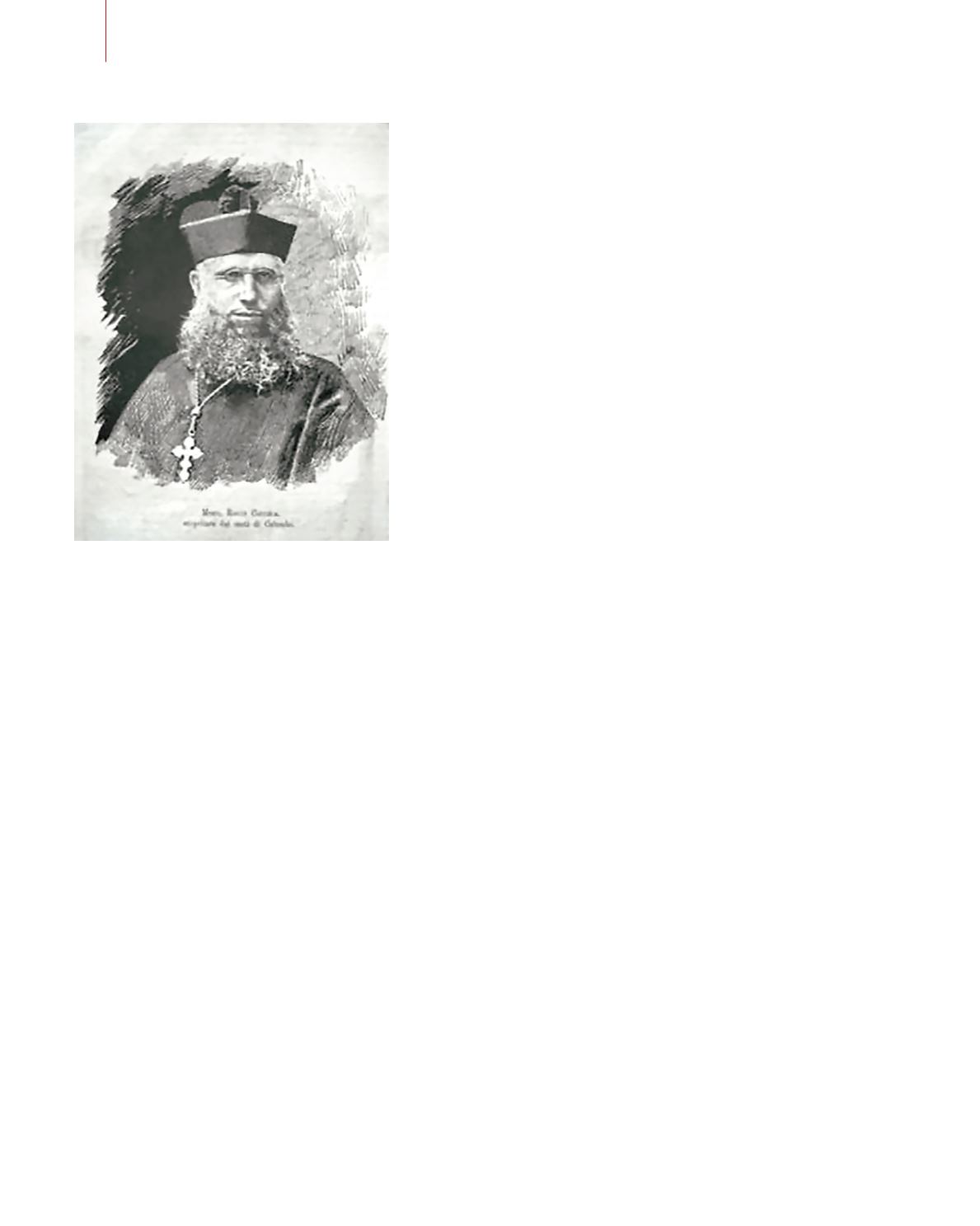
Rocco Cocchia.
© Courtesy of Monsignor
Antonio Camilo