


 134 / 540

133
ITALIAN CLERGY AND THE CATHOLIC CHURCH: BIOGRAPHICAL SUMMARIES
episcopate was the celebration of Diocesan Synod X—the first and only for a considerable part of the twentieth
century—in April 1938. In 1945, weak and with severe eye issues, Pittini received an auxiliary bishop and a
coadjutor archbishop who would succeed him. Fearing Trujillo’s menacing thirty-one-year dictatorship (his
name appeared on the government’s blacklist that was issued on June 1 of that year), he was taken to a shelter
in La Vega and died there on December 10, 1961. His funeral was held in the cathedral, and according to his
wishes, his remains were then buried in the left nave of San Juan Bosco Church in Santo Domingo.
Fr. Giovanni Francesco Fantino Falco (1867–1939)
Fantino, the fourth child of artisans Francesco Fantino and Chiara Falco, was born in Borgo San Dalmazzo in
the Cuneo province of the Italian Piedmont on May 26, 1867. He studied at the elementary school in his home-
town and then at the Episcopal Seminary of Cuneo until 1889, when he donned the cassock. He continued his
studies at the Liceo Cuneo until July 19, 1891, when he entered the novitiate of the Vincentian Fathers—or
Lazarists—of Chieri in Turin. However, he left the institution in search of a more challenging life and entered
the Hermitage of the Benedictine Camaldolese of Frascati, near Rome, where he changed his name to Friar
Arsenio. After only three months, he became dissatisfied and returned to the Vincentians. He then left them
once again to join the Order of Cistercians of the Strict Observance, or Trappists, of France.
Fantino never fully gave up his calling to a religious life, however, even when he had grown old and blind.
On September 20, 1937, he asked Fr. Auguste Cadoux, MSC, pastor of Sánchez at that time, to join the Mis-
sionaries of the Sacred Heart of Quebec; however, his request was denied. Since he was a member of the Third
Order, the Franciscan habit was the only garment he ever wore—further evidence of his aspiration to always
be among the religious.
Upon finishing his studies at the Pontifical Roman Athenaeum Saint Apollinare in Rome, Fantino was or-
dained a priest in St. John Lateran Basilica on December 19, 1896, by Msgr. Francesco di Paola Cassetta, titular
Latin patriarch of Antioch and vicegerent to Cardinal Lucido Parocchi. Shortly after completing his studies and
earning a doctorate in theology, Fantino traveled to Venezuela, where he became a professor at the diocesan
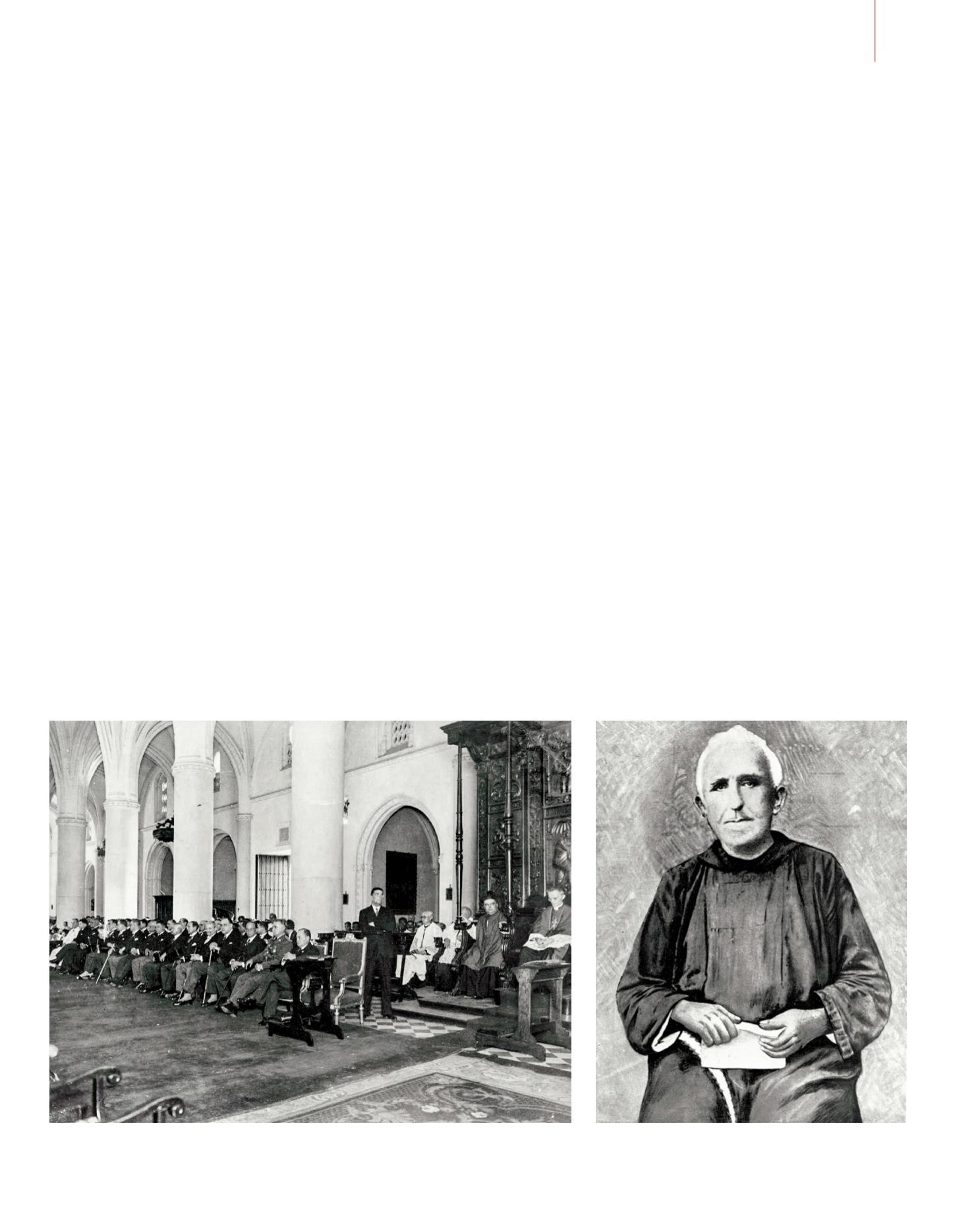
The interior of the
First Cathedral of the
Americas. From right:
Monsignor Ricardo
Pittini, Monsignor
Eliseo Pérez Sánchez
and in the front
row, first, Jacinto
Bienvenido Peynado.
© Archivo General de la
Nación
Father Francesco
Fantino Falco.
© Archivo General de la
Nación