


 141 / 540

THE ITALIAN LEGACY IN THE DOMINICAN REPUBLIC
140
Until 1959, the anti-Communist ideology of most U.S. government officials, Do-
minican elites, and Catholic Church officials (both in the Dominican Republic and the
Vatican) convinced them that support of the virulent anti-Communist Trujillo dicta-
torship was their best chance at keeping the Dominican Republic free of Communism.
The progressively increased brutality of Trujillo’s regime during the 1950s, howev-
er, coupled with the success of Fidel Castro’s Cuban Revolution on January 1, 1959,
convinced many of Trujillo’s supporters that rather than keeping Communism out of
the Dominican Republic the dictator was setting the stage for a Communist takeo-
ver of the island. Therefore, in 1959, the Vatican, led by Pope John XXIII, who had
been elected the previous year, sought to distance itself from Trujillo’s dictatorial
regime. On June 14, 1959, the Vatican appointed Lino Zanini as papal nuncio in the
Dominican Republic to implement the change in the Vatican’s foreign policy. Zanini
arrived in the Dominican Republic on October 25, 1959, which was the day after the
dictator’s birthday (a major event celebrated throughout the nation). Zanini, who
departed Rome on October 20, could have arrived in time for the celebrations but de-
liberately decided to visit Puerto Rico for a few days so as to avoid praising the dicta-
tor during the celebrations.
20
According to the 1954 Concordat, the papal nuncio was
the dean of the diplomatic corps in the Dominican Republic and would have been
required to play a prominent role in the celebrations. According to Betances, “In symbolic terms, the Church
sent a message to Trujillo saying that relationships between the Vatican and his regime had changed.”
21
Political scientist Jonathan Hartlyn, acknowledging that for most of his tenure Pittini was “an open admir-
er of Trujillo and provided unequivocal support for his regime,” posits that an “open break” between Trujillo
and the Church finally came in January 1960, “in the form of a pastoral letter” that was read at Mass.
22
Zanini’s
presence in the Dominican Republic was the catalyst for this collective pastoral letter. According to Wiarda,
“The bishops declared their solidarity with the many families bereaved by the arrests of loved ones. A long
section was devoted to an assertion of human rights which, the letter said, “had priority over the rights of any
state.”
23
Significantly, “the letter mentioned neither Generalissimo Trujillo nor his brother, President Hector
B. Trujillo, by name.”
24
Although by today’s standards the tone of the pastoral letter was moderate: “In the
context of the Trujillo dictatorship it was a political challenge to a regime that did not permit any kind of dissi-
dence.”
25
Pope John XXIII declared that the Vatican agreed with the pastoral letter published by the bishops in
the Dominican Republic.
26
Although the pastoral letter marks a turning point in the church-state relationship,
it did not lead to a complete rupture in relations between the Church and the Trujillo regime. In retaliation,
the Trujillo regime declared Zanini
persona non grata,
and he left the country in May 1960. Trujillo insisted that
“the Church grant him the title Benefactor of the Dominican Church, but the bishops refused.”
27
Tensions
between the Trujillo regime and the Church continued for the next year. On May 29, 1961, Trujillo ordered
the arrest of Bishops Panal and Reilly, the most outspoken clerical critics of the dictatorship. The two bishops,
however, were not arrested, because Trujillo was assassinated two days later.
28
Frail and blind, Pittini died on December 10, 1961 in Santo Domingo. According to his wishes, he was
interred inside the Church of San Juan Bosco (a few blocks north of the Presidential Palace in Santo Domin-
go), which was constructed during his tenure. He was succeeded by Beras Rojas, his adjutor archbishop, who
served as archbishop for the next two decades. A street in the San Juan Bosco neighborhood of Santo Domin-
go, the Calle Monseñor Ricardo Pittini, was named in his honor. According to Betances speaking of his legacy:
“The ecclesiastical government of Pittini laid the modern basis of the church in the Dominican Republic. He
expanded the institutional basis of the church from one to five dioceses, created a minor seminary, and in-
creased the number of Catholic schools and services organizations. In addition, he conducted the negotiations
that led to signing the concordat that framed church-state relations until today.”
29
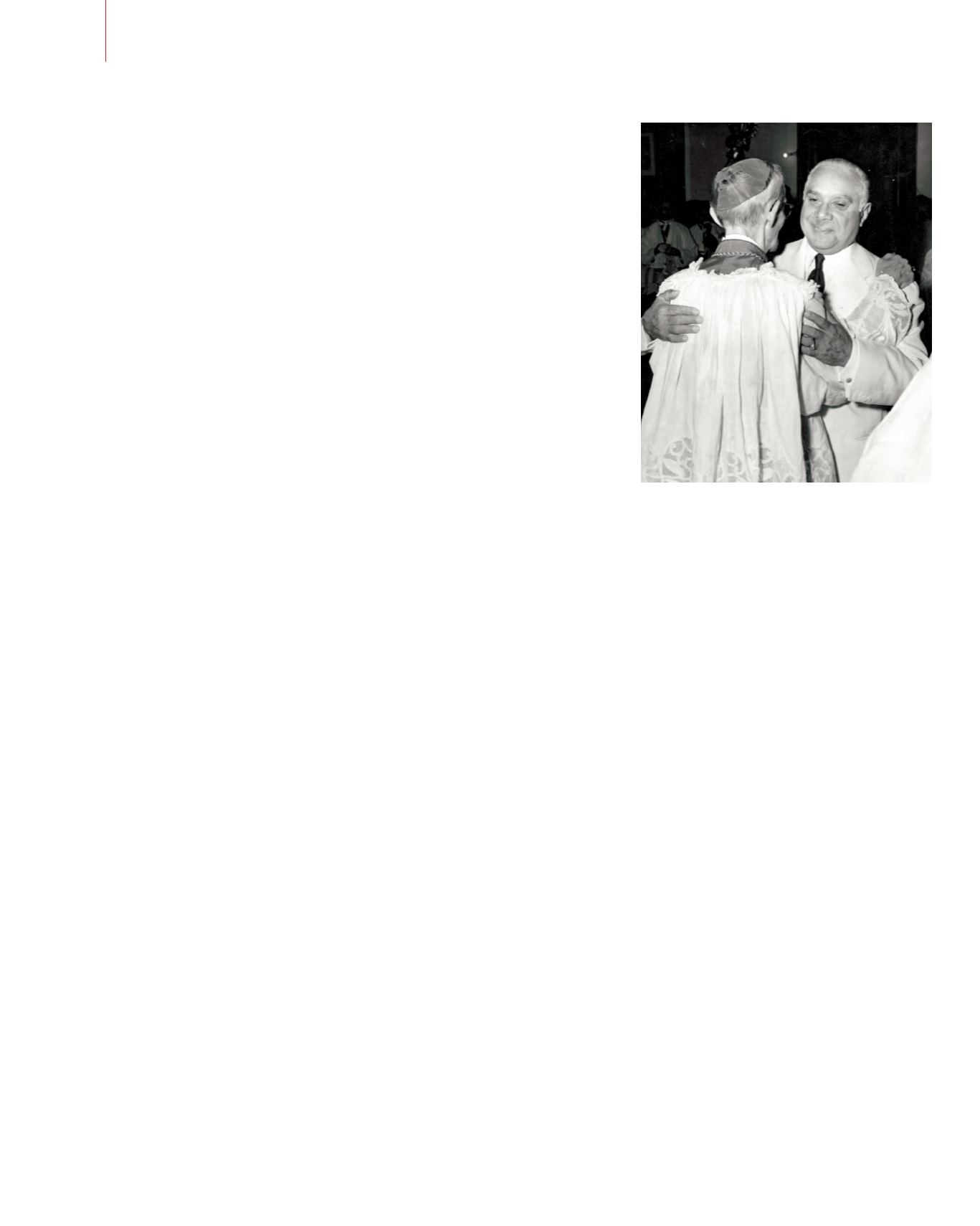
Representative of
the close relationship
between Church and
state in the Dominican
Republic during the
Trujillo dictatorship,
Pittini and Trujillo
embrace after Mass in
1954.