


 147 / 540

THE ITALIAN LEGACY IN THE DOMINICAN REPUBLIC
146
Early Life
Some Dominican historians who have writ-
ten about Juan Bautista Cambiaso have not
been able to specify the date on which this
Italian-Dominican hero first arrived in the
Spanish part of the island of Santo Domin-
go. It is curious that the national historian
José Gabriel García, who knew him per-
sonally, did not obtain precise data regard-
ing his arrival. Rufino Martínez notes that
Cambiaso “came to the colony very young
... [that] during the Haitian Occupation he
devoted himself to business [and that] he
had some practice in seamanship.”
3
The
expression “very young” used by Martín-
ez makes it reasonable to conjecture that
Juan Bautista arrived in Santo Domingo
when he was barely a young man and with
little professional experience, but unfortu-
nately, it tells us little about the skills that
he acquired in the field of seamanship and
maritime trade. If we start from his date of
birth, as recorded in his baptismal certifi-
cate, we must agree that Cambiaso arrived
in Santo Domingo during the late stage of
Haitian occupation,
i.e.,
toward the end of
the 1830s, when he was 15, or perhaps a bit
older.
4
During the 1830s, Italy was shaken
by a nationalist revolutionary movement,
led by Giuseppe Mazzini, among others,
who under the motto of “God and People”
fought for the unification of the various
Italian kingdoms and states before pro-
ceeding to the creation of an independent
republic. According to Emilio Rodríguez
Demorizi, there is an admirable parallelism
in the public careers of Giuseppe Mazzini
and Juan Pablo Duarte. Both revolutionar-
ies embodied and espoused ideas of republicanism and independence in their respective homelands, and
they dedicated their entire lives, “to the exclusion of all other endeavors, to the ideas of freedom that con-
stituted the purpose and the sole and vehement aspiration of these twin souls.”
5
These political ideas were certainly not alien to the Cambiaso brothers when they settled in the
country. What might have impelled them to migrate to Santo Domingo? There must have been a point of
reference at the dawn of the nineteenth century regarding the favorite island of the famous Genoese navi-
gator, Christopher Columbus, on the grounds that Italians had established themselves there from the initial
period of the Reconquest. It can be concluded, therefore, that Juan Bautista and Luis Cambiaso—who were
engaged in maritime trade—first arrived in the Caribbean region, via Saint Thomas, attracted by business
Opening page:
Painting of Admiral
Juan Bautista
Cambiaso, preserved
in the Academy
of Cadets of the
Dominican Navy,
whose copy was
donated by the
Dominican Navy to the
Italian Embassy during
the Italian national
festivities in Santo
Domingo on June 2,
2019.
© Dominican Navy
Page 145:
Cambiaso Letter
1/ From Juan Bautista
Cambiaso to Carlos
Nouel. Saint Thomas,
March 16, 1866.
AGN, Carlos Nouel
Collection. It gives an
account of the private
efforts made by the
former in relation
to the agreement
of a debt payment
belonging to the latter
in Saint Thomas;
Cambiaso was on his
way to Genoa, Italy,
where he was born.
© Archivo General de la
Nación
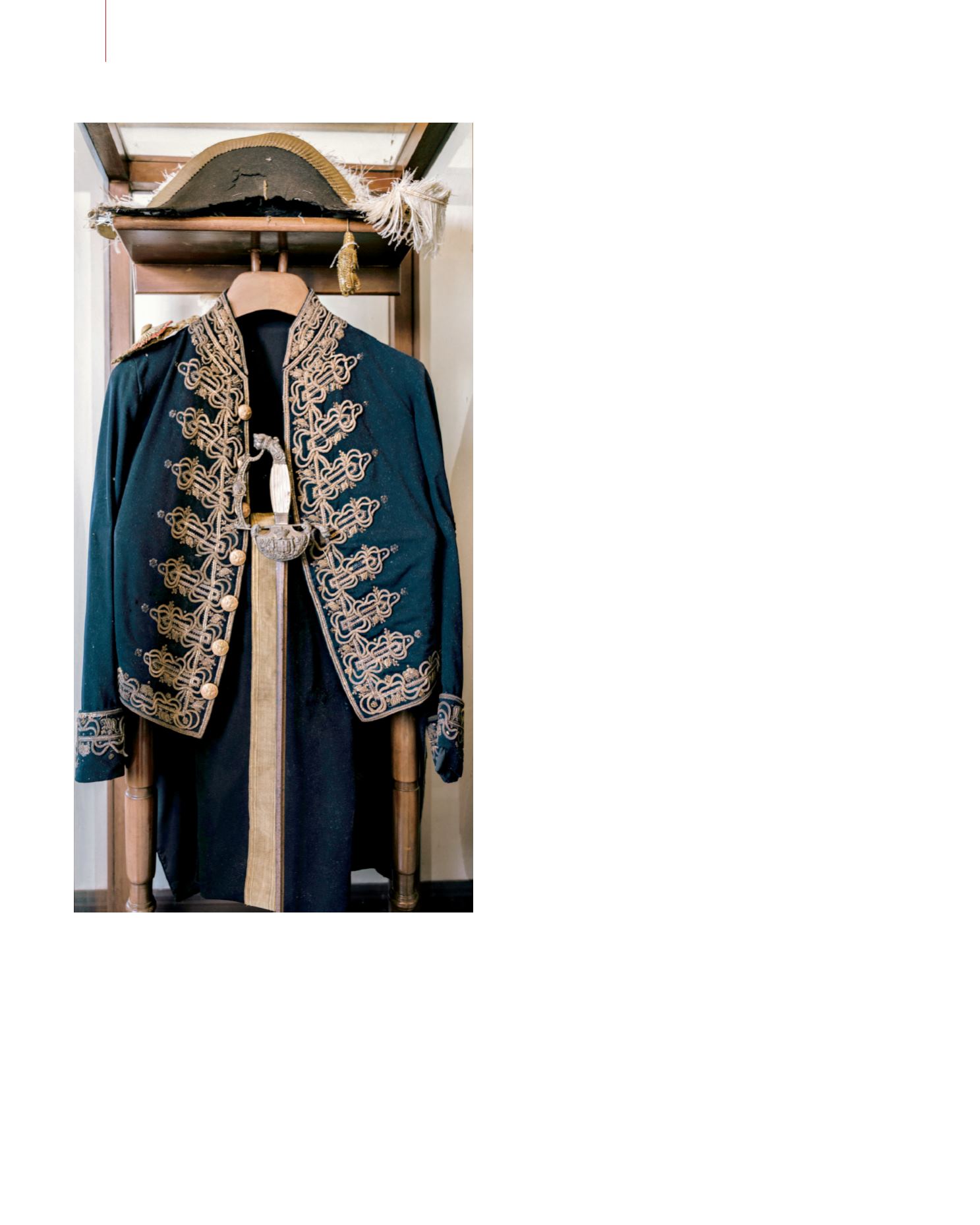
Uniform of the
First Officer of the
Navy, Admiral Juan
Bautista Cambiaso,
safeguarded by
his descendants,
the Porcella family
members.
© Giovanni Cavallaro