


 149 / 540

THE ITALIAN LEGACY IN THE DOMINICAN REPUBLIC
148
trade business, through the Cambiaso Hermanos y Compañía firm; others—in the 20th century—chose
military careers, especially in the Dominican Navy, and there were those who devoted themselves to intel-
lectual pursuits and journalism.
8
Creation of Armed Naval Flotilla
On February 27, 1844, the Dominican people declared their independence, ended Haitian domination,
which had lasted 22 years, and created a sovereign and democratic state under the name of the Dominican
Republic. Despite this milestone, the Haitians did not accept the Dominicans’ will to govern themselves
independently and declared war to the death of “the seditious citizens of the east.” This forced Dominicans
to prepare militarily for the defense of the new State, which is why the Central Governing Board, the first
provisional government, proceeded to create the National Army, as well as a small fleet of ships with which
to face the imminent Haitian military aggression. It was at that historical juncture when Juan Bautista
Cambiaso gained prominence, since, according to the historian José Gabriel García, it was Cambiaso who
was credited with founding the first armed naval flotilla of the Republic. How could Cambiaso undertake
such a task in a country without military institutions? To achieve his goal, Cambiaso took brigantines and
private schooners, which were used for commercial purposes, and turned them into warships that provided
an effective addition to the troops of the improvised national army. In this way, while the Dominican army
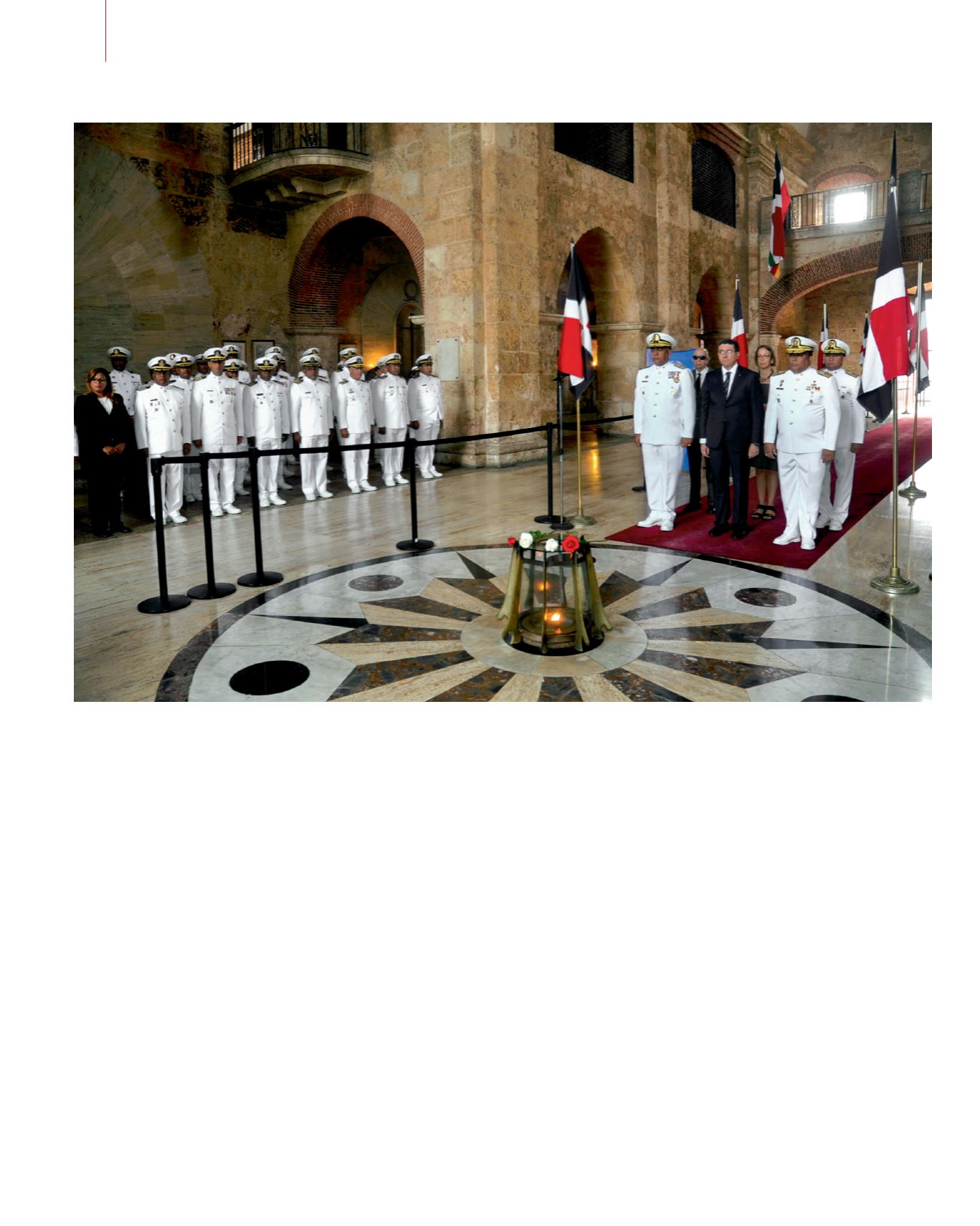
On June 21, 2018,
the Embassy of Italy
and the Dominican
Navy celebrated,
for the first time,
the anniversary of
Admiral Juan Bautista
Cambiaso’s death, at
the National Pantheon;
in attendance: H.E.
Andrea Canepari,
Ambassador of Italy in
Santo Domingo; Mrs.
Roberta Canepari; and
Vice Admiral Miguel
Peña, commander of
the Dominican Navy.
© Courtesy of Listín Diario