



 150 / 540

149
repelled the invading forces, the incipient naval flotilla prevented, in a combined operation, Haitian ships
from supporting their own ground army.
On the recommendations of Cambiaso, the Dominican government acquired ships and weapons in
such a way that, by 1846, a naval flotilla was formed that was capable of staving off the enemy’s attempts
at invasion. According to a memorandum from General Manuel Jimenes, then Minister of War and Navy,
“The Dominican fleet today consists of ten vessels, seven from the State and three taken on requisition and
armed by the government ..., [namely], the frigate Cibao, the schooner Brig San José, the gullet schooner La
Libertad, the schooners General Santana, La Merced, Separación, 27 de Febrero, María Luisa, 30 de Marzo,
Esperanza. […] This flotilla is under the command of Navy General J. Cambiaso[…].”
9
In the beginning,
the fleet operated as a division of the Army and, therefore, was subordinate to General Pedro Santana, but
later it became part of the Ministry of War and Navy. After several years, during the annexation to Spain,
the Dominican Naval Flotilla, like the Army, was dissolved by the Spanish authorities, who proceeded to
auction off the ships used to defend the country during the Dominican-Haitian war.
10
Throughout the Dominican-Haitian war, which lasted 12 years, Juan Bautista Cambiaso was a front-line
soldier in defense of the republic. As a sailor, he participated in some of the most decisive battles, including
those at Azua (1844), Beler (1845) and Las Carreras (1849), in each of which the Dominican naval flotilla
under his command had a decisive role in the triumph of the nation’s armed forces. After the battle of
Azua, the Tortuguero naval combat ensued, the first of its kind between Dominican and Haitian warships,
which occurred on April 15, 1844, and in which the fleet commanded by Cambiaso emerged victorious.
11
The same outcome occurred the following year, during the Battle of Beler, in the north of the country,
where the Dominican schooners and brigantines ensured the triumph of the local army. Later, in 1849, the
presence of Cambiaso at the command of the corvette Cibao contributed significantly to the triumph of
the battle of Las Carreras. Years later, during the fourth and final campaign of the Dominican-Haitian War,
Cambiaso’s action in a combat on January 6, 1856, would prove legendary, due to the abandonment of the
Plaza de Barahona by Colonel Bernabé Polanco. General Cambiaso, in command of four warships, pro-
ceeded to Enriquillo to provide assistance to General José María Cabral, whose troops were stationed there.
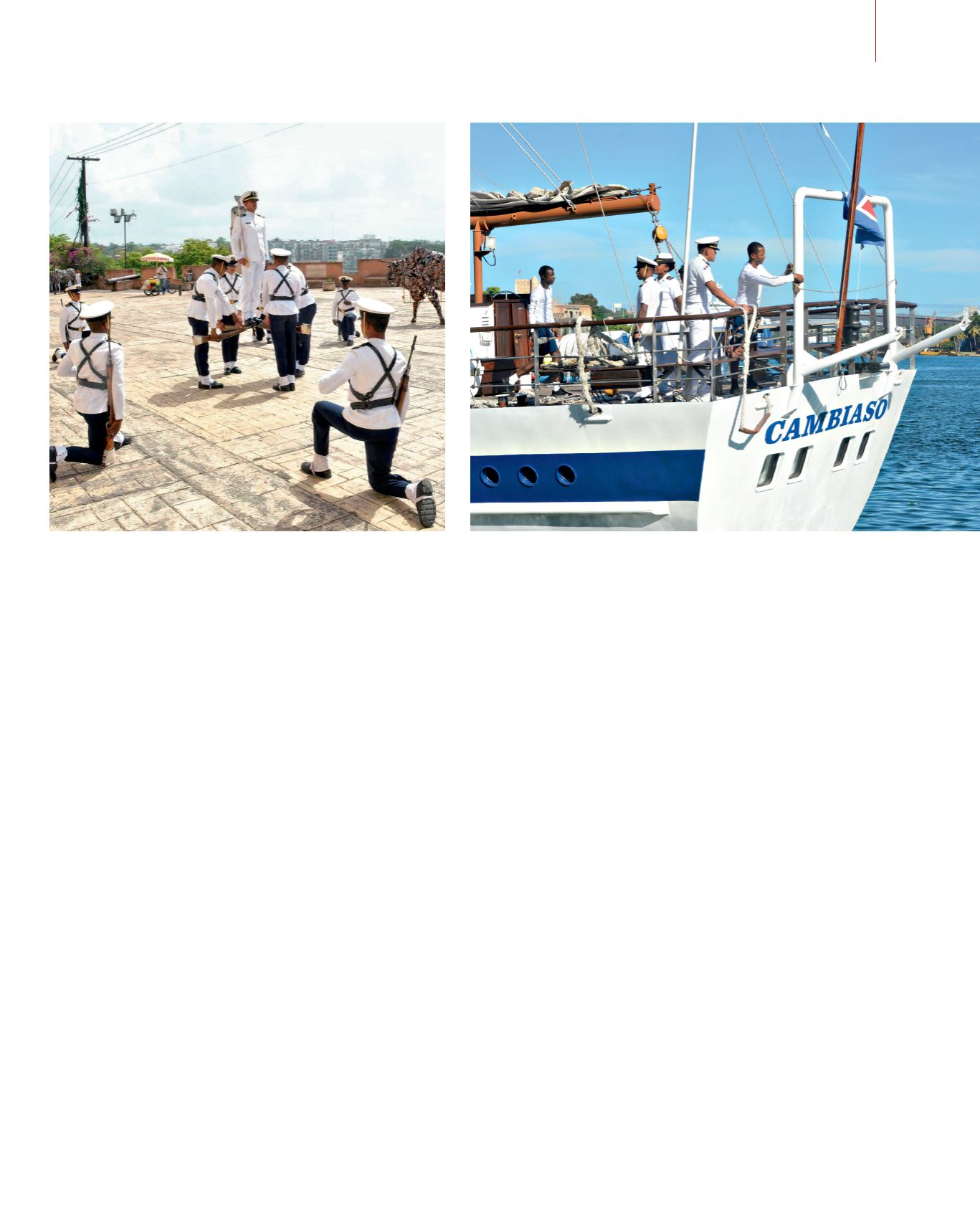
Demonstration by
the Dominican Navy
Academy cadets as
part of the second
round of celebrations
in honor of Admiral
Cambiaso, organized
jointly by the Italian
Embassy and the
Dominican Navy.
© Courtesy of Listín Diario
First School Ship
of the Dominican
Navy, dedicated to its
founder, Admiral Juan
Bautista Cambiaso.
© Armada Dominicana
JUAN BAUTISTA CAMBIASO (1820-1886)