


 478 / 540

477
contained photos, information, and various items belonging to different families from the Italian community.
Afterward, the Casa de Italia published a beautiful catalogue on these exhibitions.
Casa de Italia also opened its doors for the presentation of classics of Italian cinema, and it was also very
actively involved in various international book fairs, sponsored by the Ministry of Culture at the Plaza de la
Cultura in Santo Domingo.
With regard to fundraising activities for Casa de Italia, Italian food festivals and gala dinners were organ-
ized. These events were very popular among the members of the community and with the public in general.
Various restaurants from the capital participated in these events, as did the Punta Cana Beach Resort and Casa
de Campo in La Romana. These activities were headed by the Women’s Committee. It is also important to
mention the institution’s exciting Christmas activities, including the exhibition of crèches from different parts
of the world (North, South and Central America, Europe, Africa and Asia), which were the property of Do-
minican collectors Neidy Pons and Estela de Mella. There were also activities for children including Christmas
carols and concerts with traditional themes from the season.
It is noteworthy that as an institution, Casa de Italia has made its space available to various public and pri-
vate institutions as well as foreign ones. Some of the most important institutions represented include Las Da-
mas Diplomáticas, the European Community, the Italian Embassy, the Dominican-Italian Handicrafts Group,
Listín Diario Awards, the National Council for the Blind, the Nosside Poetry Foundation, the Dominican
Navy, the Colonial City Council, the Federation of Cinema Clubs, Lamiere Awards, Monumental Heritage,
and the Foundation of Professionals for the Development
of the Dominican Republic.
Finally, for more than 25 years, Casa de Italia has been
an invaluable institution in terms of creating unity and a
point of reference for the Italian and Italian-Dominican
community within the country. It has been the “Mon-
ument of Italian Culture”
wherein all of the significant
events have been celebrated, including Italian Immigrant
Day, as instituted by a Decree from the President of the
Dominican Republic, as well as Italian Republic Day,
which celebrates the formation of the Italian Republic.
No less important has been the Escuela de Italiano
Italian language school, a very positive institution for our
community and for Dominicans who want to learn the
melodious language of Dante and Petrarch. The children
of Italian Dominicans, the Dominican spouses of Italian cit-
izens, students who go to study abroad in Italy, and those who are preparing to work in the field of tourism
have all been our students. The complete curriculum is taught in five cycles, and our teachers are all Italian.
Before concluding, we must recall the closure of the Embassy of Italy in Santo Domingo, which took place
in December of 2014. During the two and a half years that the Embassy was closed, Casa de Italia was the only
Italian institution that remained active in the nation and which kept the Italian flag displayed continuously
along its main façade.
Although we did not have any type of official authorization, we were available to assist anyone who con-
tacted our institution for information or guidance. At the same time, the Board of Directors decided to devote
all of its efforts to fight for the reopening of our Embassy. An
ad hoc
committee was created, and supported by
partners, and we embarked on the task at hand.
On January 1, 2014, when we learned about the decision for closure, we sent the first letter of protest to the
Italian government through the embassy. We wrote to all the officials from the Italian government without
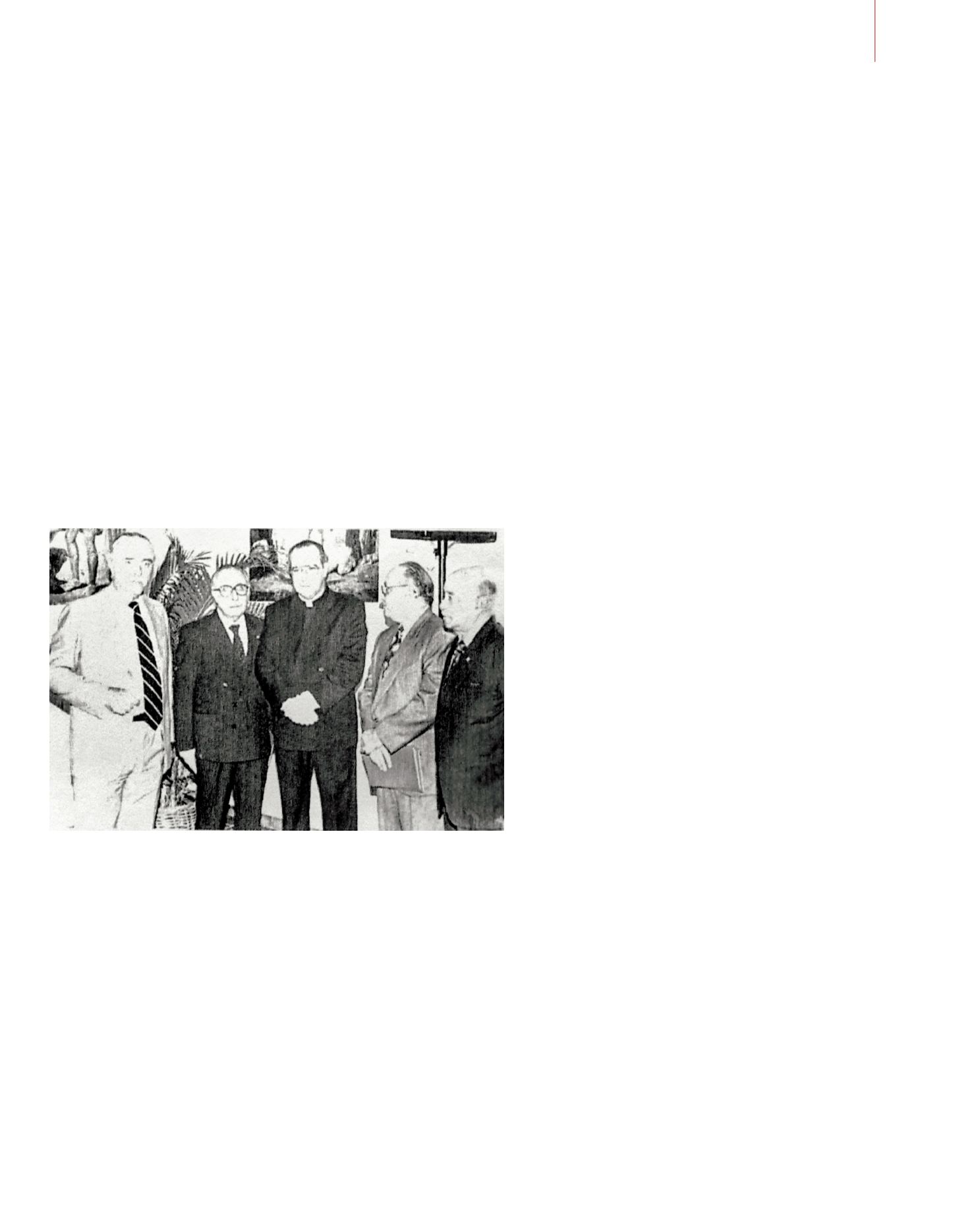
The inauguration
of Casa de Italia on
June 24, 1994.
Among those present
were Vincenzo
Mastrolilli, Ambassador
Tomaso de Vergottini,
and Cardinal Nicolás de
Jesús López Rodríguez.
© Giovanni Cavallaro
A BRIEF HISTORY OF THE CASA DE ITALIA, INC. IN SANTO DOMINGO