


 475 / 540

THE ITALIAN LEGACY IN THE DOMINICAN REPUBLIC
474
in 1979, and which remained very active throughout the
following decade.
In his role as president of the Instituto Cultural
Domínico Italiano, Inc., he sent a letter to the president
of the Dominican Republic, Dr. Joaquín Balaguer, on
December 2, 1987, asking for the donation of a site for
Casa de Italia within the Ciudad Colonial sector of San-
to Domingo. This request was sent to the president by
the Ambassador of Italy to the Dominican Republic, Dr.
Antonio Venturella, on December 21, 1987, with his ap-
proval. Shortly thereafter, on February 9, 1988, by means
of Official Letter No. 5533, Dr. Rafael Bello Andino, the
Dominican secretary of state replied:
The Honorable President Dr. Joaquín Balaguer has acknowledged your letter dated December 21,
1987, which accompanies the communication from the president of the Instituto Cultural Domínico
Italiano, Inc., and has granted his approval for a building to be assigned to the Casa de Italia within the
Colonial Zone of Santo Domingo as part of the celebration of the Quincentennial of the Discovery and
Evangelization of the Americas.
On November 14, 1988, at the site of the Embassy of
Italy, the Casa de la Cultura Italiana was founded with the
approval of Ambassador Antonio Venturella. The found-
ing partners from the association were Rolando Forestieri,
María Catalano Gonzaga de Thayer, Vincenzo Mastrolilli,
Delgis Nardi de Rivera, Giovanni Vicini, Rosa María Vicio-
so de Mayol, and Rafael Villanueva.
On December 16, 1988, Dr. Rafael Bello Andino gave
notice that the house selected for these purposes “is locat-
ed at Calle Hostos 308 at the corner of Calle Luperón in
the Colonial Zone. This house has historical significance,
as it served as the residence of General Pedro Santana, the
former President of the Dominican Republic.”
Afterward, the planned donation of the house was re-
cast as usage rights, for thirty years, on the belief of the
Office of Cultural Heritage, officials, and other technicians
that this residence was too connected with the nation’s his-
tory, given that it had been the residence of the first con-
stitutional president of the Dominican Republic, General
Pedro Santana, and it therefore must not be donated.
In November of 1991, Ambassador Roberto Rossellini
and architect Jorge Amaury Cestari Carbuccia were legal-
ly authorized to sign a usage contract for thirty years, in
which it was specified that the building at Calle Hostos
308 would be conferred as soon as the Office of Cultural
Heritage completed the restoration and it was in perfect
working condition.
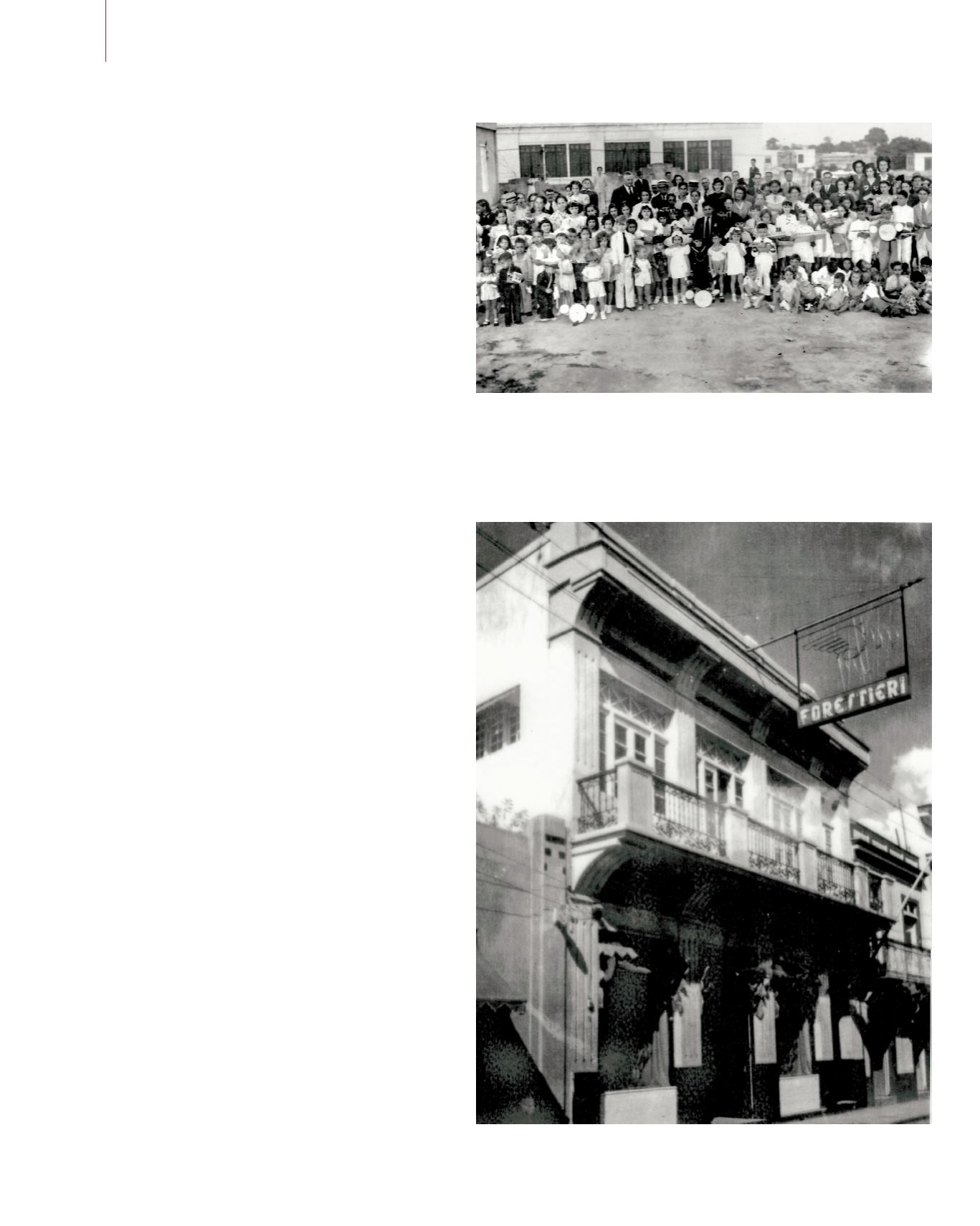
Children following
the Italian tradition,
celebrating the Befana
at Casa de Italia. Date
unknown.
© Rolando Forestieri