


 477 / 540

THE ITALIAN LEGACY IN THE DOMINICAN REPUBLIC
476
Grisolia titled
Suggestions: The Imagination of an Interpreter
organized by Fortunato Castagna; an exhibition of
lithographs by Italian masters from the 10
th
century; and that of Neidy de Seravalle titled
Marian Icons
, forged
from metal, etc.
Likewise, over the years, exhibitions have been presented by prominent Dominican artists, including the
exhibition of paintings by artist Guillo Pérez titled
50 Years of Art
; exhibitions by the painters Ada Balcácer
and Elsa Núñez; exhibitions by Cándido Bidó, Benjamín Paiewonsky, Guadalupe, and Valenzuela; and the
exhibition titled
Dopo Carnevale
by Cristian Martínez. Moreover, a significant number of new artists, painters,
and sculptors beginning their cultural pursuits have been introduced in the Casa de Italia, finding there both a
home and an art gallery to host solo and group exhibitions alike.
Furthermore, many keynote presentations have been held within the confines of Casa de Italia, including
those of Admiral De Windt Lavandier on “Italians in the Navy” and the architect César Iván Feris Iglesias on
the subject of “Art During the Italian Renaissance.” Another prominent professional in the field of architec-
ture, Eugenio Pérez Montas, gave a lecture titled “The Foundation of the City of Santo Domingo.”
A conference on issues surrounding the interesting and current topic of water was also held there by the
Italian senator Pedrini, as well as “The Julius Caesar Conspiracy” presented by jurist Dr. Carlos Balcácer. Dr.
Eduardo Mejía Jabid, the Consul General of Greece in the Dominican Republic, spoke on the topic of “The
Contribution of Classic Greco-Roman Medicine.” The notable Italian senator Paolo Emilio Taviani discussed
Christopher Columbus, the subject of his book that he also circulated during this event. Recently the architect
Jesús D´Alessandro presented on “The Reconstruction of
the National Palace.”
Finally, there have been conferences presented by Dr.
Rolando Forestieri on various topics, among which were
included the bicentennial of the celebrated Italian compos-
er, Giuseppe Verdi; a lecture on the “Centenary of the Ital-
ian Victory in World War One (1918-2018)”; a conference
on “Italian Academies”; a lecture on the “Significance of
Republic Day in Italy”; and a lecture devoted to the multi-
faceted genius of the Italian Renaissance, Leonardo da Vin-
ci. Another conference was planned in the rooms of Casa
de Italia on this amazing individual to commemorate the
5
th
centenary of his death in 1519. Also considered was the
exhibition of books related to the subject as well.
We must not fail to mention the very interesting ex-
hibition titled
1992-2002: Ten Years of Anthropological and
Archaeological Research in the Dominican Republic
presented
by Italian scientists at Casa de Italia. Six pre-Columbian col-
lections were exhibited with the collaboration of the Na-
tional Museum of Natural History. Since 1998, this Italian
mission has received support from La Sapienza University
of Rome, the Italian Ministry of Foreign Affairs, and the
Italian Ministry of Education. It has also had the support of
the Center for Research and Projects of National Interest
to Italy and from the Costa Foundation of the Dominican
Republic.
Other clear evidence of the relationship between Italy
and the Dominican Republic were the two exhibitions on
Italian Families in the Dominican Republic
. These exhibitions
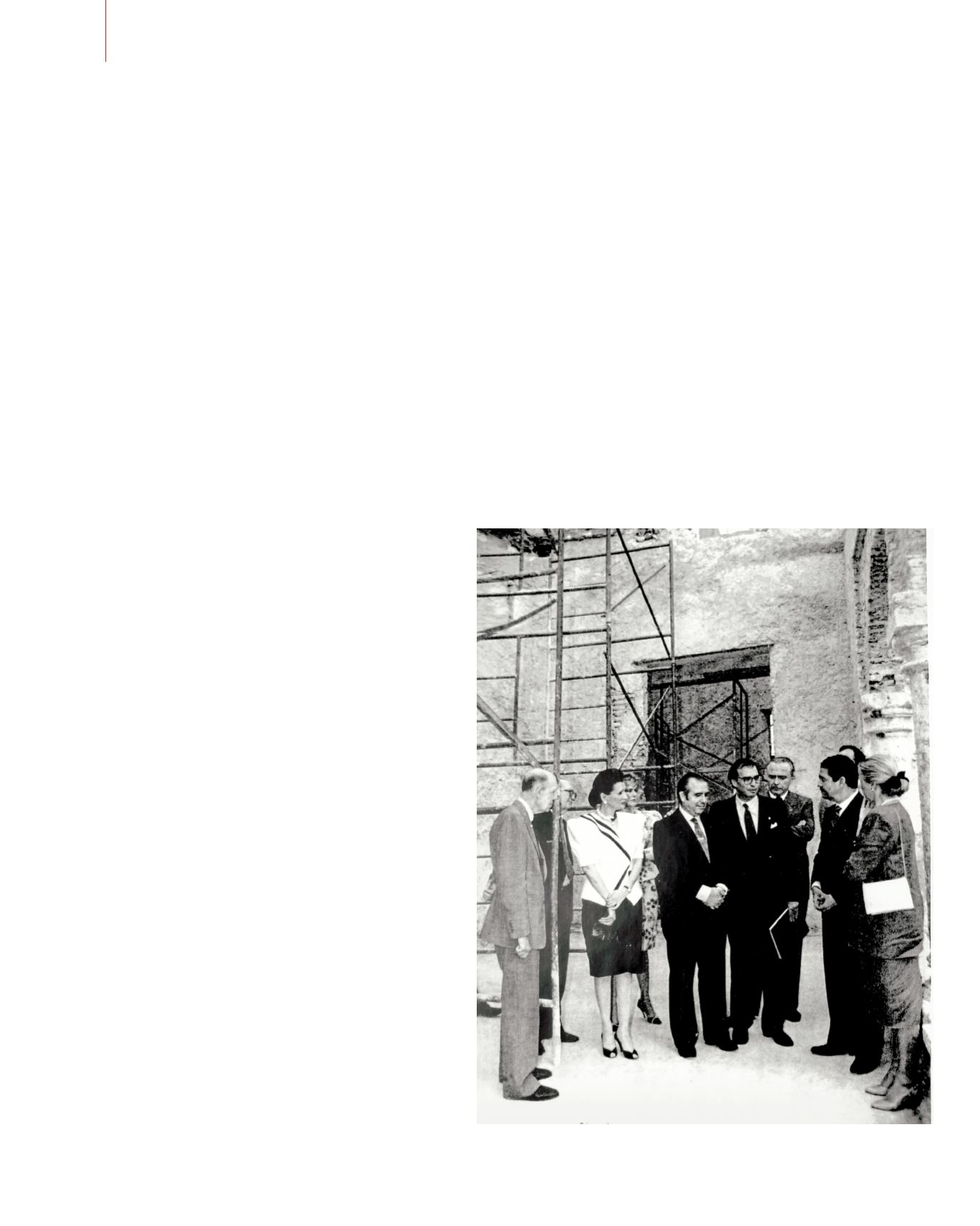
Ambassador Venturella
introducing Professor
Rolando Forestieri
to Bello Andino, the
Secretary of State.
From left to right:
Giovanni Battista
Vicini, Rosa María
Vicioso de Mayol,
Rolando Forestieri,
Ambassador
Venturella, Vincenzo
Mastrolilli, Rafael
Bello Andino, and
Rosalba de Venturella.
November 1998.
© Giovanni Cavallaro