


 483 / 540

THE ITALIAN LEGACY IN THE DOMINICAN REPUBLIC
482
As a way to help the extended family, he decided to
send for his brother Mario, who was a professional chef;
he also invited his cousin Julio, a great ice cream maker,
and his brother-in-law Vincenzo, a tireless worker who
could be useful for the business. This approach, howev-
er, ultimately failed, because these family members ex-
pressed little interest in staying in the country. Instead,
they settled in New York where they made their lives
with their own lucrative gastronomic projects.
Success for Annibale came relatively quickly. The
family business needed to expand. To build a new ven-
ue for the restaurant, he requested DOP 10,000.00 from
the Banco Agrícola. It was also alleged that Joaquín
Balaguer
2
decided to help him, recognizing in this young
businessman a zeal to succeed. Annibale’s wife, Imma-
colata, was so grateful to the official that, from then on,
until his death, she sent him mozzarella, ricotta, zuppa
inglese, and cassata every week.
Through this gesture, Immacolata demonstrated to
her children how gratitude was a quality to cultivate. After all, the Bonarellis were eternally grateful to a coun-
try that had welcomed them with open arms.
The business was a family project, and everyone worked diligently. The head of the family, Annibale, was
the chef. A lifetime working in the food business allowed him to put what he had learned into practice. Imma-
colata served as the cashier, and from there she directed everything. Their children say that she was the law,
the baton, and the very backbone of the family.
Their success was considerable. At the time, the gastronomic scene in Santo Domingo was extremely
limited. There was only a smattering of Chinese restaurants among the more popular Criollo restaurants. The
appearance of El Vesuvio gave the upper and middle classes a new venue for fine food. Many claim that in the
1960s people would dress in their finest and go out to enjoy an evening at this new establishment.
The ambassador of the United States during this time, John Bartlow Martin, commented in his memoirs
that El Vesuvio had become a barometer of the country’s economic and political situations. The Ambassador
wrote that at the time of the assassination of the Dictator Rafael Leónidas Trujillo (the night of May 30, 1961),
“even at El Vesuvio there was little movement.”
Over time, El Vesuvio became a veritable culinary school for the country. In the absence of trained staff,
Don Annibale taught many young people how to serve customers, prepare drinks, and even cook. Many of
those who passed through his kitchen would later become the chefs at other restaurants.
The success was so great that, in preparing for the Fair of Peace and Fraternity of the Free World, General-
issimo Trujillo decided to offer visitors two important culinary selections: Italian food, with a Vesuvio branch
in the area of the fair, and Spanish cuisine through the El Lina restaurant.
El Vesuvio soon became the standard-bearer for other restaurants. The eldest son of the family, Enzo, be-
gan working there even when he was quite young, but, more importantly, he accompanied his parents in the
strengthening and growth of the new company. The entrepreneurial vision of the family patriarch sparked a
desire in one of his sons to set out on his own solo journey.
In 1971, Giuseppe (Peppino) was the first of the sons to set up a separate enterprise; after purchasing a parcel
of property, he built a new culinary establishment that he called El Vesuvito. In its early days, the new restau-
rant specialized in pizza. Then he expanded his menu, introducing other dishes. Although business was good,
he wanted to explore other commercial opportunities. He decided to sell the restaurant to his brother Gaetano.
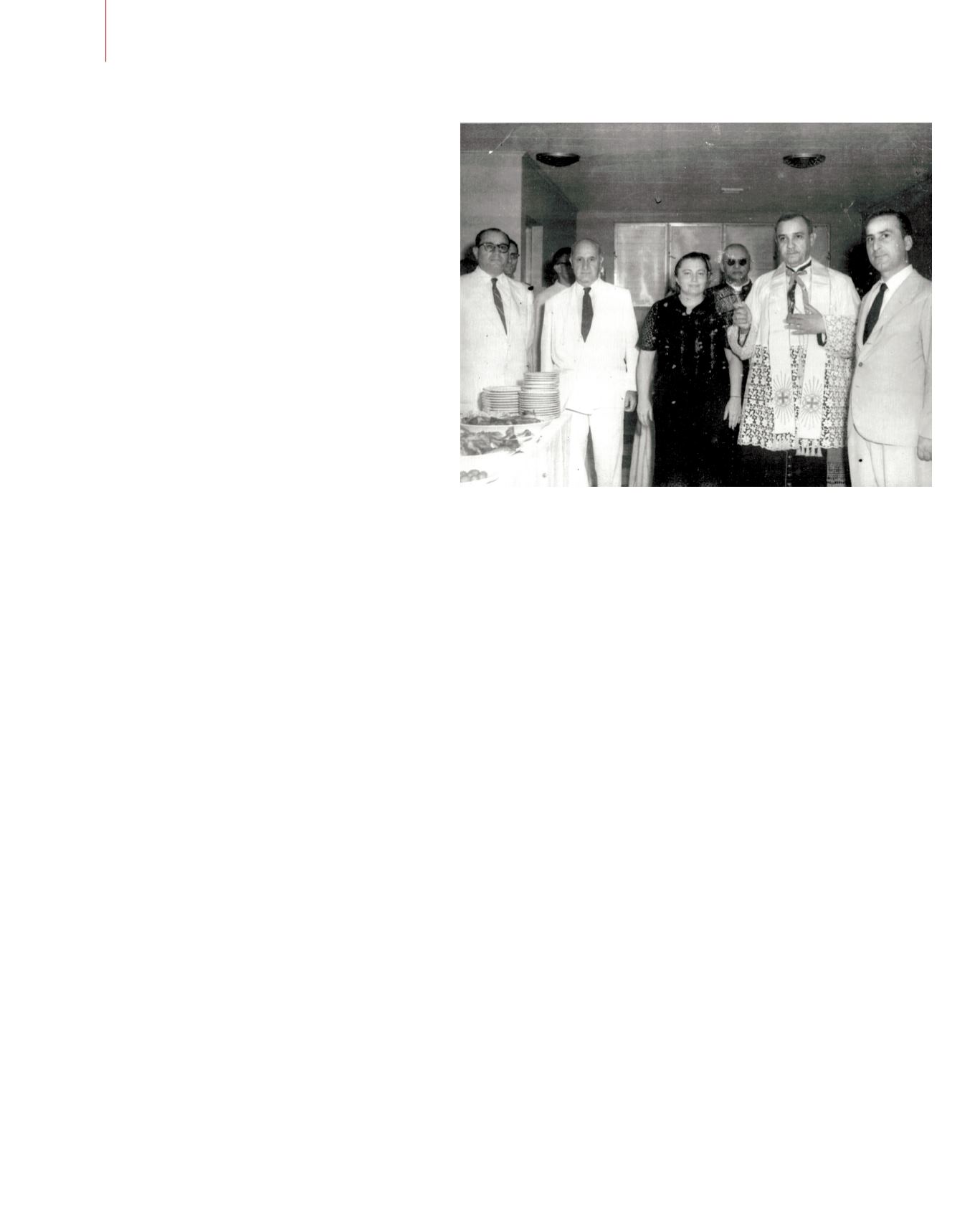
Opening of the new
Restaurant Vesuvio,
October 20, 1959.
From left to right:
Queco Rainieri
Honorary Consul of
Italy in the Dominican
Republic; Pietro Solari,
Ambassador of Italy;
Inmaculada Bonarelli;
Archbishop of Santo
Domingo, Monsignor
Beras; and Annibale
Bonarelli.
© Courtesy of the
Bonarelli Family