



 314 / 540

313
THE INFLUENCE OF THE PORTO ROTONDO MARINA ON THE CASA DE CAMPO MARINA, LA ROMANA
hoes to extract mud mixed with sand up to four meters deep near the sea. The hollow left from the extractions
was filled with an initial layer of large boulders, and later with smaller and smaller rocks, until the last layer of
about 80 centimeters, which was made with loose compacted caliche, settled in layers, until the final elevation
was established: 2.5 meters above sea level. This was also the height of the entire project, with the exception
of Piazza Portofino, which is 45 centimeters lower, making this square a natural meeting place with the glam-
ourous atmosphere of the stages Fini used in the design for the Italian Opera. The square is interconnected
by roads to the port and the docks, which have been established at 1.6 meters above sea level throughout La
Marina. The separation of the entire land-based part from the sea was carried out using concrete bulwark
panels six meters high with an inverted T base, deposited at the bottom and joined laterally by interlocking.
In order to ensure safety from flooding, a divider was inserted between La Marina and the Río Chavón in
the form of a long, thick concrete wall almost five meters high, placed along the embankment. Despite the fact
that there were many companies involved in the construction phase—which were mainly Dominican, with
each one focusing on a very specific area or task—the work was carried out in an organized manner, and har-
moniously completed three years later. The Marina was inaugurated in 2001 by Dominican President Hipólito
Mejía. The operation immediately achieved great commercial success, so much so that a year later, in 2002,
Central Romana decided to expand the port. Fini redesigned the old breakwater, modifying its height and trans-
forming it into the Paseo del Mar, a charming pedestrian promenade bordered by palm trees and gardens, with
restaurants, yacht services offices, boutiques, and culminating in a building in the shape of an old lighthouse
that is used as a restaurant and pool bar. The expansion of the Marina involved the construction of a new 1 km
breakwater, which was built in the open sea, at a depth of five meters. The operation allowed for the recovery
of an area to accommodate a shipyard and four new docks with 171 moorings, bringing the total number of La
Marina docks to 354 units. The new breakwater, the shipyard, and the four new piers with the Paseo del Mar
were inaugurated in 2006 by the subsequent president of the Dominican Republic, Leonel Fernández.
Fini’s legacy in the Dominican Republic extends beyond his many villas nestled in this prime resort location,
and the crown jewel of his work at the Casa de Campo Marina. His work was epitomized by the locals as “La
Marina,” not only for the first luxurious full-service marina on the island, but also by becoming an icon of Do-
minican pop culture that influenced the lifestyle of the latest’s generations with his platform to embrace love for
the sea. His work became the spark and proven concept of his vision of an island open to the world, surrounded
by a circuit of marinas that would lure the yachting world to rediscover this enchanted island for generations to
come. Fini made the Dominican Republic his home, and he has become a vital part of the social fabric, dedicating
his talent for art and architecture as a mentor to a new generation of brilliant architects, and devoting more time
to painting and his granddaughters, while leaving the daily task of Studio Fini in the hands of his daughter Nicola.
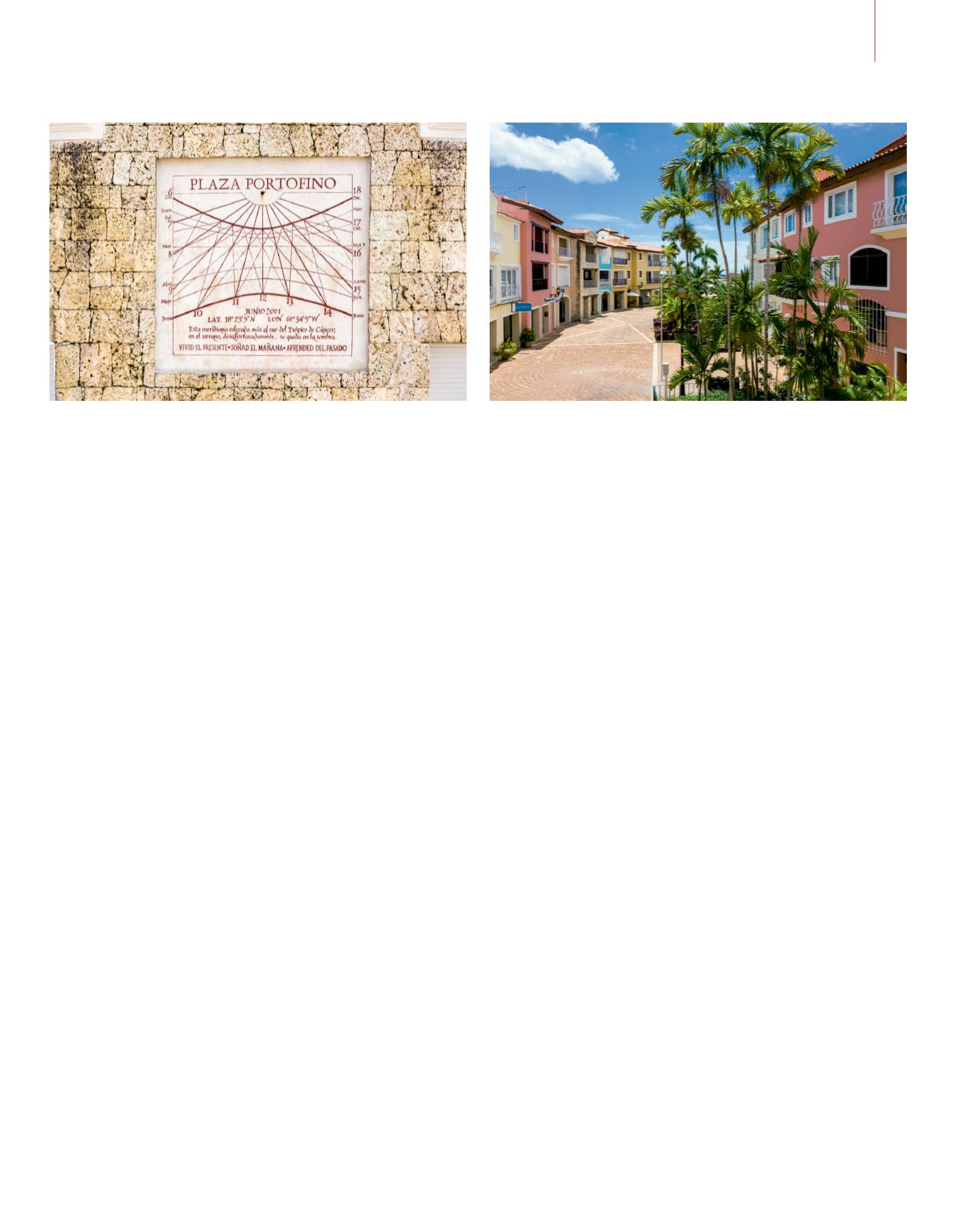
The sundial bears the
name of the square,
Piazza Portofino. The
name was given by
architect Gianfranco
Fini to recall one of the
most beautiful marinas
in the world, that of
the Ligurian village
harbor: Portofino, a
worldwide synonym
of elegance and
exclusivity and an
inspiration for the Casa
de Campo Marina.
© Thiago da Cunha
Panoramic view of
the broad “Calle
Barlovento” that leads
to the port and the
docks.
© Thiago da Cunha
Following pages:
Doors by sculptor
Thomas Gismondi in
the Cathedral Basilica
of Nuestra Señora de
la Altagracia in Higüey.
© Thiago da Cunha