


 320 / 540

319
MARCIO VELOZ MAGGIOLO: AWRITER OF ITALIAN DESCENT
of Denás’ old mother, who, impervious to the message of Christ, embraces the corpse of her son without
believing in the promise of paradise received during the crucifixion. In
Judas
(1962), the traitorous apostle
feels that he is making a sacrifice for Christ, that is, that he is predestined to play an important role in the
mechanism of salvation, and the kiss on the Mount of Olives is a symbol of gratitude for this opportunity.
However, he soon perceives that there is no great resurrection with the attendant divine glory, being forced
to accept his failure and the status of “second martyr” of Christianity. The story is made up of two letters,
which are presented as authentic, one from Judas to Father Simon and the other from his brother Moabad.
This is how Judas’s dramatic past life and courage are transmitted as “a soul that protests from eternity.”
We note that the second letter reaches the author in a French translation that was brought from Italy in the
nineteenth century by an ancestor.
La vida no tiene nombre
(Life Has No Name, 1965) takes place in the eastern
Dominican Republic during the U.S. invasion of 1916. The work revolves around a gunman by the name of
Ramón “El Cuerno,” who tells us about his life, tribulations, and motives before he was shot. Once again, a
character speaks directly: the son of a Haitian maid and object of social discrimination, he opposes the occu-
pation forces to demonstrate that he is “more Dominican” than others, as he fights for national sovereignty.
Thus, he discovers the servility and cowardice of his fellow villagers, who are sold to the gringos. Ramón kills
his abusive father and falls into the trap set by his brother, who turns him over to the Americans as a bandit
and inherits the property. Personal failure is inserted into the collective failure of rebels who are impelled to
behave like criminals.
Already in this first phase, the works of Veloz Maggiolo (as analyzed by the scholar Nina Bruni) reveal
an existentialist nature, as history is rendered a complex and opaque process when viewed with the eyes of
these silenced protagonists. If we turn now to the works of maturity, set in Villa Francisca, the capital neigh-
borhood in which the author spent his childhood and youth, we find multiple structures in which reality is
transformed into multiple realities and thus becomes richly grained and filled with contradictions. For exam-
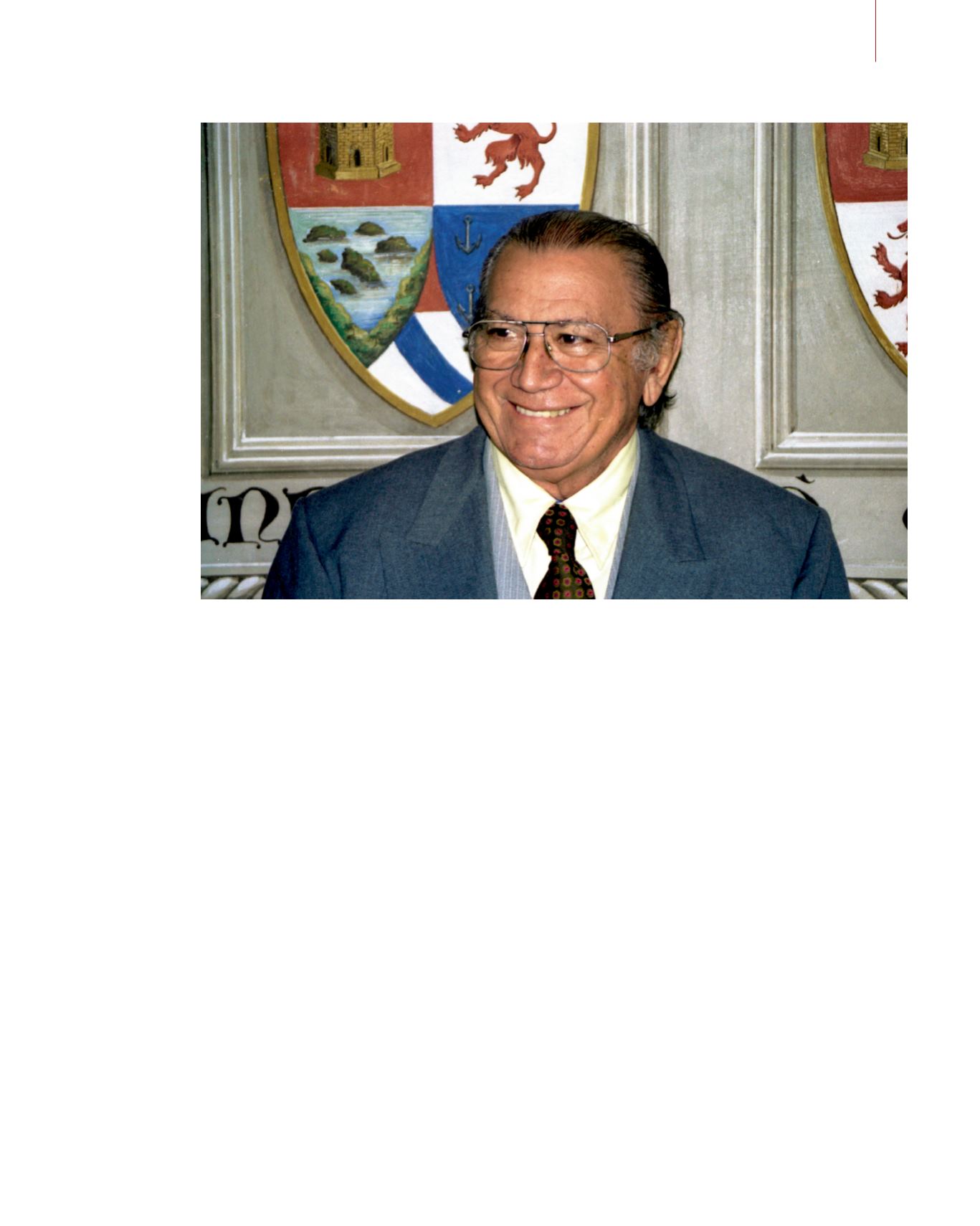
Marcio Veloz Maggiolo
during the First
Week of Dominican
Literature in Italy.
Genoa, October 2001.
© Danilo Manera