


 295 / 540

THE ITALIAN LEGACY IN THE DOMINICAN REPUBLIC
294
and I.M. Pei, where he shared an office space
with Richard Meier.
Víctor Bisonó Pichardo (March 10, 1933
- May 13, 2017).
Università degli Studi di
Roma, 1954-1965, 1966-1968
.
Born in Santia-
go de los Caballeros, Bisonó Pichardo gradu-
ated from the Colegio de La Salle in that city.
He later worked in Rome and completed his
degree in architecture in 1964. He served as
deputy director of the DNA Urban Planning
Office and director of the Monumental Heri-
tage Office. His main work in the field of res-
toration was at of the ruins of the Monastery
of San Francisco.
Manuel Polanco (October 22, 1933).
Università degli Studi di Roma, 1959-1960.
After two years of studying Civil Engineering
at McGill and Cornell Universities, Polanco
transferred to Rome and studied architecture under Pier Luigi Nervi during that extremely productive period
marked by the works for the 1960 Rome Olympics. Polanco continued to carry out projects both in the Do-
minican Republic and in Ecuador, where he has properties and family ties.
Anselmo Brache Batista (December 4, 1935).
Università degli Studi di Roma, 1953-1956. The second
Dominican to study at La Sapienza, where he completed his first two years, eventually completing his degree
at USD. Upon his arrival in Italy, the acting Dominican ambassador was César Piña Barinas, and the first sec-
retary was Cirilo Castellanos. Telésforo Calderón and Pedro Troncoso followed as ambassadors. Elías Brache,
Nicolás Vega, and Tulio Franco were at the Vatican campus. Brache served for twelve years as deputy director
general of the National Housing Institute, during which period he drafted plans for the Jobo Bonito housing
project in San Lázaro and San Miguel. He was also an official of the National Housing Bank.
Erwin Cott (November 27, 1936 - December 20, 2013).
Università degli Studi di Roma, 1956-1961. Per-
haps one of the most restless students of the “Axis” group in the 1950s. Like Gautier, he completed various
courses in Rome in order to validate his degree after leaving the classrooms of the University of Santo Domin-
go. He traveled extensively in Europe, eventually ending up in Rome and stopping in Paris, where he lived for
a time. He became a partner of Gautier in one of the most renowned firms of the 1960s, Cott & Gautier, which
had a large inventory of works of considerable significance for local culture. The firm won the competition
for the Cathedral of La Vega in the late 1960s, later executed with modifications made by the architect Pedro
Mena. He was the founder and chairman of the Society of Architects of the Dominican Republic.
José Horacio Marranzini (January 9, 1937).
Università degli Studi di Roma, 1960-1961. He was in Italy
until Trujillo’s death, prior to leaving for Madrid, where he completed his formal studies in architecture at the
Polytechnic University. He took freehand drawing with Prof. Alfredo del Fiore, at the Villa Borghese School
of Architecture, and his course of study overlapped with that of the first group of Dominican students at La
Sapienza, Rome.
Milan Lora (September 23, 1937).
Università degli Studi di Roma, 1962 - 1964. He validated his studies at
the USD, from which he eventually graduated. He is the mastermind behind numerous tourism and housing
projects, including the Sheraton Hotel on Avenida George Washington, in Santo Domingo, in asssociation
with Manuel Baquero Ricart. He also distinguished himself as a perspective artist.
Christian Martínez Villanueva (March 5, 1939).
Università degli Studi di Roma, 1961 - 1967. He took
courses in architecture and interior design. In his productive professional career, he has had the opportunity to
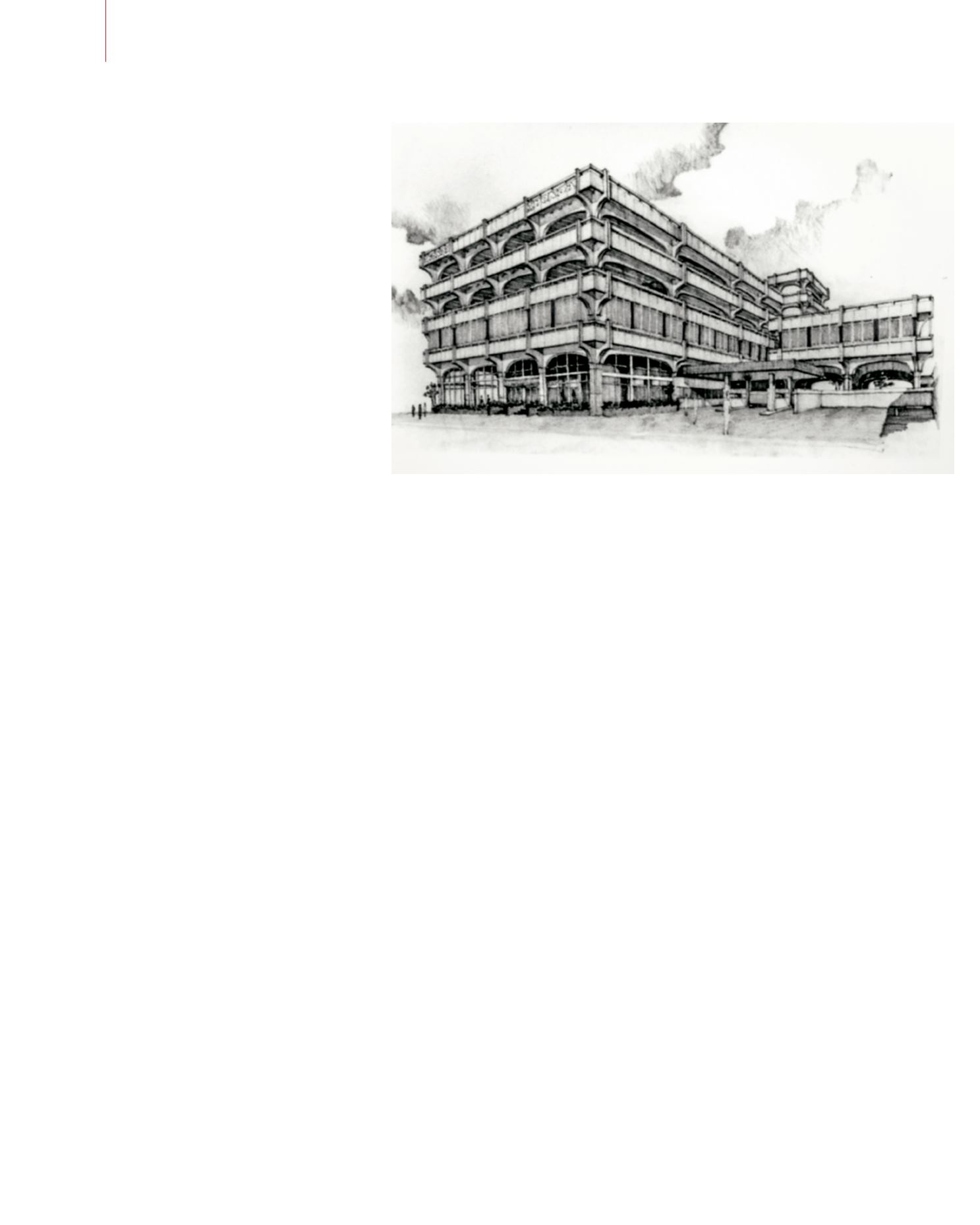
Agencias Bella
Building, by architect
Leopoldo Franco.
© Drawing by architect
Franco from the Gustavo
Luis Moré Archives