


 294 / 540

293
THE ITALIAN TRAINING OF MODERN DOMINICAN ARCHITECTS, 1950 - 2019
•
The flow of students and the alternation of study locations; at first Rome, and later Florence, Venice, and
Milan.
•
The leading role—both in the public sphere and in private practice—assumed by many of those who were
trained in Italy on their return to the Dominican Republic. It is difficult to say for sure, but in our opinion,
of all the student migrations that have taken place in the Dominican Republic, there does not seem to be
another more influential in local culture than the Italian one, until the flourishing of Barcelona as a desti-
nation after the events of 1992, and this latter assumption is yet to be proven.
•
This academic flow has been referred to as the “Italian Axis,” in truth referring to the first group that went
to La Sapienza in Rome in large numbers. However, we will see whether this name fits in terms of the rest
of the catalog of figures reviewed here briefly.
This chapter represents an initial approach to this remarkable phenomenon.
Manuel Salvador Gautier (August 1, 1930).
Università degli Studi di Roma, 1955-1960. Salvador Gautier
completed various courses in Rome in order to validate his degree after leaving the classrooms of the Uni-
versity of Santo Domingo in 1955. He was a student of Pier Luigi Nervi, who was working at the time on the
projects for the 1960 Olympics in Rome. In 1961, he worked at an architect’s studio in Basel, Switzerland. He
returned to the country after Trujillo’s death in 1961, following the appointment of his father as secretary of
public works in the Dominican Republic. He later served as director of the Regulatory Plan for the Historic
Center of Santo Domingo, and general director of the National Housing Institute. He has spent much of the
rest of his career involved in the restoration of the Convent of Las Mercedes in Santo Domingo.
Héctor Ramón Morales
(n.d.). Università degli Studi di Roma. Little is known about this architect, who
apparently attended but did not finish formal studies at La Sapienza.
Glauco Castellanos (1932 - 2012).
Università degli Studi di Firenze, 1965 – 1972. Initially focusing on art
studies, Castellanos remained for quite some time in the city of Florence, where he established relationships
and carried out some noteworthy professional projects. Upon his return to Santo Domingo, he served as pro-
fessor of art and history at UNPHU for decades. He was one of the most renowned artists and art restorers in
the country.
Rafael Calventi (March 18, 1932 - August 19, 2018).
Università degli Studi di Roma, 1951 – 1960. The first Do-
minican student of architecture in Italy. He completed
the entire curriculum at La Sapienza. Shortly after hav-
ing begun his studies in architectural engineering at the
University of Santo Domingo, he became disenchanted
and decided to study at La Sapienza, Rome, allegedly be-
cause a relative of his was a diplomat at the Dominican
Embassy in that city. This connection opened the door
to a notable group of young people who today we could
group in the “Italian Axis,” a dozen students located al-
most all in Rome, who were the vanguard of architects
trained in Italy. Many of these students returned to the
Dominican Republic and worked on several important
projects in the country. Calventi took advantage of the
advanced level of architecture he had attained in Italy in
the 1950s, and was an outstanding student of Pier Luigi
Nervi. After completing his formal studies in Rome, he
settled in Paris, where he worked in the studio of Pierre
Dufeau, and later in New York City with Marcel Breuer
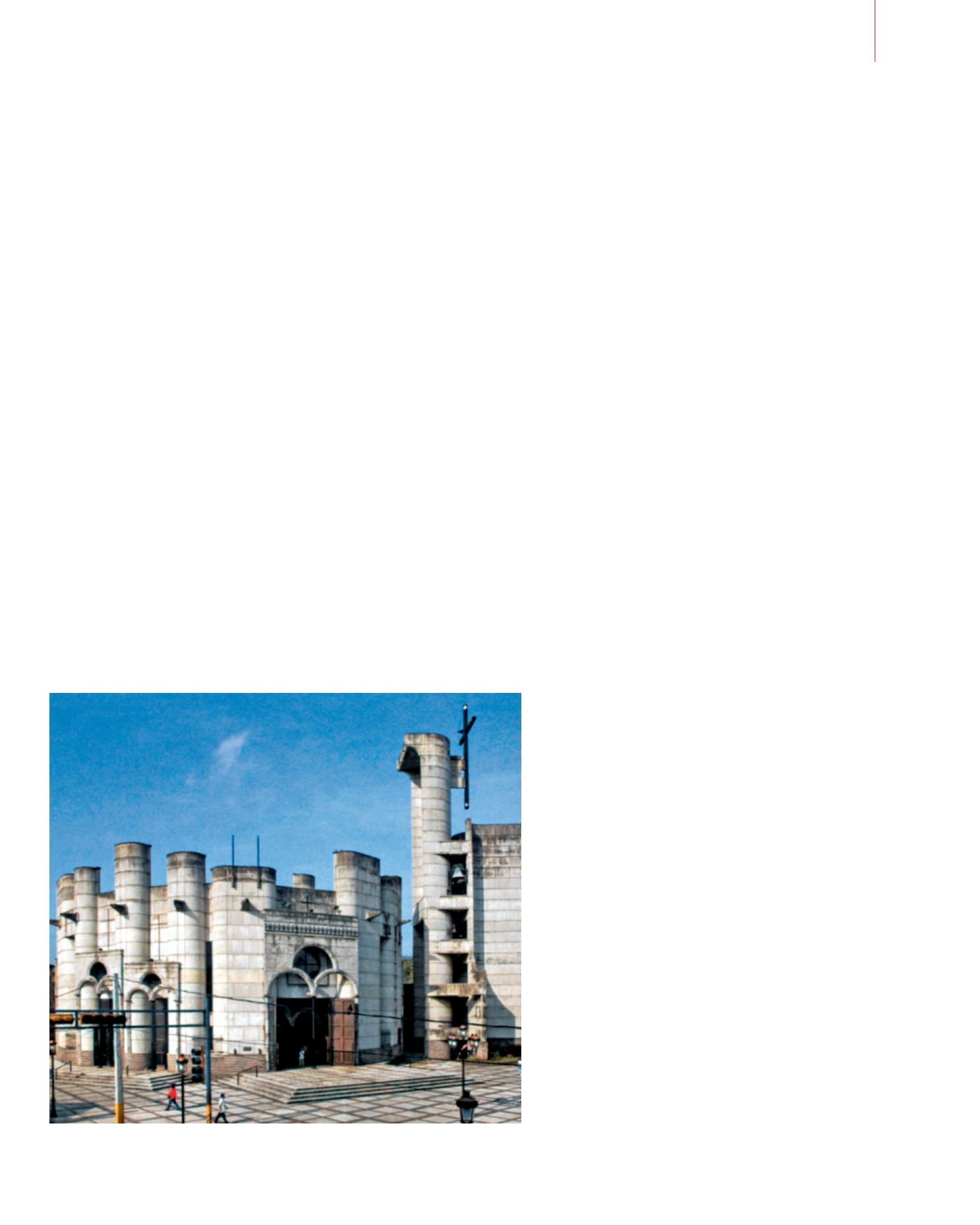
La Vega Cathedral,
c. 1982, finished by
architect Pedro Mena
based on an original
design by Erwin Cott,
greatly modified.
© Gustavo Luis Moré
Archives