


 293 / 540

THE ITALIAN LEGACY IN THE DOMINICAN REPUBLIC
292
prepared the field for reflection in all subse-
quent contributions of a global scope by Italian
theorists in the 1970s.
Buildings for commercial firms, housing
groups, public buildings by architects such as
Ernesto N. Rogers and his group BBPR, Gar-
della, Moretti, Ridolfi, Quaroni, Albini, Figi-
ni-Pollini and Michelucci that, together with
the strength of Italian design that it exports to
the entire world and the power of the Italian
specialized press as a means of international
reflection, all contributed in making this stage
of Italian architecture one of the most fruitful
episodes of European architecture in the sec-
ond half of the twentieth century. Significant
works such as the BBPR Velasca tower, the
“Girasole” residential building in Moretti or
the residential neighborhoods of Ridolfi, Albi-
ni and Figini-Pollini.
Such was the panorama in Italy. In a parallel
reality, the Dominican Republic was experiencing the outset of the Trujillo regime. Within this scheme of
things, there were various Italians present in the Dominican Republic who excelled within the context of ar-
chitecture. Alfredo Scaroina had already participated decades before in various public works, including the San
Cristóbal City Council building. Amadeo Campagna (1893-1962) from Santo Domenica Talao, who had stud-
ied engineering in Naples, launched and carried out works in Santiago and Puerto Plata. In 1927, the engineer
Guido D’Alessandro Lombardi settled in Montecristi. He would undertake many important works during the
era, including the National Palace of the government. In 1927, the engineer Baldassare Guaschino (1898-1950)
also made his mark at the Ingenio Angelina sugar mill, and in installing the cable car over the Higuamo River,
as well as in infrastructure works.
Around 1950, when this story actually begins, there were still eleven years remaining to the Trujillo era.
Young people seeking a career in architecture had no other alternative than to attend classes at the Universi-
ty of Santo Domingo (USD) and pursue a degree in architectural engineering, as it was understood in those
years, until the curriculum was changed after the Reform Movement of 1965. It was not until 1966 that Pedro
Henríquez Ureña National University (UNPHU) was founded, and there were no other possibilities aside
from the USD, later UASD. When Trujillo was assassinated on May 30, 1961, Dr. Joaquín Salazar was the
Dominican ambassador to Rome, and he managed to successfully steer a course through the strong winds of
this transition.
Italy, as noted, already excelled as an icon of postwar architecture worldwide, and therefore architecture
and Italy seemed to be an inevitable equation. The schools of Rome and Milan were of great renown, boasting
the greatest academic talent in Italian design. This was how this pilgrimage of young Dominicans to the Italian
academies began, and it was Calventi who broke the ice. According to M.S. Gautier, “Calventi was never calm;
he was always very restless; and he achieved what he set out to do.” It is to this spirit of achievement that we
owe the transfer of the first Dominican to the Italian classroom, a journey that has been repeated dozens of
times in the nearly 70 years that followed.
Below is a chronologically sequenced list of Dominican students who attended Italian schools of architec-
ture. The list may certainly not be complete; however, we should note the following interesting tendencies:
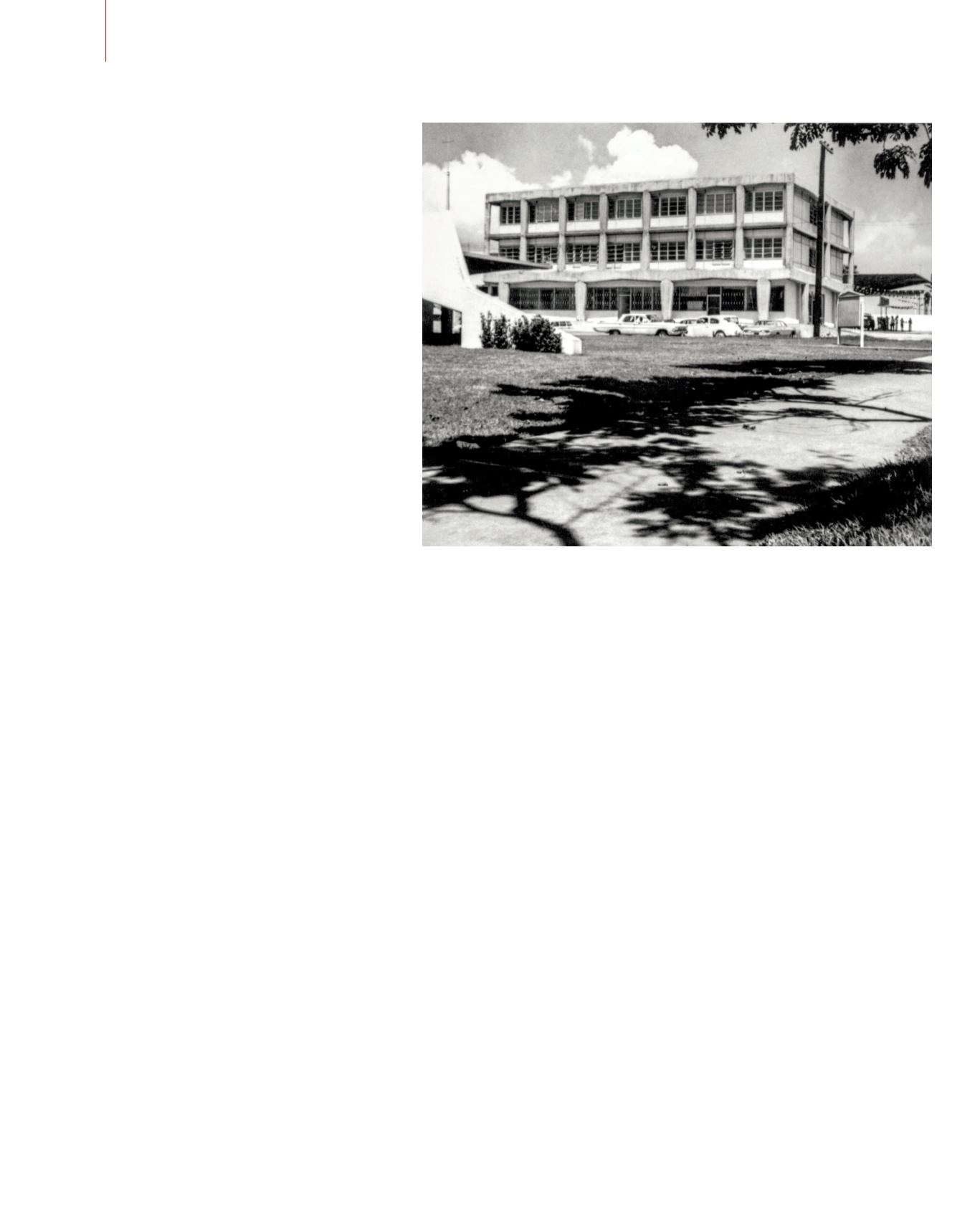
Office building of
the Shell CONALCO
complex, c. 1966, by
the Architects Manuel
Salvador Gautier and
Erwin Cott.
© Gustavo Luis Moré
Archives
Opening page:
South view of the
Central Bank of the
Dominican Republic
complex, work
by Rafael Calventi,
won by public contest
in 1974.
© Ricardo Briones