


 157 / 540

THE ITALIAN LEGACY IN THE DOMINICAN REPUBLIC
156
he faced several serious dilemmas, aware that the coun-
try was headed for disaster but unable to do anything
about it. First, as will be shown in detail, he restricted
himself to theoretical commentary that placed evils in a
timeless dimension, avoiding conflicts that might have
landed him in prison or exile. The evolution of the life
of the nation, which marked the fate of his generation,
placed him in a pathetic situation, doomed to preach
without the prospect of tangible effects. Within this
context, one could understand his shift toward positions
contrary to those he had defended all his life. He went
so far as to justify autocracy and abjure many of his con-
victions, and in a dramatic twist, he began to believe
that his life as a warrior had been an utter mistake.
A Tumultuous Presidency
In 1882, Ulises Heureaux became president. Despite
Heureaux’s heavy-handed approach to governance,
Meriño distrusted him and sought a replacement. Lu-
perón, imbued with civilian illusions, again suggest-
ed that Pedro Francisco Bonó and various others take
office, but they all rejected the offers. At that time,
Heureaux was Luperón’s right-hand man, apparently
revering him as a father figure. Luperón overlooked
Heureaux’s violent tendencies and mandatory use of
force against his enemies. He instead focused on busi-
ness and left the country again for a prolonged period of
time. He was not aware that Heureaux’s first adminis-
tration had shifted, putting the state at the service of private interests, and this resulted in the coming together
of the modern bourgeoisie and the ruling clique.
Unbeknownst to Heureaux, his successor was gaining ground in the government, aiming to undermine
his previously undisputed reign as leader of the Partido Aazul (Blue Party). Luperón had proposed his close
friend Segundo Imbert, a native of Puerto Plata who was a veteran soldier, and Heureaux turned to Meriño,
who believed that the ideal candidate was Billini.
This dispute led to a tipping point in the dignitary’s standing, and challenges to Imbert’s competence;
particularly, his regionalist motivations became a concern. However, Imbert was a more popular candidate
than Billini, as his support came mostly from Cibao, the richest and most populous region. Thus, Heureaux
engaged in the dirty job of electoral fraud. Logically, this upset Luperón and resulted in friction, but the two
still maintained a relationship.
Billini did not realize that his election was won on the grounds of electoral fraud with sinister motives, tar-
nishing the establishment of his administration. From the beginning, Heureaux was committed to preventing
the emergence of a successful administration. The new president lacked the necessary support to establish a
stable government because nearly every prominent figure in the Blue Party opposed him or, at least, cautious-
ly kept him at a safe distance, and Meriño did not have the influence to clear the way for his protégé.
The situation became unsustainable when Cesareo Guillermo returned to the country from exile after be-
ing granted amnesty. As president, Billini followed the law, believing that every citizen had the right to reside
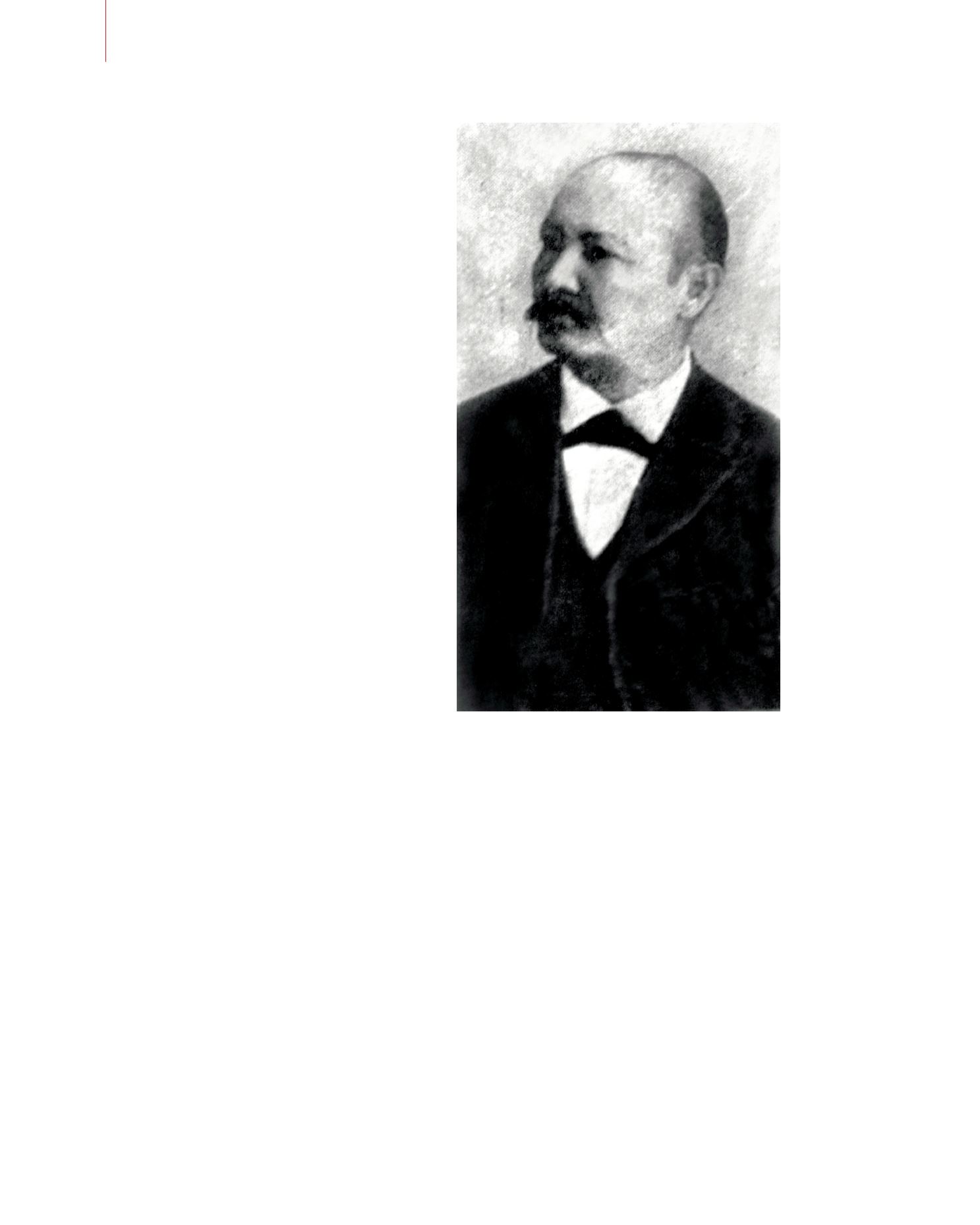
Francisco Gregorio
Billini.
© Archivo General
de la Nación
Opening page:
Cover of
Amor y
expiación
by Francisco
Gregorio Billini.
© Archivo General de la
Nación