


 108 / 540

107
CHRISTOPHER COLUMBUS: A MAN BETWEEN TWO WORLDS
lived by the gate of the “Jewish Quarter” in Lisbon; the
heirs of Luigi Centurione Scotto, a Genoese businessman,
and the heirs of Paolo di Negro; Battista Spinola, son-in-
law of the centurion and son of Nicolò Spinola di Luccoli
di Ronco, who was in Lisbon in 1482 (or his heirs, if he had
already died). As during all the important moments of his
life, Bartolomeo Fieschi was by Columbus’s side.
For a period of time, no one spoke about Columbus.
But one thing is certain: from the time of his voyages on-
ward, a new West had begun to take shape. Immediately
thereafter, in fact, the world was opened up to the Euro-
pean powers, who, in the construction of their mythog-
raphy, may have qualified this important link between
the Mediterranean world and the subsequent rise of the
Western Hemisphere, although they could never deny the
contribution of the man from the “most Atlantic” of Italian
cities and the acts by which he “founded” a new trans-Atlantic world. It is not by chance that in 1688 Christopher
Keller, professor at the University of Halle, in the first edition of his
Historia Universalis
(1685) introduced the
tripartition between Antiquity, the Middle Ages and the Modern Age, establishing that the Middle Ages ended
with certain fundamental events: the fall of Constantinople, the invention of the printing press, the Protestant
Reformation, and the “discovery” of the Americas.
Columbus, the hero, or Columbus the murderer; Columbus, the son of a wool weaver, or heir to a line of
admirals and corsairs; Columbus, mystic or even Templar; Columbus, not Genoese but Catalan, Portuguese, or
fromwho knows what origin. Over time, the powerfully magnetic allure of this figure has generated immeasura-
ble scholarly, literary, and artistic production and, despite so many controversies, once again exalted the mythical
dimension that has always accompanied the history of humankind. In fact, in cultures of all places and times,
the navigator who explores unknown routes, the “inventor” of new lands, assumes in the collective memory a
double physiognomy: the historical and mortal and the heroic and mythical. The man without whom the notion
of “discovery” would not exist becomes not only a part of rational and documentary memory, but also of con-
sciousness and collective memory in which, much more than historical fact, the eternity of myth prevails, along
with the ritual, the foundational gesture
7
, and, at the same time, the memory of the man-hero who created it.
Among these myths—which societies of all ages continuously embrace as a way to justify their own expe-
riences, needs, desires, encounters, and confrontations—is the figure of the Genoese admiral who, like a knight
errant seeking his fortune, will always seem to be the man of impossible challenges and dreams. But myths are
not born overnight. On the contrary, the gesture performed
8
immediately overlaps the figure of the man, recon-
figuring it and even erasing it, making his image almost indefinable—until the NewWorld, detaching itself from
the Old World, decides to introduce it again.
ENDNOTES
1
It is an artificial aggregation of families that all take the same
surname. It is a well-known Genoese institution typical and
unique in history.
2
A particular form of republican regime that privileges in every
age freedom from any sovereign control.
3
See note 1.
4
The “asiento” was a contract granted by the Spanish Crown
to an individual or company allowing the holder exclusive rights
in trade, often with the colonies or in transporting slaves, which
sometimes extended for centuries and, increasingly, financed a
tremendous number of initiatives.
5
See note 1.
6
William Eleroy Curtis, ed.,
The Authentic Letters of Columbus
,
translated by José IgnacioRodríguez (Chicago: Field Columbian
Museum, 1895), 115.
7
In this particular case gesture means “act of discovery.”
8
See note 7.
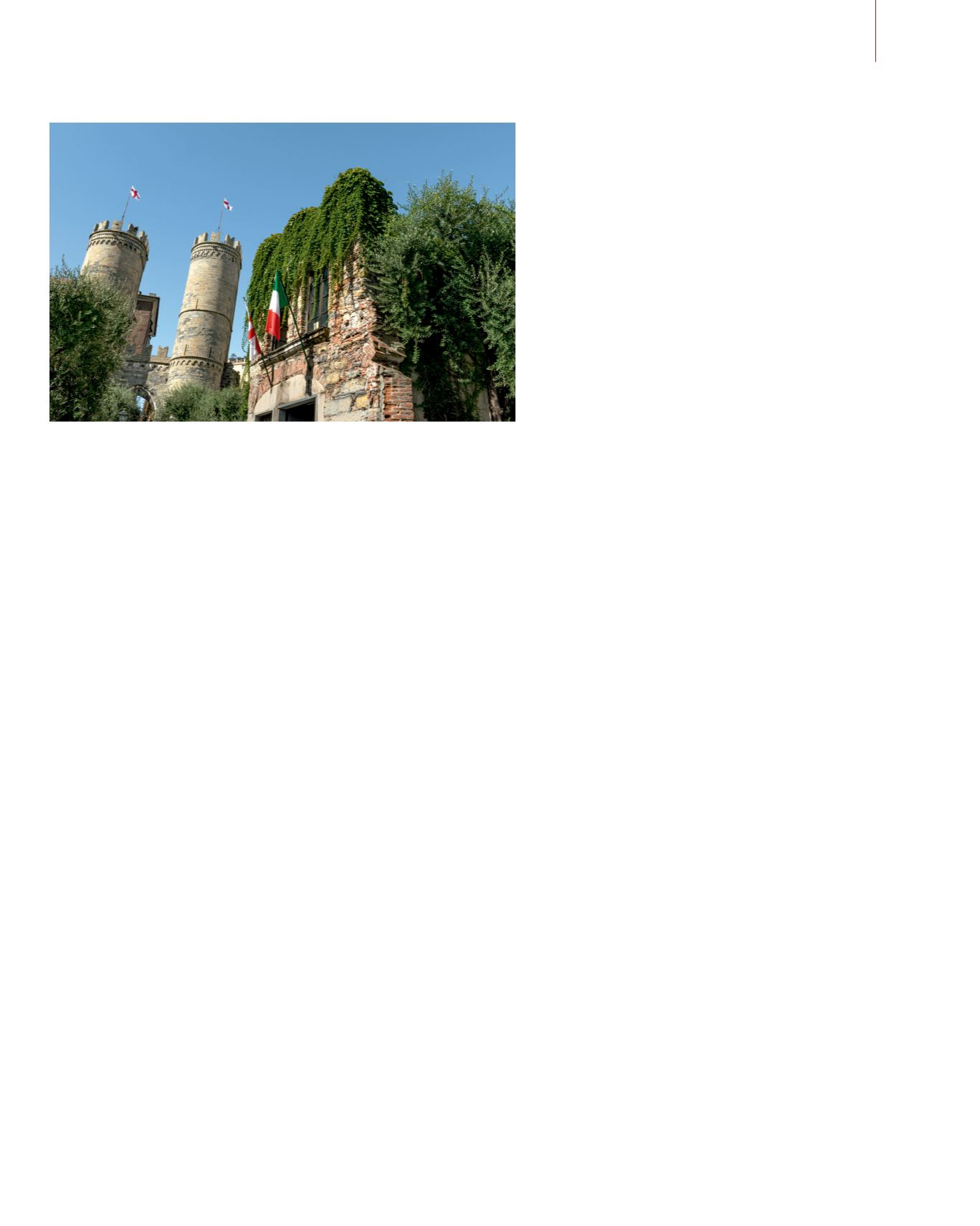
Genoa, Italy: House of
Christopher Columbus
and San Andrea
(St. Andrew) towers.