


 104 / 540

103
CHRISTOPHER COLUMBUS: A MAN BETWEEN TWO WORLDS
the East through the West, a quest with an important precedent in 1291, when the Genoese Vivaldi brothers
attempted to venture “ad partes Indie.”
It is difficult to determine the extent to which these early adventurers impacted the development of Co-
lumbus’s project, and to assess the influence of the direct experiences of and contact with Atlantic experts at the
Portuguese Court, the exchange of information with the Florentine geographer Paolo dal Pozzo Toscanelli, and
reflections on texts and maps later collected in his numerous journals and correspondence regarding the texts of
Marco Polo, Pierre d’Ailly, Pope Pius II, Pliny, and others.
The rejection of his project of a voyage to the Indies by the Portuguese King John II, also supported by
the constant success of the Portuguese expeditions to the Indies and later confirmed by Bartolomeu Dias and
Vasco da Gama, was followed in 1484-1485 by a dark period, which ensued after a sudden trip by Columbus to
Andalusia in the company of his only son Diego (his wife had probably already died). This “flight” seemed the
consequence of the unfortunate outcome of a conspiracy organized by the Order of Santiago against King John
II in which Columbus was—apparently—at least indirectly involved (his wife was related to the Braganzas). In
Andalusia, Columbus was welcomed by a protective family network of powerful Italian and Spanish laity—in-
cluding the Genoese, who were already the most faithful and powerful “asientistas”
4
—Spanish and Italian clerics
of equivalent prestige from powerful religious orders (in particular, the Franciscan Order).
While his brother Bartholomew approached the English and French Courts in search of possible support,
Columbus set forth on a new itinerary that has often been colored in romantic tones. In those years the Crown
of Castile, linked to the Crown of Aragon only by the marriage of Ferdinand and Isabella, was involved in opera-
tions of great importance, including the final “settlement” of Jewish and Islamic issues, two secular and important
presences in Iberian history, as well as in the attempt of a possible opening to Atlantic colonization, which found
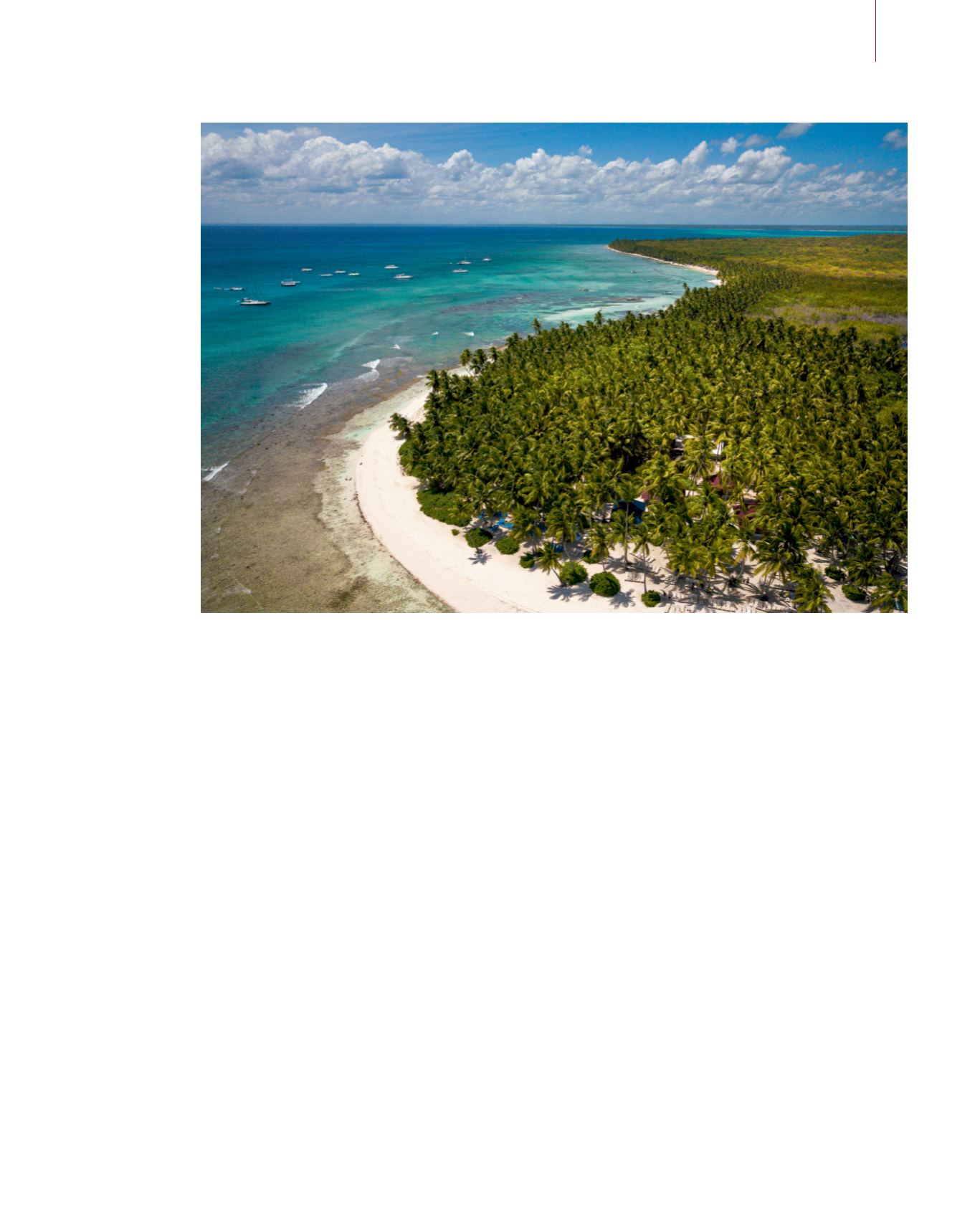
Partial view of Saona
Island. The famous
“Bella Saonese” of
Columbus takes its
name from the city
of Savona, where the
businessman Michele
de Cuneo was born,
a very dear friend of
Christopher Columbus,
who during his second
voyage (1493-1496),
decided to donate
and dedicate the
island to him.
© Thiago da Cunha