


 438 / 540

437
FRANK RAINIERI MARRANZINI: CREATOR OF DREAMS
er to form the Asociación para el Desarrollo Turístico de la Región Este
(Association for the Development of Tourism in the Eastern Region).
Once formed, the Association became the primary voice advocating for
the development of the East. Its persistence paid off, and in March 1984,
President Jorge Blanco could no longer disregard the growth of tourism
in the East. Blanco failed to mention, however, that this growth had
been achieved through private initiatives and not through government
policies.
An essential element of tourism is the image of the country that is
being visited, and the events of April 1984
6
showed the world a violent
image of the Dominican Republic. This had a significant impact on the
country’s appeal as a tourist destination, a situation that greatly con-
cerned private investors. Some of these investors included the board of
directors for the newly minted Club Med. Club Med was able to hold its
fishing tournament regardless, managing to attract participation from
various countries such as South Africa, the U.S., Mexico, Venezuela,
Costa Rica, Curaçao, Aruba, Tahiti, Puerto Rico, and Brazil. All partic-
ipants, foreign and local, stayed at Club Med’s Aldea de Vacaciones de
Punta Cana. The unrest that stoked concern eventually subsided, and
the club resumed operations without further complications.
Despite all the problems, limitations, and lack of opportunities, the country’s eastern region continued to
grow. In 1985, the national press announced that the Playa Bávaro hotel would open its doors on February 1,
with the arrival of a Canadian airplane carrying 120 passengers. The hotel would officially open for business in
April of the same year. It was commissioned by Spanish hotel conglomerate Grupo Barceló, based in Palma de
Mallorca, Spain. The structure housed 400 guest rooms and cost US$10 million, with no financial input from
the Dominican government. This move galvanized local investors, and a group fromHigüey city—comprising
Dr. Manuel Aquiles Cedeño and his siblings—would eventually come together to invest in an ambitious resort
of nearly 200 rooms to be built on El Cortecito beach, in Higüey municipality.
A Motivated Dreamer
It all began in 1969 when a U.S. resident flew over the east coast of the Dominican Republic in search of good
location to establish a merchant marine academy. On this flight, he sighted a five-mile stretch of coast inter-
spersed with white sandy beaches, turquoise waters, and rocky cliffs, all guarded by a barrier reef. He had
sighted Punta Cana.
Impressed by the area’s beauty, he convinced a group of American investors to buy a plot of land in what
was formerly an isolated area, populated by some twenty rural families living in rudimentary conditions.
Theodore W. Kheel, current president of the Board of Directors of the Puntacana Group, was one of these
investors.
Frank Rainieri recalled how inaccessible the area once was, limited to sea, air, or mule routes. He said of
his first visit: “When the helicopter landed, one of the families living there ran away, terrified by the giant
flying bird.”
The encounter between the American Ted Kheel and the Dominican Frank Rainieri was the start of a busi-
ness venture, which, 25 years later, would become the fastest-growing tourist destination in the Caribbean. On
October 23, 1973, after so much hard work and with high hopes and immense pride, the Punta Cana Club was
established as the zone’s first hotel. The hotel was launched with 10 modest cabins, eight employee residences,
a clubhouse, a rustic landing strip and a small generator to power the entire compound.
7
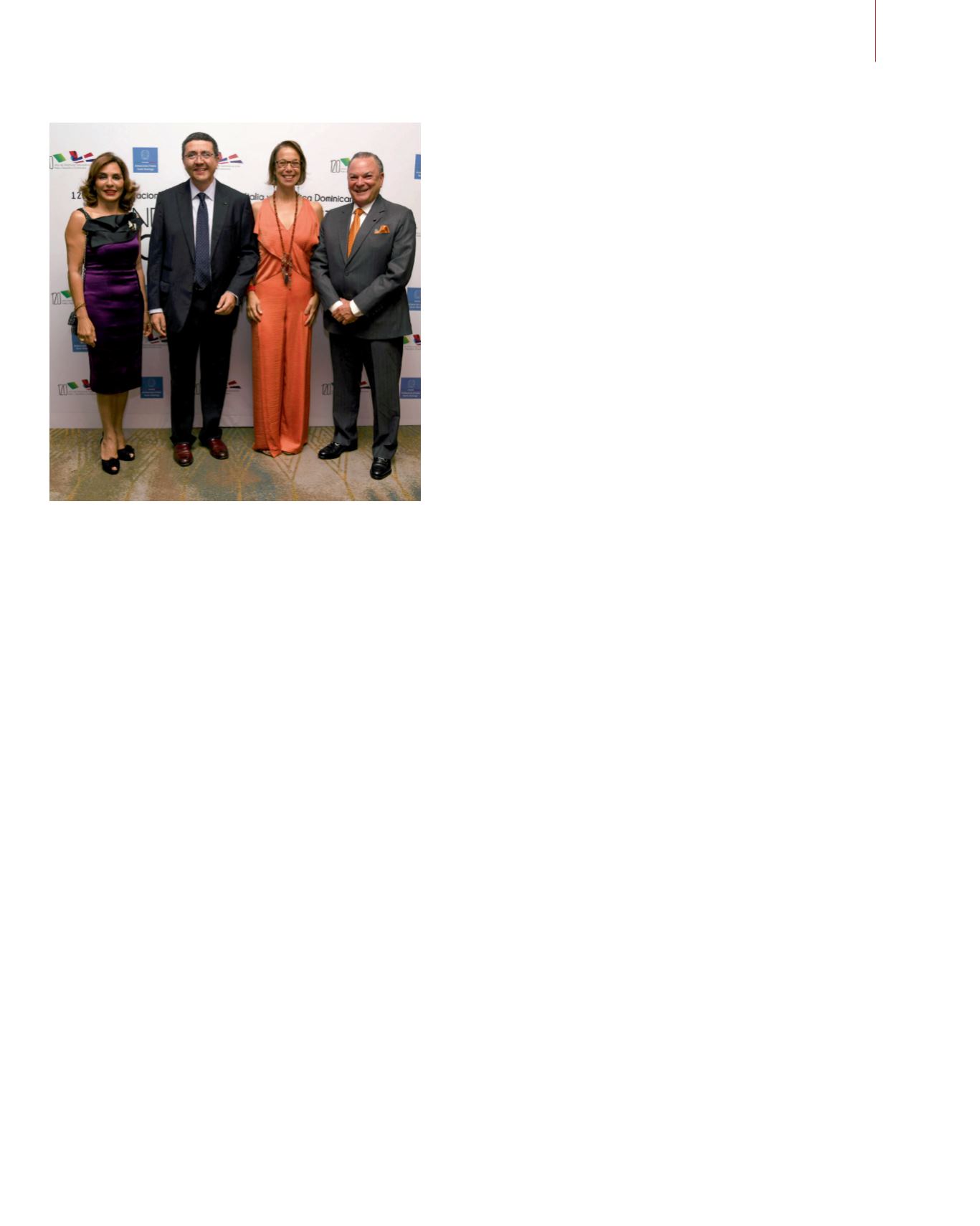
Haydée Kuret de
Rainieri, the Italian
Ambassador Andrea
Canepari with his wife
Roberta Canepari,
and Frank Rainieri.
Santo Domingo,
May 29, 2019.
© Courtesy of Listín Diario