


 36 / 540

35
contribution to the country’s growth and engage in closer relations with each other, and between Italy and
the Dominican Republic.
I am convinced that the contributions, images, and texts from such different voices, from the Academy to
the institutions, from the religious to the cultural, political, and economic worlds, collectively compose a sym-
phony of Italianism in the Dominican Republic and allow us to understand the essence of the Italian cultural
heritage here in the country. I am similarly convinced that through the lens of Italianism, a picture emerges of
the Dominican Republic as a country with structures forged by centuries of communication with Italian im-
migration and as a country capable of creating opportunities at an international level, owing to its engagement
in international dialogue since its foundation. In this process of creating closer international relations, starting
from Italy, I am certain that the Italian community of early as well as recent immigration to the Dominican
Republic can play a decisive role.
I am grateful to all the authors of the book who accepted my invitation to participate, generously offered
important written contributions, and with great patience have at times been willing to supplement their work
in order to highlight and clarify points that I believe are fundamental for illustrating the iconic stories of the
cultural marriage between Italy and the Dominican Republic. I would also like to express my deepest thanks
to Dr. Frank Moya Pons, Professor Danilo Manera, and architect Virginia Flores Sasso for their initial ideas and
enthusiasm during the conception of this book. Many thanks also to the President of the Academia Dominica-
na de la Historia, José Chez Checo, for the continuous dialogue and work of organizing the texts.
Special recognition for their support goes to the various Dominican government officials and institutions,
starting with the Foreign Affairs Minister, Roberto Álvarez, that accepted my invitation to take part in the pro-
jects to illuminate the Italian cultural heritage in the Dominican Republic: the various cultural events held to
celebrate the 120th anniversary of diplomatic relations, the 500th anniversary of the arrival of the first resident
bishop in Santo Domingo Alessandro Geraldini, and the 200th anniversary of the birth of the first admiral and
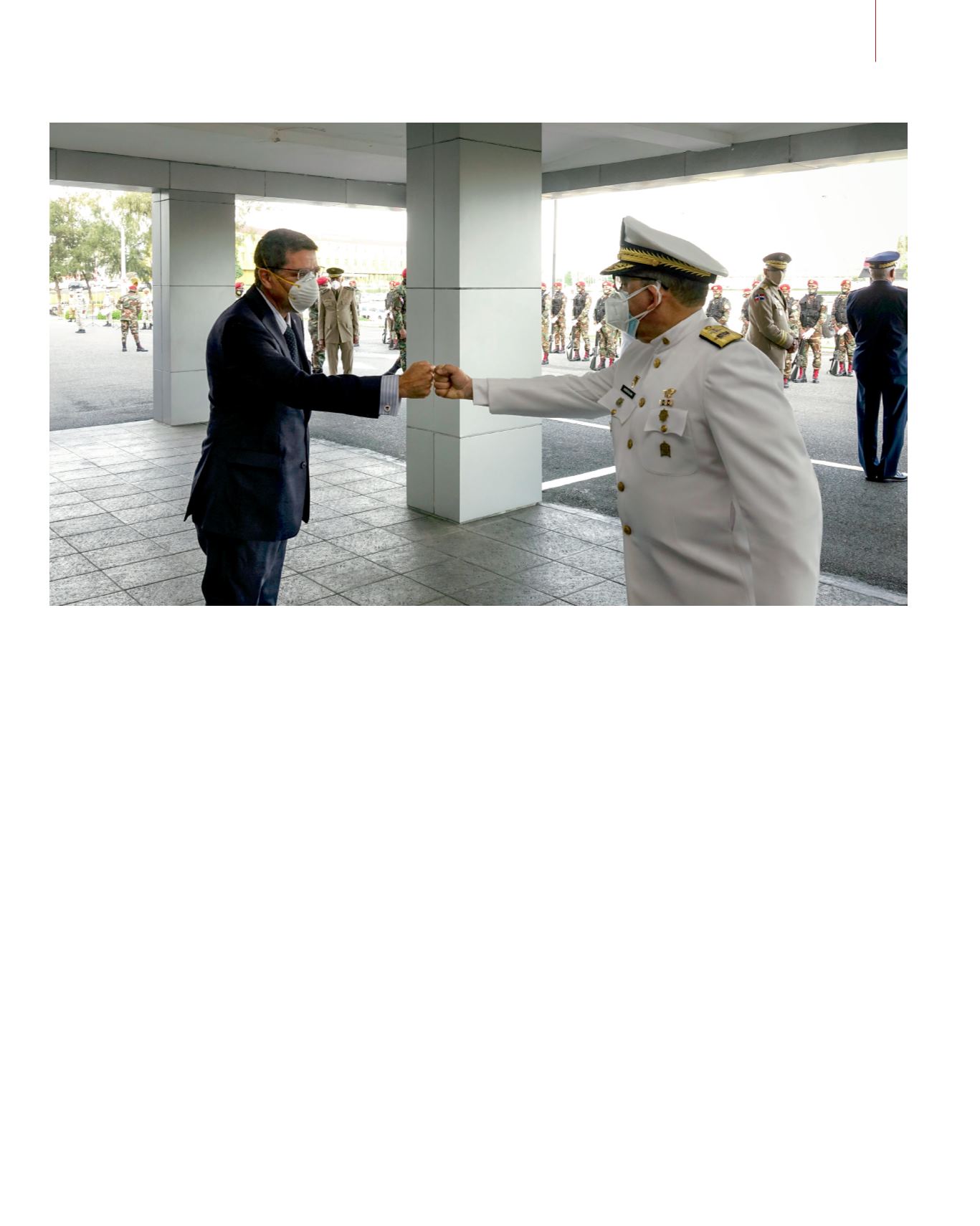
INTRODUCTION BY THE EDITOR
Greeting of
Ambassador Andrea
Canepari and Vice-
Admiral Joaquin
Augusto Peignand
Ramirez, Vice-Minister
of Defense for Naval
and Coastal Affairs,
upon the arrival of
the former at the
ceremony honoring
the birth bicentenary
of the first admiral
of the Dominican
Navy, Italian Giovanni
Battista Cambiaso.
Santo Domingo, 4
December 2020.
© Courtesy of Listín Diario