


 352 / 540

351
formally attired and well groomed; he holds a founding document in his right hand, while his left hand rests
on a pedestal. Meanwhile, Mella appears in military dress, holding his hat in his hand, while his left hand is in
the hilt of a saber.
The unveiling of the new Altar of the Fatherland, on February 27, 1976, was one of the milestones for the
centennial of the death of Juan Pablo Duarte. The name “Altar de la Patria” was officially ascribed through
Law No. 1185 of October 19, 1936. The remains of the founding fathers, which for many years lay in the Chap-
el of the Immortals in the Cathedral of Santo Domingo, were transferred to the Altar de la Patria within the
Puerta del Conde in 1943 and from there to their current residing place. This emblematic site was remodeled
with the intention “of integrating the Altar de la Patria within a larger ensemble, in keeping with its historical
significance. The entire monumental group representing the colonial and republican periods form a conglom-
erate linked by paths that form the cross of our flag, transforming the area into one of reverence and respect.
Ramparts, old and new roads, moats and monuments, all form a unit that embodies the historical patriotism
of our people” (
El Caribe
, February 27, 1976, 2).
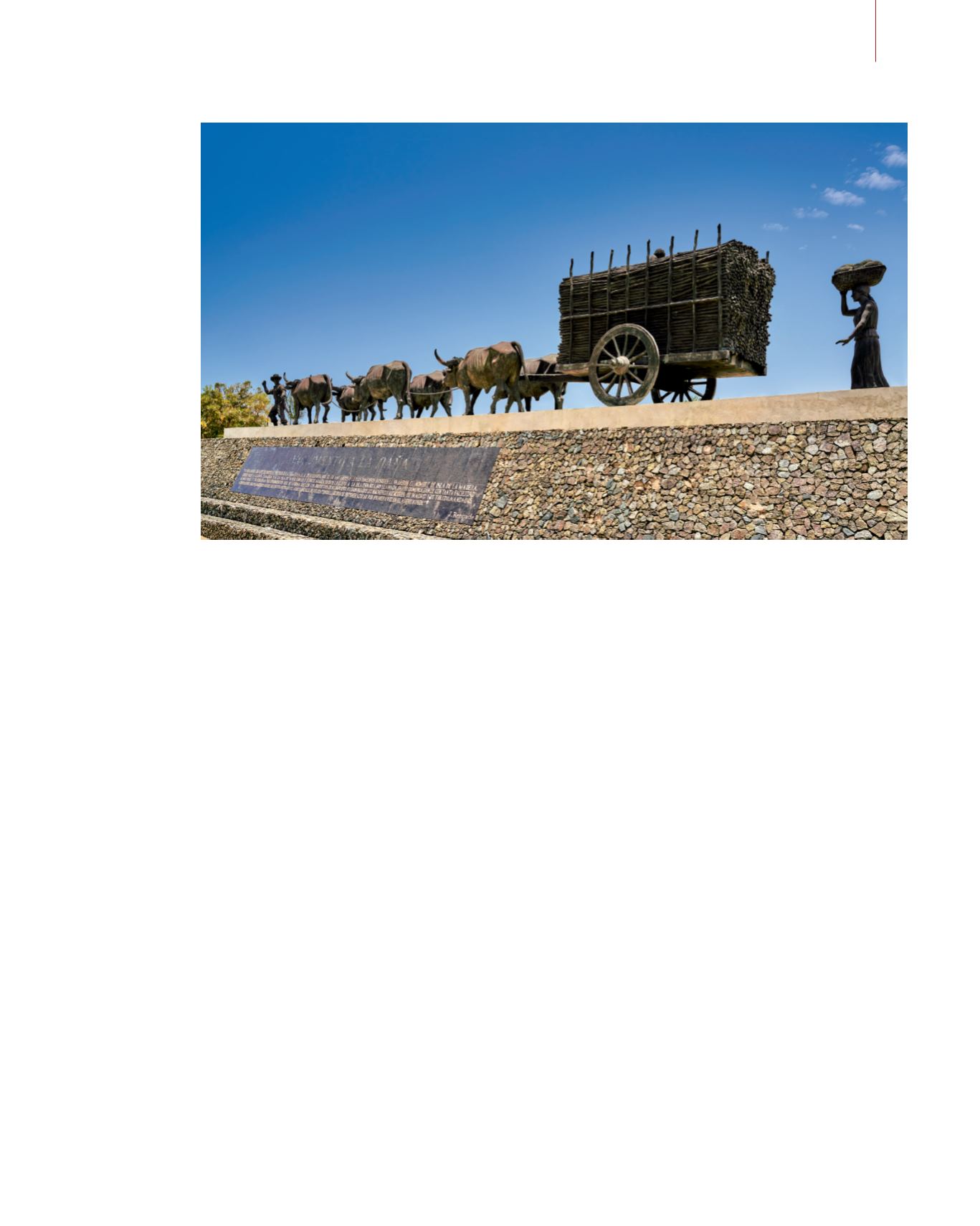
Arrighini later created the
Monumento a la Caña
(Monument to Sugarcane), a sculptural ensemble cast in
bronze and inaugurated in 1992 on a small public square located on the eastern bank of the Ozama River, in
Santo Domingo Este province. The design of the project is the work of architect Martínez Villanueva; sculp-
tural elements are by Nicola Arrighini; and the bronze casting was produced at the Fonderia d’Arte Massimo
Del Chiaro in Pietrasanta, Italy.
The Monument to Sugarcane consists of a cart loaded with cane drawn by six oxen accompanied by a
family, with the father leading the oxen, the wife behind bearing a basket of food on her head, and a child
perched atop the cart, representing the families that worked in cutting and milling of sugarcane. The figures
have been idealized with Europeanizing features, eliminating any vestige of the African origin of the people
who have generally toiled in this activity in the Dominican Republic. In this work the artist creates a work
freed from historical or mythological ties. The monument is one of the most beautiful sculptural ensembles
in Santo Domingo. It is particularly noteworthy for the realism and volume of the animals and the sense of
movement expressed by the male figure.
Monument to the
sugarcane by the artist
Nicola Arrighini. Santo
Domingo Este.
© Giovanni Cavallaro
ITALIAN SCULPTORS IN THE DOMINICAN REPUBLIC