


 351 / 540

THE ITALIAN LEGACY IN THE DOMINICAN REPUBLIC
350
cus Aurelius (second century) that is located in the Capito-
line Museum in Rome; this work served as a model during
the Renaissance for Donatello’s Equestrian Statue of Gat-
tamelata (1447–1453) in Padua, and
Il Colleoni
by Andrea de
Verrocchio in Venice (1488). This type of sculpture became
quite prevalent during the Baroque period, and appeared in
the twentieth century throughout Latin America to exalt
the memory of independence heroes.
The statue inaugurated in Santo Domingo presents
Luperón at a gallop, with a sword in his right hand and the
horse with its left leg raised and its head veering to the left,
paralleling the body of the rider, who is dressed in a mil-
itary uniform and hat and whose feet are held in the stir-
rups. The animal’s musculature is impressively rendered
in a sculpture that inspires respect and admiration. Cur-
rently this work is in front of the Monument to the Heroes of the Restoration in Santiago de los Caballeros.
In the Puerto Plata piece, Arrighini presents a challenging Luperón who is seen leading his forces into
battle. He is also outfitted in military uniform, with his feet in the stirrups, and with the horse depicted with
front legs raised. Both sculptures have granite-covered pedestals indicating the dates of the birth and death of
this hero of the Republic Restoration.
A few years later, with the inauguration of the Teatro Nacional (National Theater), on August 16, 1973, a
new opportunity arose for Nicola Arrighini, who was then commissioned to design two fountains to be placed
in front of the theater. The Italian sculptor carried out the work, but by some strange circumstance they were
not located in the designated place until 2018, when the building underwent refurbishment and—on instruc-
tions from Culture Minister José Antonio Rodríguez—the fountains were inserted in the location for which
they had been originally designed, at the front of the building by the main entrance, and to the north of the
compound, near the Metro station.
These cast-bronze Baroque-inspired fountains from Arrighini’s workshop are embellished with allegorical
motifs in theater and music. They include female figures that evoke the muses and sea creatures placed in
various overlapping registers with references to Greek mythology, in a set articulated by harmonious curves,
recesses and projections, water features, and movement. Today they are undoubtedly the most beautiful
fountains in the city of Santo Domingo but which, unfortunately, are not kept in permanent operation, a situ-
ation that contributes to their progressive deterioration.
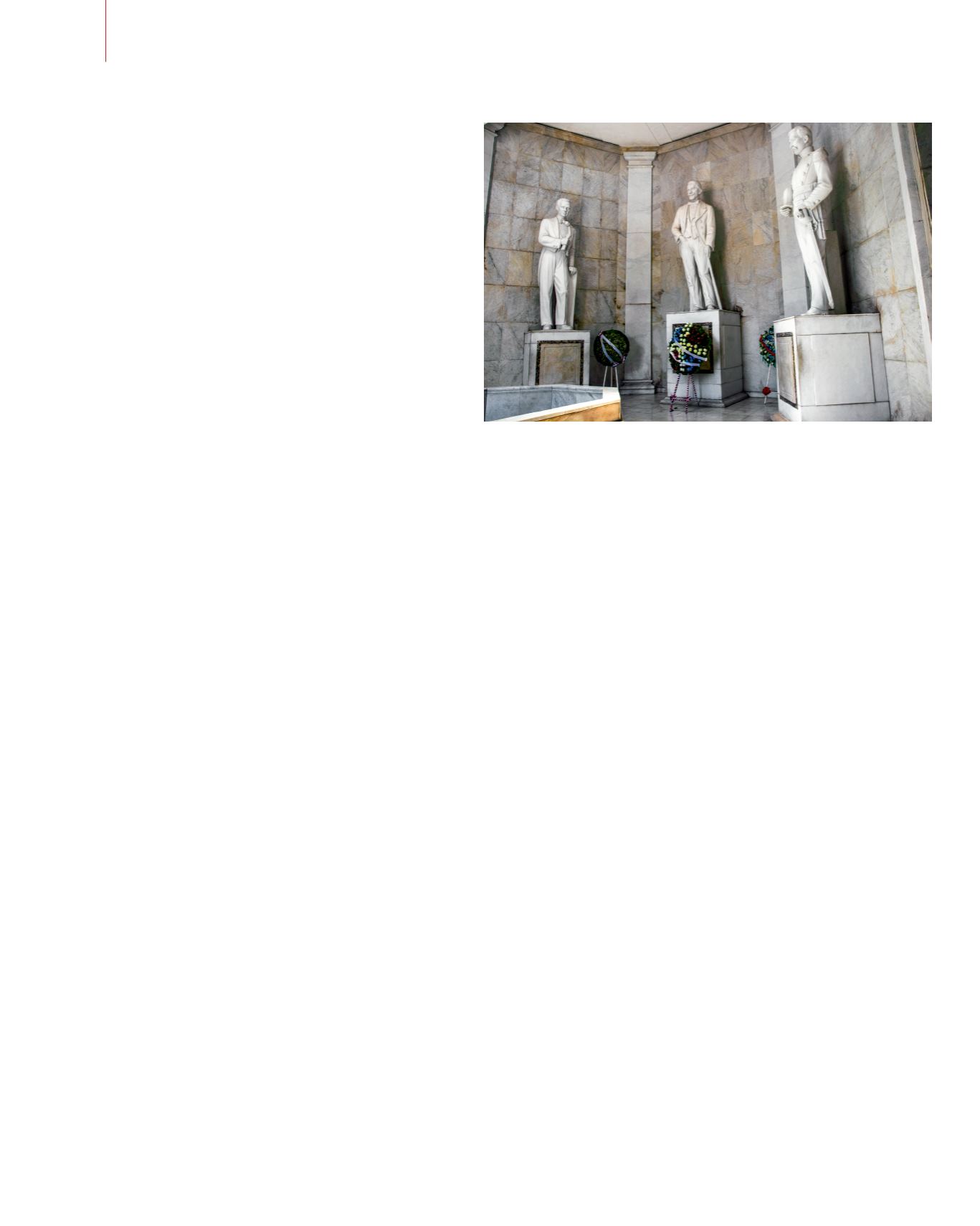
Later, when the remodeling of Parque Independencia (Independence Park) and construction of the Mon-
ument to the Fathers of the Homeland were proposed in 1976, President Balaguer recommended using the
services of Nicola Arrighini. The architect Christian Aníbal Martínez Villanueva (Crismar), designer of the
Altar de la Patria (Altar to the Homeland), visited the sculptor in his workshop in Pietrasanta, Italy, to explain
the details of the project. On this occasion, Arrighini worked with marble at the express instruction of the Do-
minican president, according to the architect Martínez Villanueva, because the objective was “to respect the
memory of the patriots, and for Balaguer, marble represented eternity.” It was decided to work with Carrara
marble; the quarry from which the material came “is only intended for the statuary of national heroes.” The
marble is pure white and veinless, and it is extracted by laser. After polishing, it acquires great transparency.
3
The busts of Duarte, Sánchez, and Mella created by Abelardo Rodríguez Urdaneta in 1919 set the bench-
mark for the work displaying the faces of the Trinitarians. The 3.85-meter-high work rises imposingly on
2.3-meter pedestals, also fashioned from marble.
Duarte is dressed in formal attire, including a bowtie, his hair and mustache neatly groomed, fob at his
side, his right hand inside his pants pocket, and his left hand resting on his thigh. Sánchez is also presented
Large sculpture group
depicting Duarte,
Sánchez, and Mella,
made in 1976 in
Carrara marble by the
Italian artist Nicola
Arrighini for the Shrine
of the Homeland of
Santo Domingo.
© Fausto Ortiz