


 347 / 540

THE ITALIAN LEGACY IN THE DOMINICAN REPUBLIC
346
admired was the equestrian statue in San Cristóbal, the dictator’s birthplace, the work of the Italian sculptor Au-
relio Mistruzzi (Villaorba, 1880 - Rome, Italy, 1960), a work that was demolished after the ruler’s assassination.
Sculptor and medal artisan to the Vatican, Aurelio Mistruzzi was trained at the Academies of Venice, Mi-
lan, Breda, and the School of the Art of the Medal in Rome. Prior to World War I, he worked on sculptural
decorations at the Municipal Palace of Udine. At the end of the war, he made monuments to dead soldiers, as
well as religious statuary. One of his works can be found in the Basilica of San Antonio de Padua. From the
twenties onward, he devoted his efforts more specifically to the making of coins and medals, including the
coin of Pope Pius XI and that of Pius XII. One of his best-known civil works is the
Fontana delle Rane
(Girl with
a Frog fountain) in Monza, Italy.
His last work was the equestrian statue of Trujillo, made from two cast-bronze sections, 6.5 meters high and
placed on a 12-meter pedestal, in 1957. The sculptor received payment of US$90,000 and began work in 1956,
after being selected from several renowned sculptors. According to Néstor Uribe Matos, the artist was inspired
by the equestrian statue of Frederick William II of Prussia in Cologne, Germany, and that it may have been
Trujillo’s visit to the Vatican and the signing of the Concordat in 1954—whereby the Catholic religion would be
acknowledged in all official acts of the Dominican Republic—which inclined him to select Mistruzzi, given that
he was a sculptor who was very close to the Holy See and who served as its medal artisan (Uribe Matos, 2019).
Referring to this sculpture, Emilio Rodríguez Demorizi points out that “the beautiful equestrian statue erected at
the entrance to San Cristóbal, the birthplace of the Generalissimo, was demolished and destroyed in the delirium
of devastation that occurred at the fall of the political regime” (Rodríguez Demorizi, 1972, 135).
Previously, in 1952, Mistruzzi had made a bust of Julia Molina, mother of the dictator, destined for Mon-
tecristi. The work’s arrival in the Dominican Republic was featured in the Dominican press (
El Caribe
[C. T.],
August 3, 1952, 24).
Nicola Arrighini in the Dominican Republic
From 1966, the leading role in the realm of Dominican politics was assumed by Joaquín Balaguer Ricardo,
president from 1966 to 1978 and 1986 to 1996, secretary of Education and president of the republic during
the Trujillo regime, and a great admirer of the arts and Greco-Latin antiquity. President Balaguer developed
a policy of extreme controls and physical elimination of his opponents, while, on the other hand, becoming
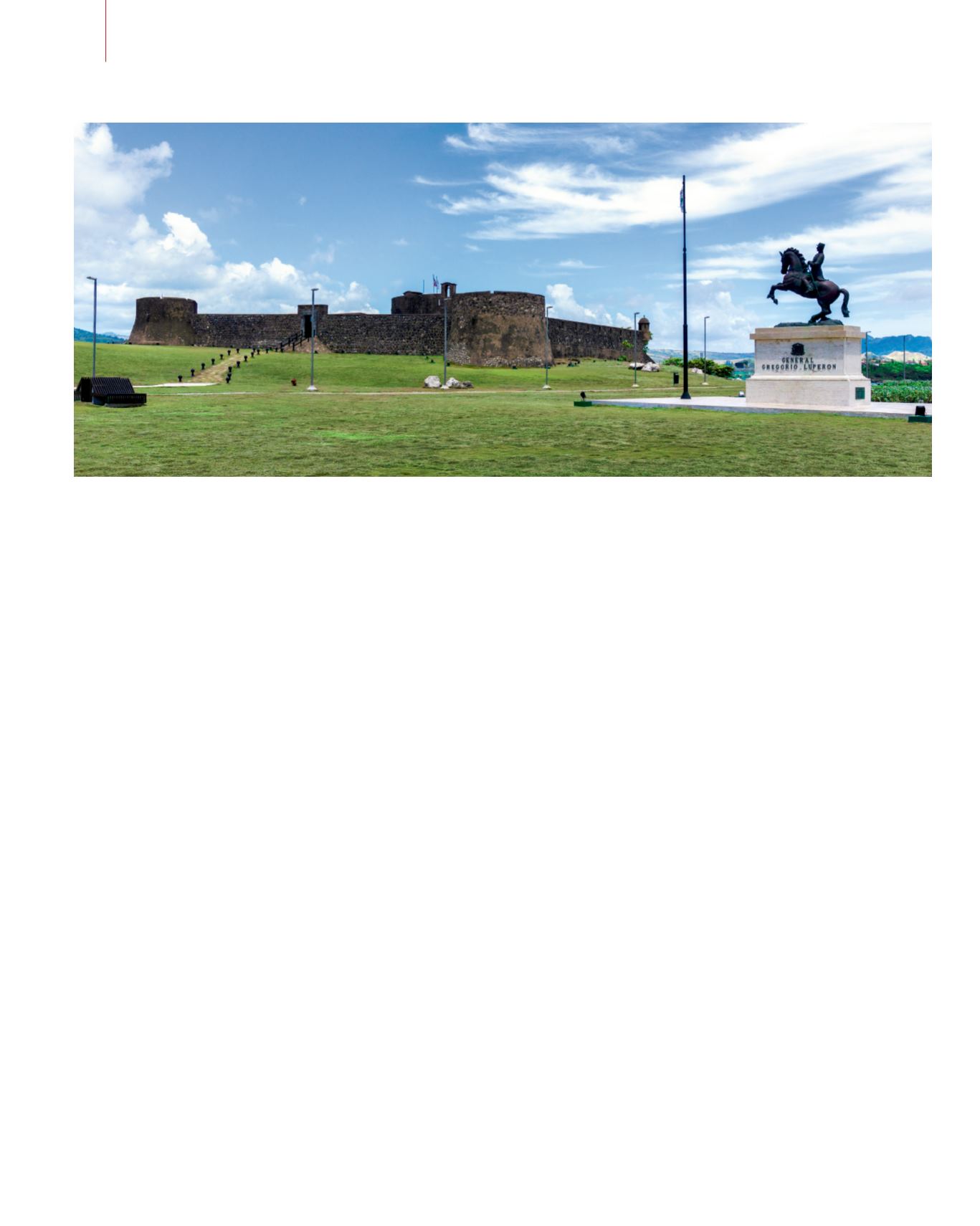
Bronze equestrian
sculpture of Gregorio
Luperón on the Puerto
Plata boardwalk,
executed in 1971 by
Nicola Arrighini.
© Fausto Ortiz