


 225 / 540

THE ITALIAN LEGACY IN THE DOMINICAN REPUBLIC
224
Marines, was convinced that the constitutionalist uprising was led by Communists—a vision without factual
evidence but fueled by the geopolitical obsessions of the Cold War. Capozzi proved to be more lucid than the
American diplomat. In an interview with an Italian journalist shortly before his death, Capozzi explained that
among the insurgents there were only a few hundred Communists. “The craziest ones,” he explained, “are
those of the [Revolutionary] June 14 Movement [...], but more than communists or Fidel Castro’s supporters,
they are anti-American nationalists, with whom, therefore, I understand myself very well.”
12
The evaluation of
the Italian ambassador to the Dominican Republic, Roberto Venturini, was similar: “The constitutional gov-
ernment of Colonel Caamaño [...is] progressive but not communist.”
13
The British
chargé d’affaires
, Stafford
F. Campbell, was of the same opinion, and in his telegrams to London, he did not spare any irony about the
analytical superficiality of the powerful American allies.
14
Capozzi would end up being killed on the afternoon of May 19, 1965, in a failed assault on the National
Palace, occupied by the putschist Dominican military supported by the U.S. troops. He fell together with
Colonel Rafael Tomás Fernández Domínguez, the political leader of the Constitutionalists, and two promi-
nent cadres of the June 14 Movement, Juan Miguel Román and Euclides Morillo. In the assault, Montes Arache
was wounded. Capozzi, at the head of one of three columns that tried to reach the palace, was the one who
managed to get closest to the target, before being hit twice by bullets and falling lifeless.
The night before, as a volunteer from his column would later remember, Capozzi had gathered the young
men who were to take part in the assault, and for the first time he had talked about himself. He told them that
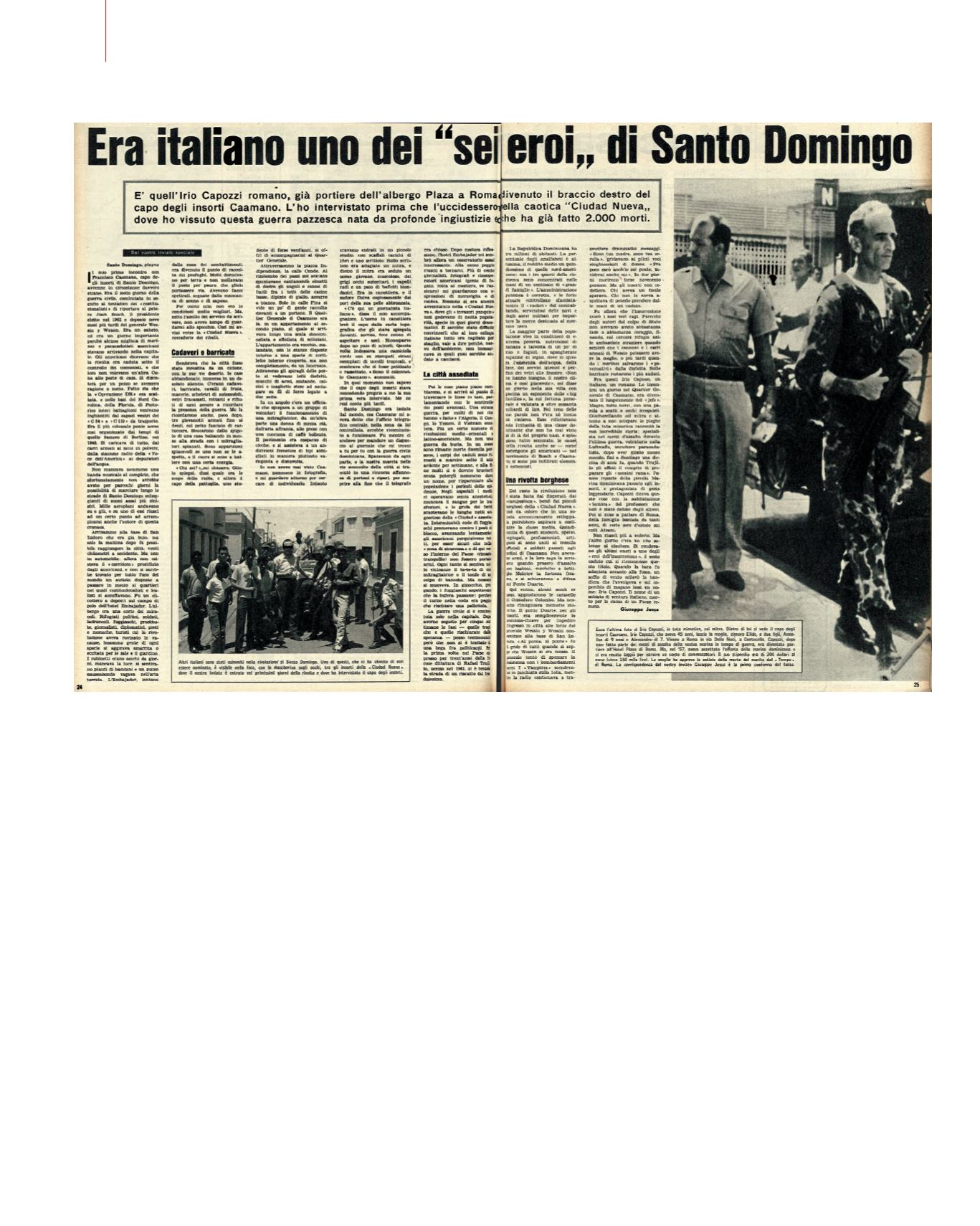
An article published
on June 6, 1965 in the
weekly
Domenica del
Corriere
, at that time
the most widely read
Italian news magazine.
The photo on the right
shows Capozzi with a
rifle in his hand, next
to President Camaaño.
© Giancarlo Summa