


 224 / 540

223
The frogmen were never to see action against Venezuela and Cuba. On May 30, 1961, Trujillo was killed
in an ambush organized by high-ranking Dominican officers, probably with the logistical support of the CIA,
triggering a series of events that four years later would culminate in the outbreak of civil war. On April 24,
1965, civilian and military supporters of President Juan Bosch, elected in 1962 and deposed in 1963, overthrew
Donald Reid Cabral, who had led the coup d’état, and demanded Bosch’s return. The insurgency divided
the Armed Forces: the constitutionalist troops, loyal to Bosch, were led by Colonel Francisco Caamaño; the
putschist troops, by General Elías Wessin.
The frogmen were the only Navy unit that sided with the Constitutionalists: of the 147 men in the unit
only three did not join the uprising; 23 of them would fall in combat in the following weeks.
9
Camaaño ap-
pointed Montes Arache as Minister of the Armed Forces. Of the group of Italian instructors, however, only
two remained in the country to fight: Ilio Capozzi and Vincenzo Lovasto.
10
Capozzi, above all, made himself
well-known and highly respected. He was always on the front line in the toughest battles, such as the one at
the Duarte Bridge on April 27; he organized and trained civilians in guerrilla techniques and was appointed as
head of Camaaño’s personal escort. When the president of the United States, Lyndon B. Johnson, announced
the sending of thousands of soldiers to Santo Domingo—officially to protect the lives of American citizens in
the country but, in reality, in fear that the revolt could become a second Cuban revolution—Capozzi, speaking
slowly with his strong Italian accent, invited the constitutionalist fighters not to give up: “The Americans have
one head, two arms and two legs. They are not a phenomenon; they get bullets like everyone else.”
11
William Tapley Bennett, the U.S. ambassador who recommended to President Johnson that he send in the
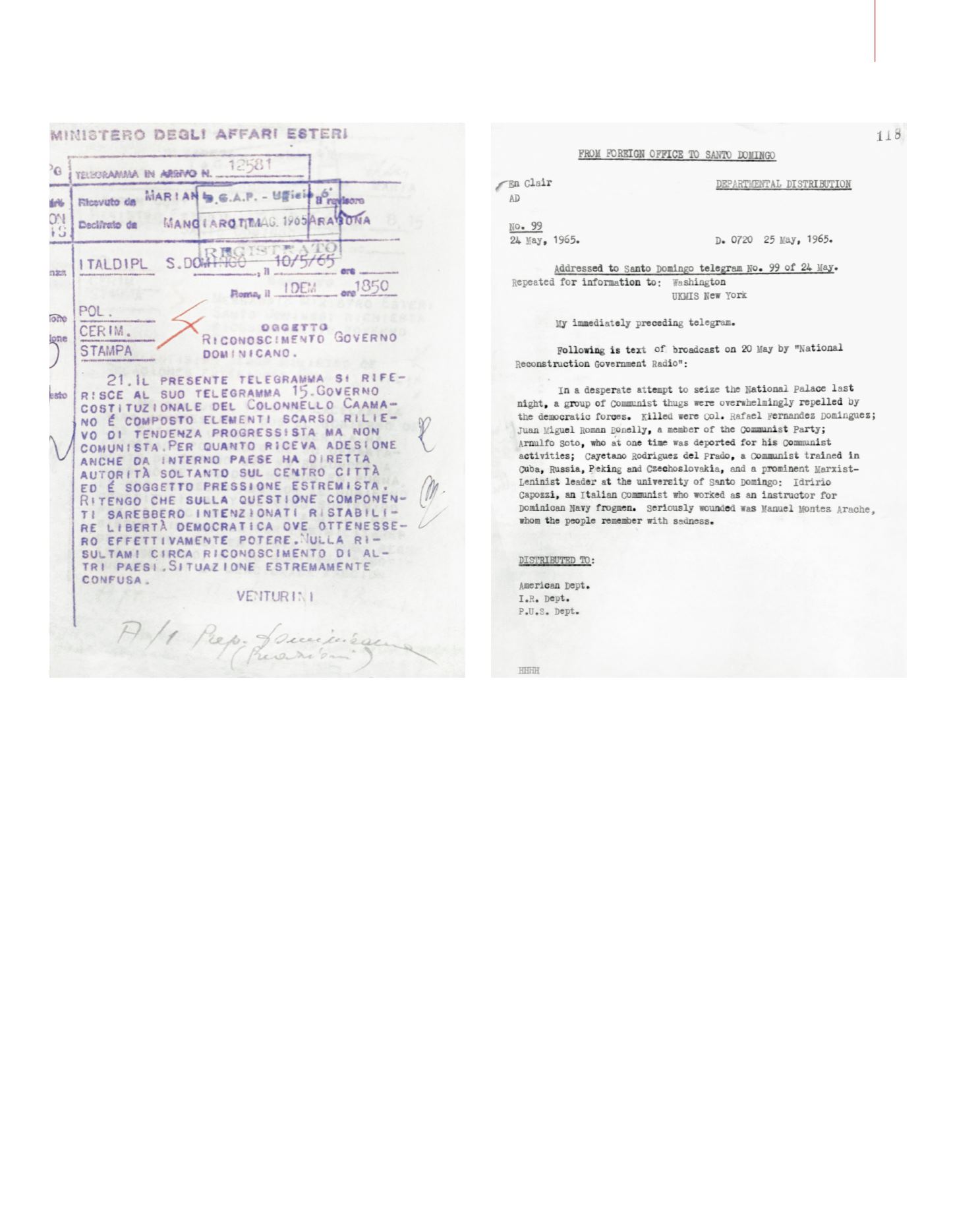
Telegram from the
Ambassador of
Italy, dated May 10,
1965, in which he
informs Rome that the
Caamaño government
is progressive but
not Communist, and
that the situation is
“extremely confusing.”
© Diplomatic Historical
Archive of the Ministry
of Foreign Affairs and
International Cooperation,
General Directorate of
Political Affairs - Office XII
1964-1976, Year 1965,
b. 1 A.
Telegram from the
Foreign Office to the
UK Embassy in DR,
May 25, 1965.
© Foreign and
Commonwealth Office of
the United Kingdom
THE CHOICE OF FREEDOM: ILIO CAPOZZI AND THE 1965 APRIL REVOLUTION