


 166 / 540

165
DIPLOMATIC RELATIONS. PART ONE. NOTES FOR A CHRONOLOGY: 1844-2017
The President of the Dominican Republic and His Majesty the King of Sardinia, wishing to establish
solid foundations for the development of diplomatic and commercial relations between States, resolve
to establish a treaty of friendship, navigation, and commerce, with the intent of declaring the Kingdom
of Sardinia’s recognition of the Independence of the Dominican Republic…
Article 1. Peace and friendship. There shall be ever-
lasting peace between the Dominican Republic and
the Kingdom of Sardinia, as well as between the citi-
zens and vassals of either State, without exception of
persons or locations.
Article 2. Freedom of trade. National treatment. Do-
minicans in Sardinia and Sardinians in the Domini-
can Republic shall be allowed to enter all ports and
markets open to foreign trade as freely as any other
citizen of their respective States.
[…]
They shall be at liberty to conduct business for them-
selves, deliver their own customs declarations, or to
be represented, at their discretion, by an agent, co-
signer, or interpreter, be it in the sale or purchase
of their goods, possessions or merchandise, the load-
ing, unloading and dispatch of their ships […]
Article 4. Exemption from embargoes or indemnifi-
cation for citizens and subjects.
Citizens and subjects of the respective States shall
be exempted from embargoes and seizures of their
ships, cargo, merchandise or property, be it for mili-
tary or public purposes, without indemnification ne-
gotiated in advance by the involved parties.
3
1872
•
Juan Bautista Cambiaso is appointed consul of the Kingdom of Italy. Worthy of noting, he also
served as consul of the Kingdom of Sardinia under Buenaventura Báez during the First Republic.
1886
•
A bilateral trade treaty is signed on October 18, establishing trade regulations between both coun-
tries. It granted complete freedom of trade and movement to the citizens of each country. Interestingly, and
to Italy’s favor, merchants were afforded preferential treatment, being granted immunities, exemptions and
privileges in commercial matters. When compared to the previous treaty with Sardinia, few differences can
be discerned. Italy’s unification meant that the previous treaty could be used as a base for this later one, with
some minor modifications. It comprised 30 articles and was signed by Juan B. Morel and Luigi Cambiaso. In
1890, President Ulises Heureaux ratified it with Resolution No. 2905.
1888
•
A supplementary act to the bilateral trade treaty was signed, which introduced amendments to Arti-
cles 1, 4, 9, 13, 17, 22, 26, and 30. Manuel María Gautier and Luigi Cambiaso signed this amendment.
Article 1. The following paragraph shall be added to Article 1 of the treaty of October 18, 1886: “The
privileges, rights, liberties, favors, immunities, and exemptions declared herein shall not impede the
enforcement of each State’s respective customs laws where gross registered tonnage is concerned, and
each State shall collect the appropriate taxes in accordance with said laws. […]
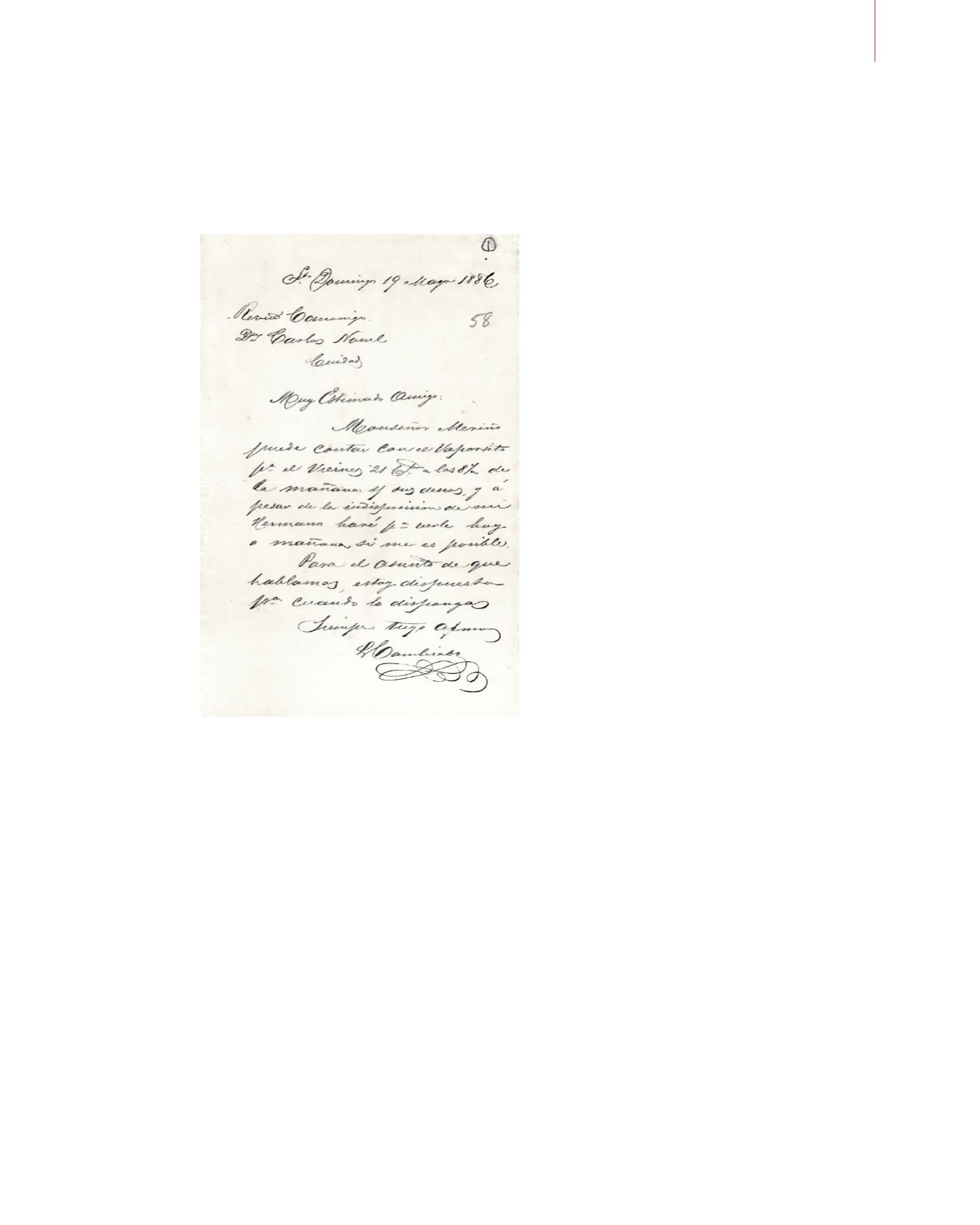
Letter of Luigi
Cambiaso to vicar
Carlos Nouel. Santo
Domingo, May 19,
1886. Archivo General
de la Nación, Carlos
Nouel Collection.
© Archivo General de la
Nación