


 176 / 540

175
has created the momentum behind this book project on Italian cultural heritage in the Dominican Republic,
on which I have worked together with the president of the Dominican Academy of History, José Chez Checo,
and through which has brought together not only great scholars and historians but also great institutional fig-
ures from the Dominican Republic, while attracting the strong support of important entrepreneurs.
In writing this part of the chapter, it is my desire to share the most recent history that I have been fortunate
to have experienced first person, and how diplomatic, but also human, cultural, and economic relations have
been strengthened in these years, living up to the great shared history.
I have decided to follow in the second part of this article the chronological structure proposed by Sang Ben
in the first part, thereby highlighting the commitment of Italy and the Dominican Republic over the years.
These last years have led both countries to demonstrate concrete gestures of friendship, seizing the oppor-
tunities that the history and relevance of the Italian community in the country have offered. As many successes
have been achieved, I am confident that we can—and indeed should—do even more to take advantage of the
many concrete opportunities that exist. The election of President Luis Abinader and the beginning of his gov-
ernment on August 16, 2020 have changed the leadership of the institutions of the Dominican Republic, thus
opening new scenarios for the country. Within this renewed framework, the link with Italy remains strong.
The new Minister of Foreign Affairs, Roberto Álvarez, has repeatedly indicated to me that, he is convinced
it is time to relaunch relations between the two countries, and that, this is the intention of the new govern-
ment. Some scholars of international affairs foresee a very positive and promising evolution in the relations
between Italy and the Dominican Republic after the election of President Luis Abinader. As Michael Kryzanek,
professor emeritus of political science at Bridgewater State University, Massachusetts, stresses in Chapter 14:
“The victory of Luis Abinader as the new Dominican president in July 2020 is also important in government
relations between Italy and the Dominican Republic.”
6
On September 22, 2020, the new Minister of Foreign Affairs Roberto Álvarez accepted my invitation to
be the keynote speaker at the conference titled
Foreign and Commercial Policy of the Dominican Republic, in the
current economic context conditioned by COVID-19
, which began the cycle of virtual meetings organized by the
Dominican-Italian Chamber of Commerce together with the Italian Embassy in Santo Domingo. It was the
first participation by a newly designated Dominican Minister in an international event in Santo Domingo.
During the conference, the Minister expressed his personal commitment, and that of President Abinader, to
strengthening the country’s relations with Italy.
7
Furthermore, he spoke about the historical importance of
relations with Italy.
DIPLOMATIC RELATIONS. PART TWO. DIPLOMATIC RELATIONS IN THE PRESENT: 2017-2020
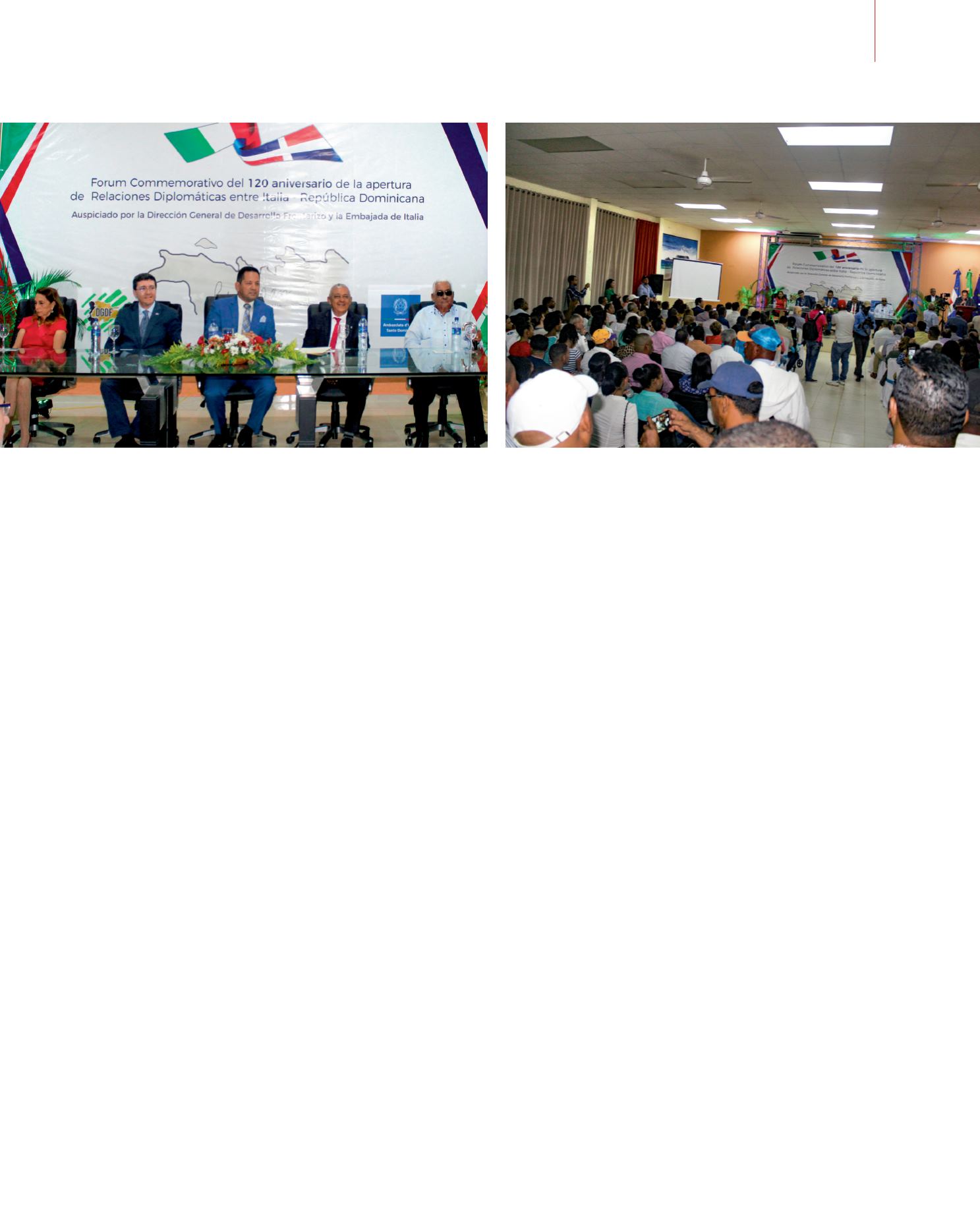
The Forum “1492,
Montecristi Primada
del Nuevo Mundo”
(1492, Montecristi
First City of the
New World) with
conferences presented
by historians Carmen
Prestinary and
Euclides Guitiérrez
Félix and the
Ambassador of Italy
to the Dominican
Republic, Andrea
Canepari. The opening
was overseen by
the Civil Governor of
Montecristi, Marcos
Jorge and the activity
moderated by the
Director of the DGDF
(Dirección General de
Desarrollo Fronterizo),
Miguel Bejarán.
September 22, 2018.
© General Directorate of
Border Development