


 455 / 540

THE ITALIAN LEGACY IN THE DOMINICAN REPUBLIC
454
ence, political and economic freedom, and economic progress and
development. Consequently, he took part in the Dominican Restora-
tion War (1863–1865) in opposition to annexation by Spain. He also
fiercely opposed the dictatorship of Buenaventura Báez (1868–1874),
an act for which he was exiled in 1868.
When he returned to the country, he served as a public official.
He became a representative of the Azua Province in 1874, Minister
of War in 1880, and head of the Senate in 1882. He was also president
of the Republic from 1884 to August 16, 1885 when he was forced to
resign due to pressure from General Ulises Heureaux, whose influ-
ence was growing.
At an early age, he began writing literary works, such as
Una flor
del Ozama
,
Amor y expiación
,
Los enamorados de Carmita
, and his most
famous work,
Baní o Engracia y Antoñita
, the first
costumbrista
novel
in the country. It narrated the traditions of Baní, the town where his
mother was born and where he spent his youth, and which is also
known for its cultural and economic development. When his uncle,
Padre Billini, died in 1890, he became director of Colegio San Luis
Gonzaga, but he had to quit because he was not successful at this job.
Interestingly, his journalistic work began at a partisan newspa-
per,
El Pabellón Dominicano
, the sounding board for the revolution
against Báez, and
La Voz del Sur
, which addressed the issues of his
native region. His masterpiece, however, was
El Eco de la Opinión
,
which distributed its first edition on March 2, 1879.
El Eco
became
a mouthpiece to advance the peace and progress that the country
experienced during this period. It advocated for exportation, migra-
tion, rural itinerant teachers, and the bourgeoning sugar industry.
Two works are worth highlighting: “Haciendas de Caña,” a se-
ries of articles he authored and published from June 1870 to Septem-
ber 1880 in which he describes the status of the sugar industry and
its development, and the articles written by José Gabriel García from March 1889 to June 1892—at odds with
Manuel de Jesús Galván—about the key players of the independence movement and, specifically, the battle of
March 19, 1844 and General Pedro Santana’s role.
4
His brother Hipólito (1850–1903) was a diplomat and public administrator, and he also worked as a col-
umnist for
Eco de la Opinión
and
Listín Diario
. In 1885, while he was acting as consul in New York City, he wrote
“Present Condition of the Dominican Republic.” He wrote about border issues and a treaty of friendship with
Haiti. In 1901, he published an article in
Listín Diario
in opposition to the Minister of Foreign Affairs, Francis-
co Henríquez y Carvajal, and the contract with the Santo Domingo Improvement Company, the American
company that owned most of the Dominican government’s public debt. Although this is important, of even
greater journalistic value are a series of articles, written under various pseudonyms and the guise of written
correspondence, and dealing with Dominican history, customs, and societal criticisms, that were published in
El Eco de la Opinión
between 1886 and 1997.
5
Later descendants of this family that was so widespread and influential in Dominican society also pursued
careers in journalism. One of these was
Mario Bobea Billini.
According to Carlos Larrazábal Blanco, he was
a descendant of José Altagracia Billini de Mota and Narcisa Cruz Figueredo of Baní. Their daughter, Dolores
Billini Cruz, married Pedro Antonio Bobea Montes de Oca, and they became the parents of Mario Bobea Bill-
ini (1916–1996), who excelled at journalism and floriculture.
6
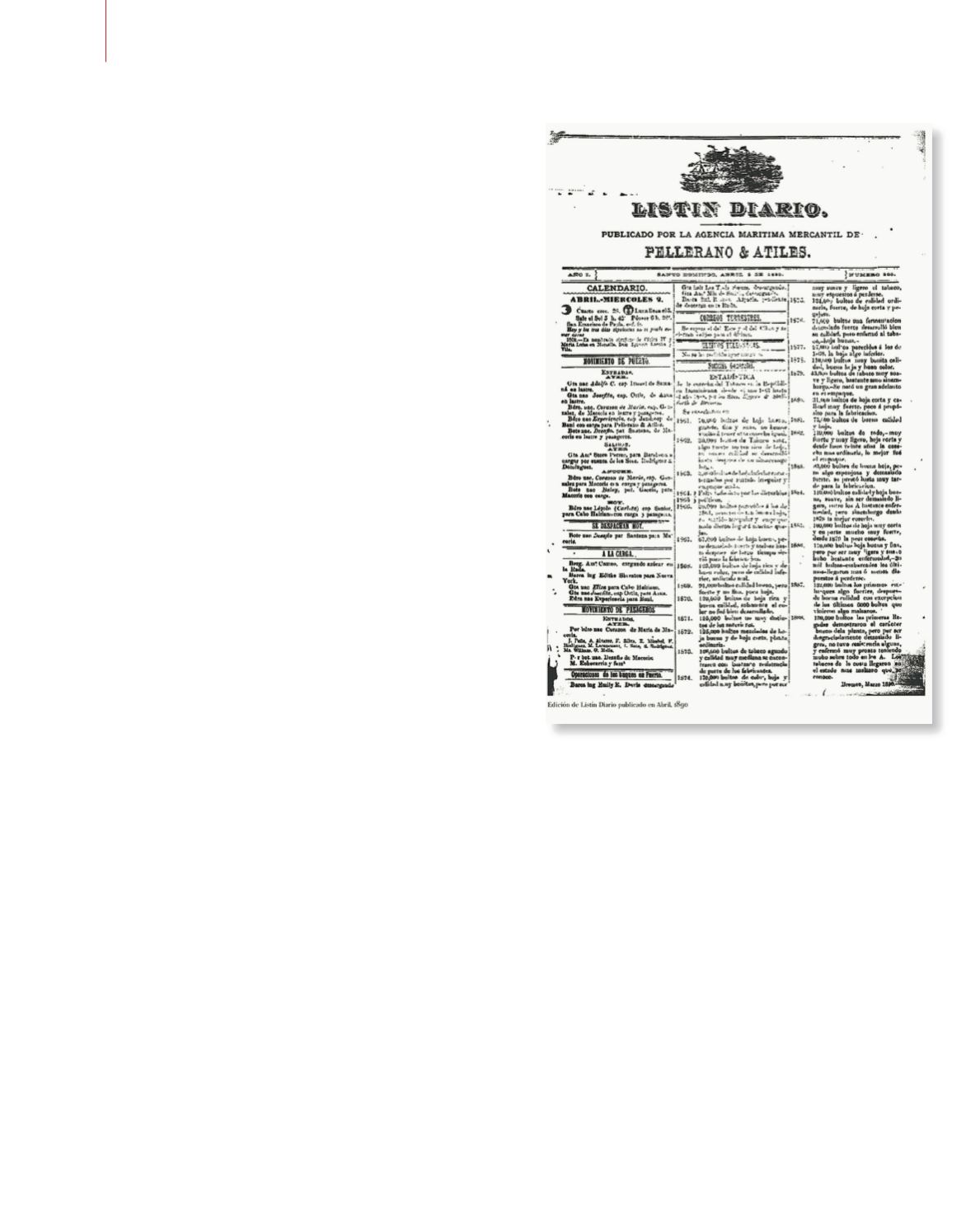
An April 1890 edition
of
Listín Diario.
© Courtesy of Listín Diario