


 392 / 540

391
ITALIAN INVESTMENT IN THE MODERN DOMINICAN ECONOMY
to develop the dream of the Punta Cana Club
tourist complex, on coastal land at the east-
ern-most tip of the Dominican Republic.
The modest tourist initiative evolved into
what is now known as the Punta Cana Group,
made up of the companies Punta Cana Beach
and Golf, Punta Cana Resort and Club, Punta
Cana International School, Corporación Aero-
portuaria del Este, Punta Cana Yacht Club,
Punta Cana Tourist and Service Corporation,
and the Guardians of the East.
Tourism has become the most successful
activity for the Dominican economy in mod-
ern times, with a positive and growing impact
on GDP. The tourist industry contributes ap-
proximately 7% to GDP and employs more
than 370,000 Dominicans, representing 8% of
the employed population (4,715,879 people in
2019); in terms of balance of payments, it annu-
ally generates more than $7 billion in revenue.
Due to the push by Rainieri and companies, the tourist mecca Punta Cana Club, combined with what
is known as the far-eastern coast of the country, the Macao-Punta Cana area, was declared Tourist Hub
No. 3 in 1986. This area accounts for the greatest contributions to the tourism economy of all the country’s
tourist hubs, attracting the largest number of tourists from the United States, Europe, Latin America, and
other regions of the world to enjoy its mega-marinas, 18-hole golf courses, villas, and hotels. In addition, its
natural white sand beaches, coral reefs, and coconut forest were certified by UNESCO as one of the world’s
best beach areas in the mid-1960s.
Other Italian families with investments in residential tourism in Punta Cana and Casa de Campo, La
Romana, have been generally characterized as having considerable purchasing power.
The entrepreneur Mauro Caslini and family founded the IBI Yachts company in 1996, with exclusive
representation in the Caribbean for the Italian brand Azimut-Benetti Group, among others.
With IBI Yachts, Caslini introduced a new way of utilizing the sea—which was previously considered
only for fishing—creating a completely new niche market to generate foreign exchange in the Dominican
economy, an activity that led to the development of other foreign exchange generators, while also sparking
a demand for infrastructure related to corresponding activities and lifestyle.
With intense work in the market and dealing with “after-sales,” Caslini created a complete package
including services and sales of spare parts, giving rise to IBC Shipyard, a company that over time has po-
sitioned itself as the most vertically integrated shipyard in the Dominican Republic and in the Caribbean,
with workshops specialized in mechanics, electronics, carpentry, painting, and “refitting” services.
IBC Shipyard regularly transfers technologies and knowledge to Dominican workers so that they can
become updated specialists in different areas, thereby developing previously untapped work niches and
placing the Dominican Republic at the forefront in the Caribbean region.
IBC Shipyard invested in a new 300-ton Travel Lift to attract new vessels and mega-yachts to the coun-
try, increase the flow of customers on the coasts and marinas of the Dominican Republic, and provide
professional service to boats, such as catamarans, which are used by the major tour operator in the coun-
try, thereby improving the quality and safety of this type of boat and helping to increase the protection of
tourists, coasts, and seas.
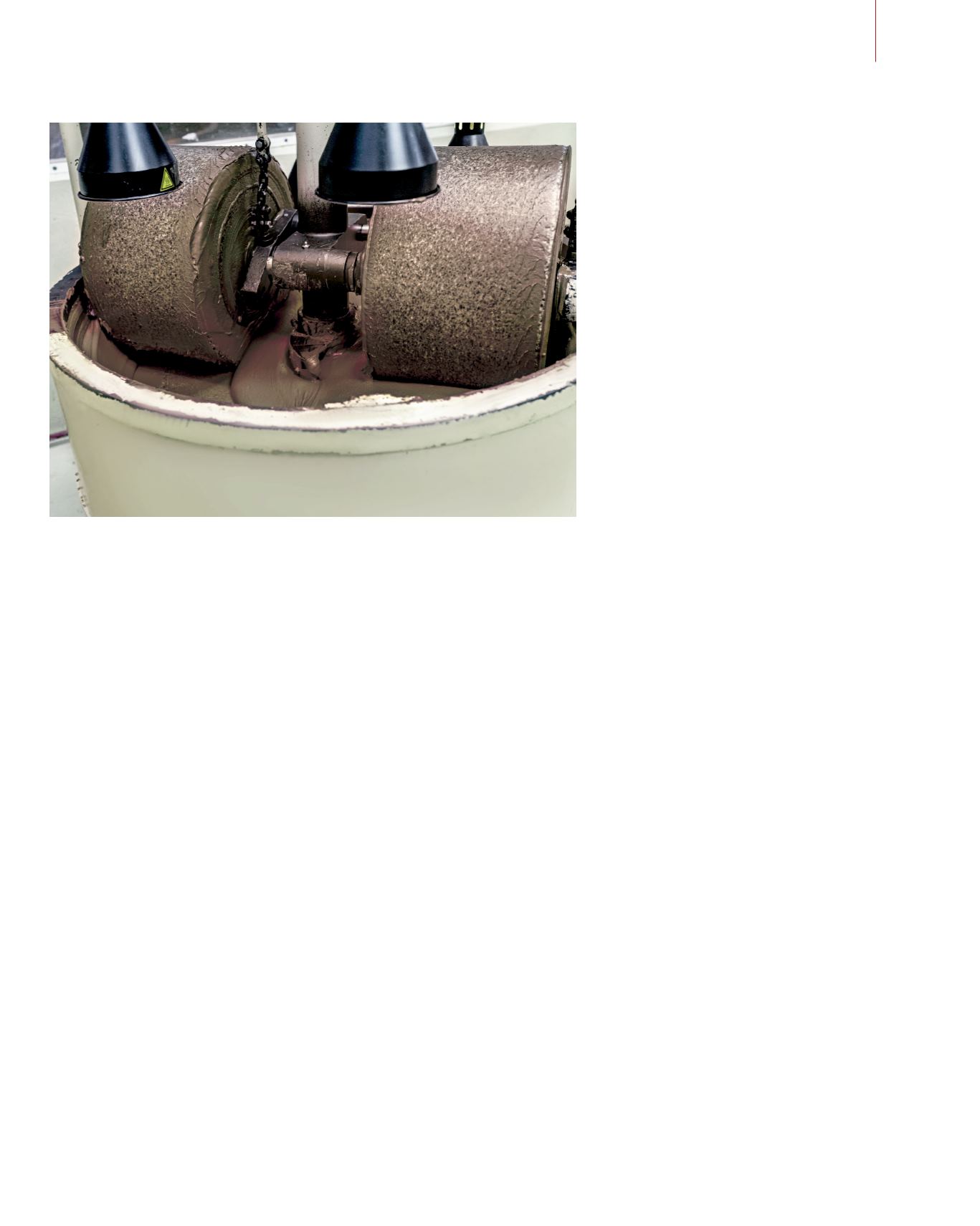
An Italian machine,
made by
Carle & Montanari,
used by the
Rizek Group for
the processing of
cacao paste.
© Rizek Cacao