


 384 / 540

383
ITALIAN INVESTMENT IN THE MODERN DOMINICAN ECONOMY
with approximately 100 around Baní.
10
The economy grew
by 4.9% in the 1880s and 5.9% in the 1890s.
As it occurred in other countries, new production tech-
nologies were imported with capital from foreign entrepre-
neurs. Thus, the Dominican sugar industry, which at this
stage was far more labor-saving and competitive, became
more robust, significantly increasing its range of economies
of scale and with sugar occupying the central position in
the national economy,
11
replacing tobacco, which was a far
more labor-intensive product.
12
Many of the workers displaced by the new production
technologies were absorbed by the coffee- and tobacco-pro-
ducing sectors, as well as the subsistence economy, although
later, when the international sugar market demanded high-
er volumes, these workers returned to sugar production.
With the opening of the economy to international trade,
the need for working capital increased tremendously. This
was facilitated by foreign agents and local merchant-whole-
salers, who went on to become the first members of the Dominican bourgeoisie,
13
as was the case with Miguel
Ventura and Juan Bautista Vicini Cánepa, the latter known as “Baciccia”
14
(1847-1900), who at nineteen years
of age was already fully immersed in business and other national economic activity.
15
Working astutely, these entrepreneurs and intermediaries generated savings that they then invested in
land for the cultivation of sugar cane, while contributing financial support to the production of cocoa, tobac-
co, wax, honey, mahogany wood, cedar, and oak, as well as leather products,
16
which were destined mainly
for export markets. Due to their aggressive participation in financial intermediation in the market, the cost of
investment was reduced from 10% to 3% per year in the years 1897, 1898, and 1899.
17
By the end of the nineteenth century, intermediaries controlled most of the country’s wholesale trade, with
themost aggressive participation by Germans and Americans, in addition to Italians, Cubans, and Puerto Ricans.
18
The investments made by Italian businessmen also augmented the country’s federal coffers; total gov-
ernment liabilities with such businessmen and those of other nationalities rose from DOP 500,000 at the end
of 1884 to DOP 659,000 in 1893, of which a little less than a third (DOP 199,000) was accounted for by Juan
Bautista Vicini Cánepa and his companies.
19
In 1897, 1898, and 1899, the Italian merchant Miguel Ventura lent
the government DOP 6,307 in merchandise and capital.
20
Attempts were made to establish commercial banks in the last decades of the nineteenth century; howev-
er, it was not until 1912 that they began to operate on any normal basis, thereby reducing the number of loans
made by foreign merchants and agents to the producing sectors of the economy, to commercial enterprises in
general, and to the federal government.
The government authorized the installation and operation of the Banco Nacional de Santo Domingo
through a capital investment of DOP 500,000; its main office was located in Santo Domingo, with branches
in San Pedro de Macorís, Puerto Plata, and Sánchez. The Royal Bank of Canada also established branches in
Santo Domingo and Santiago.
With the entry of major sugar mills principally in the vicinities of Azua and Baní in the 1870s, the second
stage of the sugar industry in the Dominican Republic began, following a first stage that had extended from
the sixteenth through the eighteenth centuries.
This second industrial phase was initially financed with capital from Cubans displaced by the ten-year war
(1868 - 1878), and through the initiatives of Juan Bautista Vicini Cánepa, who quickly learned the advanced
techniques of sugar production and management.
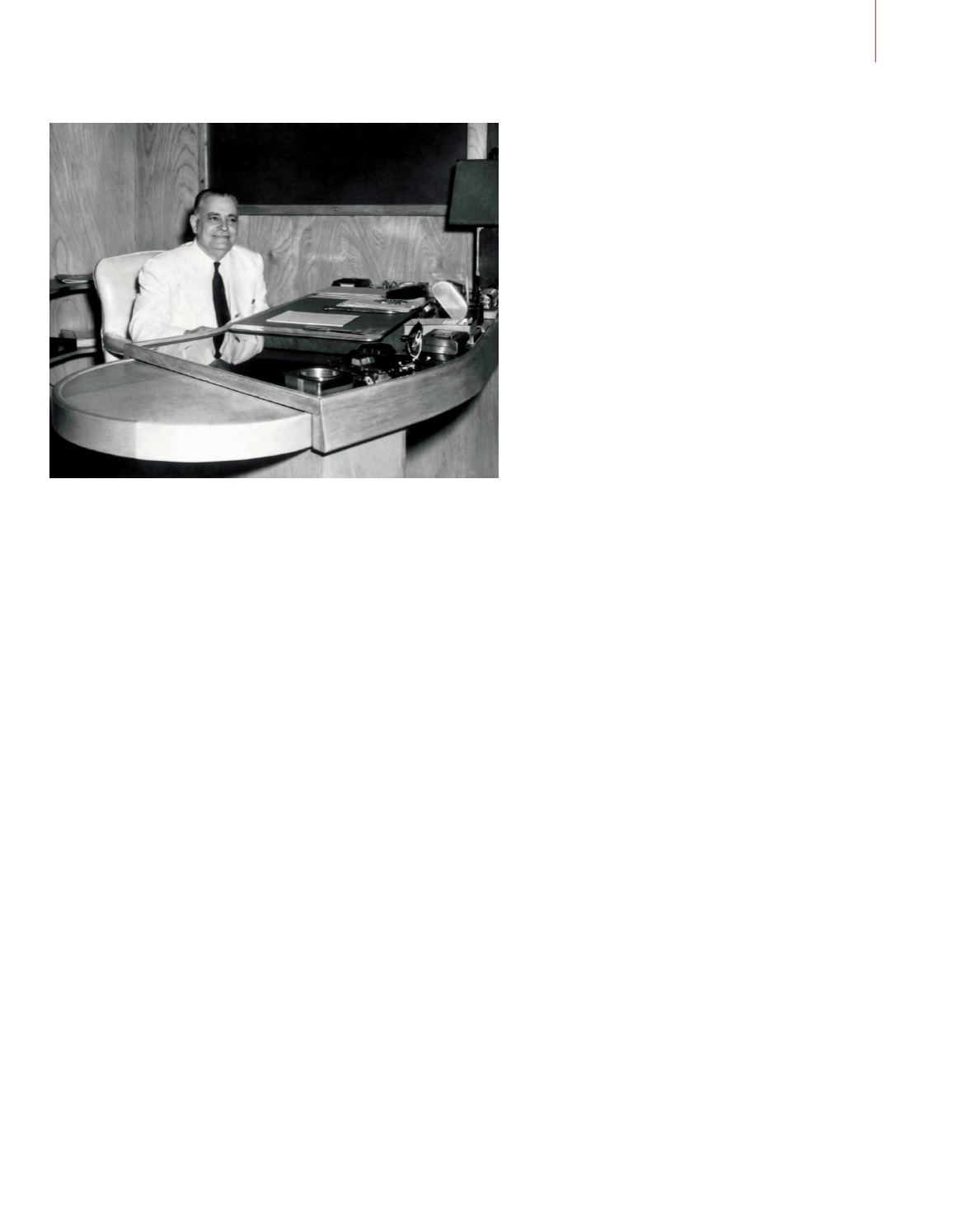
Early 1950s, Amadeo
Barletta, Cuba.
© Miguel Barletta