


 215 / 540

THE ITALIAN LEGACY IN THE DOMINICAN REPUBLIC
214
On April 22, the U.S. State Department in-
structed its representative in Santo Domingo
to deliver a note to the Dominican Ministry of
Foreign Affairs complaining about the boycott.
In response, the Dominican Secretariat de-
nied Todd permission to visit Barletta. On the
same day, Macario visited the U.S. minister in
Santo Domingo and informed him that he had
spoken twice with Dominican Minister of For-
eign Affairs Arturo Logroño, and that in the last
meeting Macario had explained how severe Ita-
ly considered the situation, a state of affairs that
could “result in unpredictable consequences.”
The Italian fascist foreign minister, Count Gian
Galeazzo Ciano, had studied with Barletta and
was his friend. Minister Macario ended his con-
versation with Logroño, telling him that Macario and his government considered the Dominican govern-
ment’s treatment of the Italian subject illegal and arbitrary, and that such treatment should lead to direct
conversations between the Italian and U.S. governments. Representatives from Penn Tobacco traveled to
Washington, D.C., to ask for support from the State Department. On April 29, German Chargé d’Affairs Her-
mann Barkhausen informed the U.S. minister that Logroño had told him, in a way that he considered would
be pleasing to Hitler’s representative, that “[…] the Dominican government is following the same politics as
the German government. President Trujillo is playing the role of Hitler, and I am playing Goebbels.” The
following day, the State Department asked the American minister to present a note to the Dominican govern-
ment in which the U.S. government “expressed its reserves regarding the case.”
On May 15,
The New York Times
published the following headline: “Italy Threatens
the Dominican Republic. Informs Washington That a Warship Will Be Sent If the Consul Is Not Released.
The Delay Enrages Mussolini.” The newspaper added that the Italian ambassador in Washington had in-
formed the State Department regarding those plans.
Two days before this headline was published, Secretary of State Cordell Hull, accompanied by Assistant
Secretary of State for Latin American Affairs Sumner Welles, had personally called in Dominican Minister
Rafael Brache to Hull’s office and handed him a diplomatic note in which the U.S. government expressed
“its serious concern regarding the treatment certain U.S. citizens and interests had received in recent months
from the Dominican government.” But if the note had been sharp, what Hull told Brache was even sharper:
he referred to the efforts by Latin American countries to strengthen “the international reputation of the family
of American nations” and how that effort was founded on just and reasonable relations between the countries
in the region. It was part of President Roosevelt’s “Good Neighbor Policy.” Hull added that “he had been
highly surprised, upset and concerned when he found out that of all the governments in the hemisphere, only
the Dominican had apparently abandoned such efforts.” Later on, Hull referred specifically to Barletta’s case,
telling Brache that “he would be naïve if he failed to mention that the Italian government obviously could
not allow an insult of this nature to go unchallenged” and that the Italian government could resort to drastic
measures “such as sending not one, but several warships to the Dominican Republic, in which case, the Do-
minican government would truly not be in a position to appeal for the U.S. government’s sympathy or that of
any other country in the region.” Brache chose to simply say that for a while he had been thinking specifically
of traveling to the Dominican Republic and that he considered, in the light of what Hull had expressed, that it
would be advisable to travel immediately in order to discuss the situation with Trujillo. When Trujillo found
out about the affair, he sent Andrés Pastoriza to Washington.
Opening page:
Amadeo Barletta in
his office in Cuba in
the 1940’s, behind
him an image of
the Barletta family’s
hometown, San
Nicola Arcella, Italy.
© Miguel Barletta
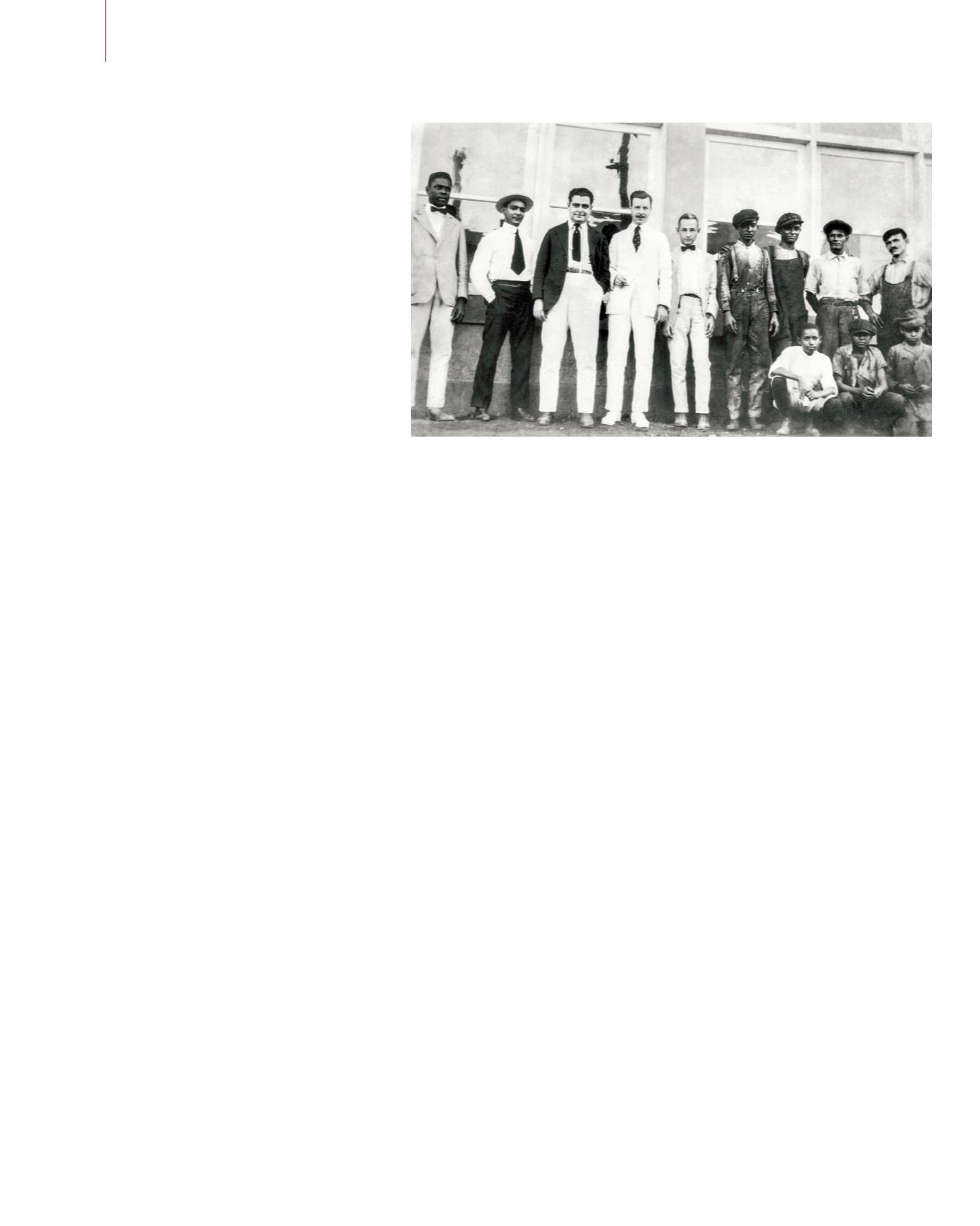
First work crew
of Santo Domingo
Motors (1920).
© Miguel Barletta